

The first time I tied an obi over a plain black dress, a friend asked where I had bought the dress. She never noticed the belt was traditional. That is the whole point: japanese clothing for women goes far beyond the ceremonial kimono (着物, "thing to wear"). Today it covers kimono dresses, yukata, haori jackets, hakama pants, kimono robes, jinbei, sukajan, kimono shirts, obi belts and tabi socks with geta. Most of these pieces work with jeans and a white tee as easily as with a full traditional set. The main thing to get right is sizing, because Japanese cuts run narrower and shorter than US and EU standards.
In short
- Ten core pieces cover every situation, from daily wear to conventions and summer festivals.
- Haori jackets, kimono shirts and tabi socks are the easiest entries for a Western wardrobe.
- Japanese sizes run roughly one to two sizes smaller than US sizing, so measure shoulders and sleeve length first.
- Layering rules matter more than the garment itself: left side over right, obi at the waist, tabi with any thonged sandal.
Kimono dress, yukata, kimono robe or jinbei?
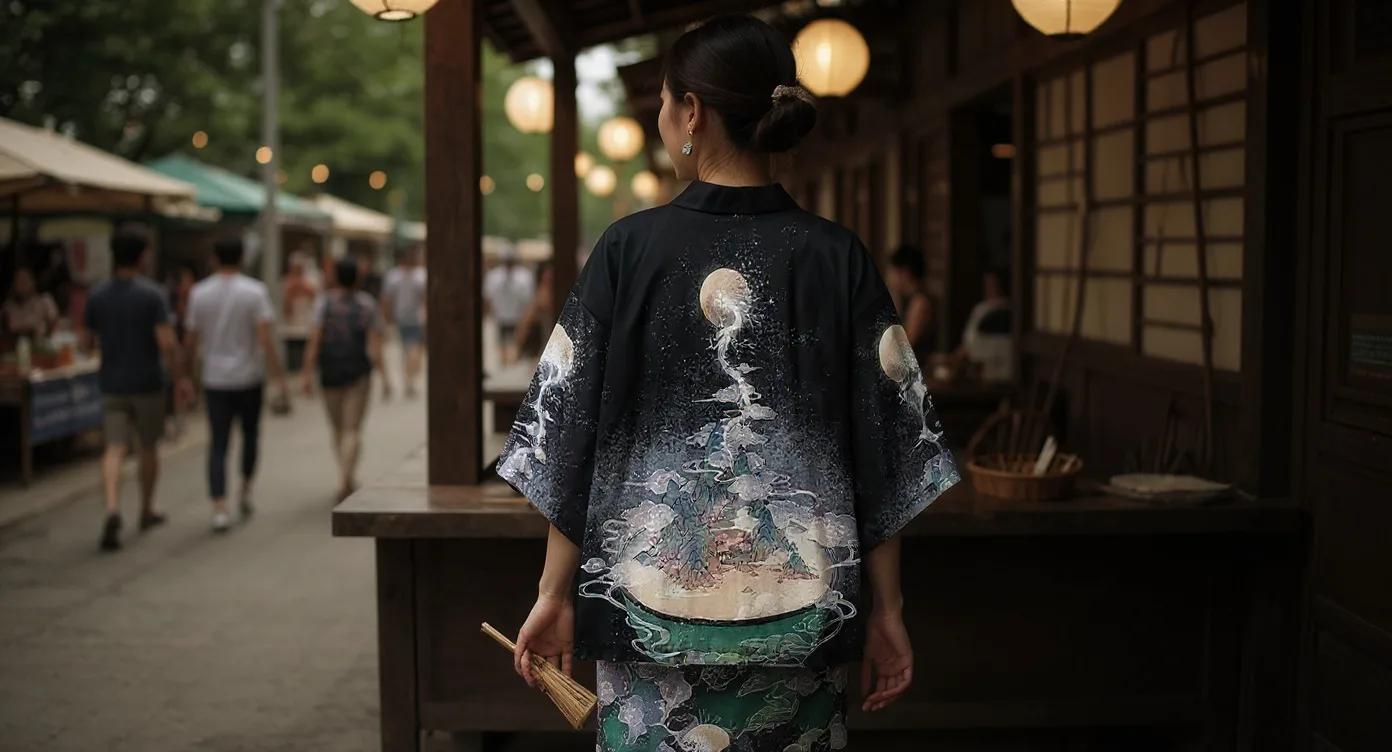
These four pieces share a silhouette and nothing else. They differ in fabric weight, lining, closure and formality. Choosing badly is the most common mistake I see: a yukata ordered for a winter wedding, or a robe for an outdoor festival. Start with the occasion, then the fabric.
| Piece | Occasion | Fabric | Closure | Formality |
|---|---|---|---|---|
| Kimono dress | City, work, dinner | Polyester, cotton blend, lined or unlined | Wrap front, side ties or hidden buttons | Casual to smart |
| Yukata (浴衣) | Summer festivals, warm evenings | Unlined cotton | Obi belt only | Casual, outdoor |
| Kimono robe | Home, hotel, travel | Satin or light cotton | Sash belt | Indoor |
| Jinbei (甚平) | Home, garden, hot weather | Cotton or linen, two pieces | Side ties plus shorts | Very casual |
The kimono dress: a wearable version for everyday outfits
A kimono dress keeps the wrap front and the wide sleeve, then shortens the length and slims the body. You wear it like any dress, with boots in autumn and sandals in summer. The sleeves are cut shorter than on a true kimono, so they clear a table and a car door. Choose a lined version if the fabric is thin, and side ties rather than a full obi if you want to dress in one minute.
Yukata for summer festivals and warm evenings
A yukata is not a light indoor kimono. It began as a garment worn after the bath, but its modern life is outdoors: fireworks, matsuri, summer evenings. It is unlined, made of cotton, and always worn with an obi and no under-kimono. Cross the left panel over the right, never the opposite, since the reverse is reserved for dressing the deceased.
Kimono robe and jinbei for home and travel
The kimono robe is the softest entry point. Satin, sash belt, nothing to learn. The jinbei is a two-piece set, top and shorts, in cotton or linen, worn at home in summer. I keep one for long flights and hot nights, and I recommend it to anyone who finds a full-length robe too warm. For a full-length silhouette, our Japanese Kimono Dress collection is where I would start.
Haori jacket vs sukajan: two Japanese jackets for women
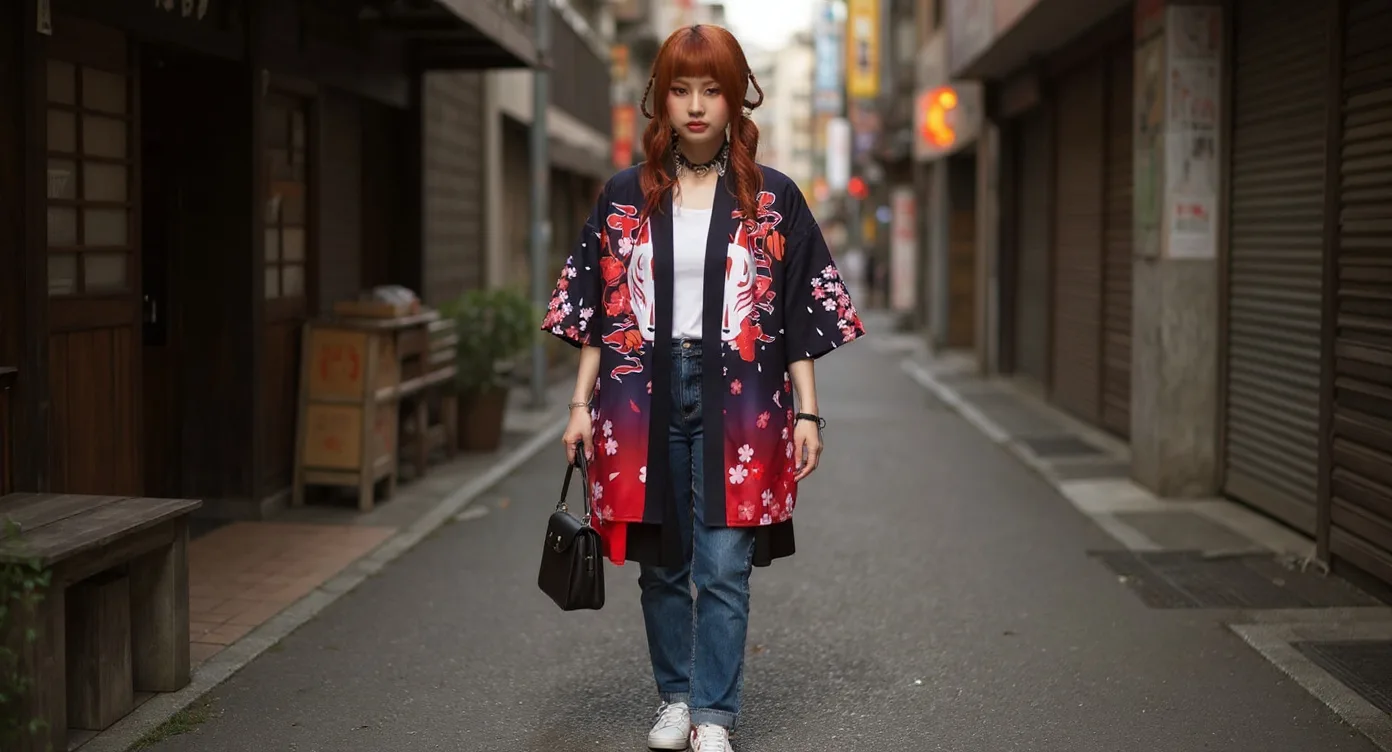
Both are jackets, from different worlds. The haori (羽織) is a traditional open-front jacket worn over a kimono, with straight sleeves and no closure beyond a small cord. The sukajan (スカジャン) is a postwar souvenir bomber: embroidered satin, zipped, ribbed cuffs. One softens an outfit, the other anchors it.
| Criterion | Haori | Sukajan |
|---|---|---|
| Cut | Straight, open front, wide sleeve | Bomber, zipped, ribbed collar and cuffs |
| Weight | Light to mid, drapes | Mid to heavy, structured |
| Season | Spring, autumn, indoor layer | Autumn, winter |
| Style | Traditional, modernised | Streetwear |
Wearing a haori jacket over jeans and a white tee
This is the outfit I recommend most often, and the one I wear most. Black haori jacket, black jeans, white tee, plain sneakers. The jacket does all the work and nothing clashes. Second option: a printed haori over a monochrome dress, belted at the waist with a thin obi. When someone wants one piece to test Japanese style, I point them to a plain black haori jacket.
The sukajan souvenir jacket for streetwear looks
The sukajan souvenir jacket was born in Yokosuka after the Second World War, embroidered for American servicemen who wanted a memory of Japan on their back. Dragons, tigers, eagles, cherry blossoms. Wear it over a hoodie with cargo pants, or over a slip dress with chunky boots for contrast. For a first sukajan I would choose the Dragon Souvenir Jacket: the embroidery sits on a single-colour base and stays readable from a distance, which is what you want at a convention.

Choosing between silk-feel haori and embroidered satin
Silk-feel polyester haori drape and fold small, so they travel well and suit warmer months. Embroidered satin sukajan hold their shape, add volume at the shoulder, and need hanging storage. If your wardrobe is mostly fitted, take the haori. If it is mostly oversized, the sukajan blends in better.
Hakama pants and Japanese trousers women actually wear
Hakama (袴) are the pleated trousers worn over a kimono for graduations, kyudo and aikido. Modern Japanese-style wide pants borrow the volume without the ceremony. Both solve the same problem: you want the silhouette without a full traditional set.

Women's hakama pants: pleats, ties and how to sit in them
Hakama pants sit high, at the ribcage or the natural waist, and close with long fabric ties called himo. Women's hakama are often andon bakama, cut like a pleated skirt rather than divided legs, which makes them far easier to wear. Keep the front pleats flat when you sit: gather them with one hand, sit, then let them fall. Our Hakama Pants Women style suits graduation-inspired and kendo-inspired looks, and the waist ties adapt to a wide range of body shapes.
Japanese-style wide pants for daily wear
These are the everyday cousins: elastic or drawstring waist, wide leg, cropped ankle, cotton or a cotton blend. Our Japanese Style Pants suit an office, a train and a long walk. Cropped lengths flatter shorter frames because they show the ankle and keep the leg line visible.
Matching hakama with a kimono shirt or a plain top
Keep the top simple and tucked. A kimono shirt tucked into the waistband, or a fitted knit, both work. Avoid a long tunic: it hides the waistband, and the waistband is the whole point of the piece.
Kimono shirt and obi belt: Japanese tops with jeans
This is where japanese clothing for women becomes genuinely daily. A kimono shirt is a shirt with a wrap or asymmetric front and a straight sleeve. An obi (帯) is a wide sash. Together they turn jeans into an outfit, and neither requires any dressing knowledge.
The kimono shirt as a light layer or a top
Three ways to wear it. Open over a tank top, like a light overshirt. Closed and tied at the side, as a top on its own. Tucked into high-waisted trousers, with the wrap panel flat. Our Black Japanese Shirt is the version I reach for most: a plain black wrap front reads as fashion rather than costume in any city.
Tying an obi belt over a dress or a shirt
Start with three options. A flat front bow, wrapped twice and knotted low. A back bunko bow, the folded butterfly used on yukata. Or the simplest: wrap, cross, tuck the end under the layers and leave no bow at all. A narrow obi belt over a plain dress is the fastest way to add a Japanese line to clothes you already own, and our Obi Belt collection covers both narrow and wide widths.
Japanese motifs that stay wearable outside conventions
Small repeated patterns like asanoha, seigaiha waves and shippo circles read as texture from two metres away. Large dragons, oni faces and full-back scenes read as statement. I keep one statement piece and build everything else in discreet motifs.
Tabi socks and geta: finishing a Japanese outfit
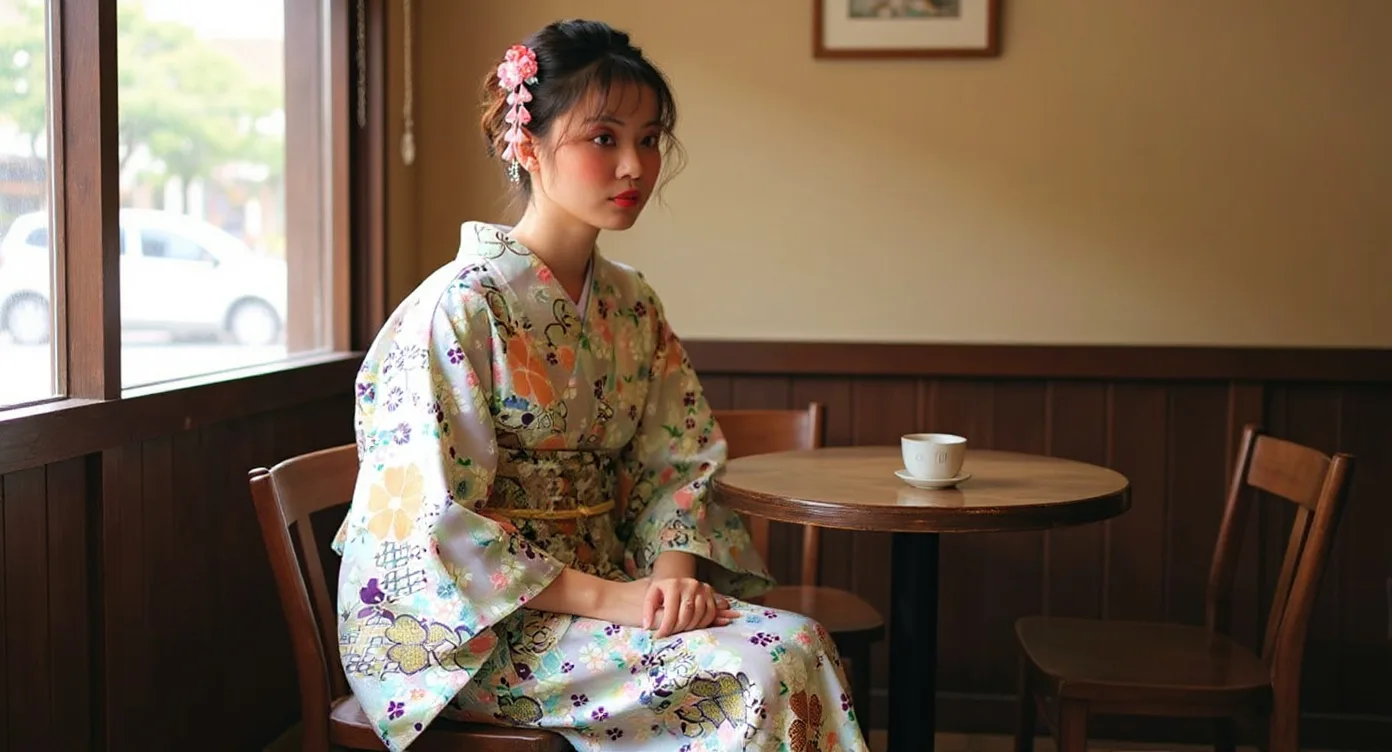
Footwear is what people forget, and it is what makes photos look right. Two items matter: tabi socks and wooden geta sandals.
Why tabi socks are split at the toe
The split exists so the sock can sit around the thong of a sandal. Traditional tabi close at the ankle with small metal clasps called kohaze. Tabi socks in stretch cotton, like our Tabi Socks, skip the clasps and pull on like normal socks. They are the cheapest way to test the aesthetic.
Geta and zori: sizing, sound and comfort
Geta are wooden and raised on teeth, made for summer and outdoor wear. Zori (草履) are flat and more formal, worn with tabi and a kimono. Both run in fewer sizes than Western shoes, so choose by foot length in centimetres, not by your usual EU number. Our Geta Sandals collection lists that measurement for each pair.
Wearing tabi socks with sneakers and modern shoes
Split-toe socks work with any thonged sandal, and also with low sneakers, loafers and mules. Ankle-length black tabi under cropped trousers is a small detail people notice and rarely identify.
Japanese clothing for women: JP, US and EU size guide
Here is the part I answer by email every week. Japanese ready-to-wear is drafted on a narrower shoulder and a shorter sleeve than US or EU patterns. As a rule, order one to two sizes up from your usual size. Then check the measurements, because a rule is not a fitting.
Why Japanese sizes run smaller than US and EU sizes
The gap comes from the base pattern, not from the letter on the label. Shoulders and sleeve length are where it shows first. Use this table as a starting point, and compare with the measurements listed on the product page.
| JP size | US size | EU size | Bust (approx.) | Shoulder (approx.) |
|---|---|---|---|---|
| S | XS | 32-34 | 78-84 cm | 36-38 cm |
| M | S | 36 | 84-90 cm | 38-40 cm |
| L | M | 38-40 | 90-96 cm | 40-42 cm |
| XL | L | 42 | 96-102 cm | 42-44 cm |
Which measurements matter for kimono, haori and hakama
Three measurements, in this order. Shoulder to shoulder across the back. Shoulder point to wrist, arm slightly bent. Bust at the fullest point, tape flat. Tolerances differ by piece: a haori is cut loose and forgives two or three centimetres, a hakama adjusts through its ties, a kimono shirt forgives nothing at the shoulder. Our guide on taking measurements before ordering a kimono walks through each step.
Free size, one size and what they really mean
Free size is a real Japanese sizing convention, not a shortcut. It usually corresponds to a JP M to L, which lands around a US S to M. For open pieces like haori and robes it works well. For anything with a fixed waist or a closed front, ignore the label and read the centimetres.
FAQ
These are the five questions that reach my inbox most often. They cover what Japanese women actually wear today, the right word for a traditional outfit, the size to order from a US reference, and how to mix a haori with clothes you already own. The last one settles the kimono dress and yukata confusion for good.
What do most Japanese women wear day to day?
Western clothing, in the vast majority of cases. Traditional wafuku (和服) is kept for festivals, ceremonies, tea practice and New Year visits. What has crossed into daily wear are the details: wide pleated trousers, wrap-front tops, split-toe socks.
What is a female Japanese outfit called?
The general term is wafuku, meaning Japanese clothing, as opposed to yofuku, Western clothing. Within that, the garment names are specific: kimono, yukata, haori, hakama, jinbei. There is no single word for a woman's outfit as a whole.
What size Japanese clothing should I order if I wear a US M?
Order a JP L, and check the shoulder measurement before confirming. A US M usually corresponds to a JP L, sometimes a JP XL for structured pieces with sleeves. For an open haori or a robe, a free size will normally fit.
Can I wear a haori or kimono jacket with regular clothes?
Yes, and that is how most of our customers wear them. A haori over jeans and a plain tee is the combination I recommend first. Keep the rest of the outfit simple in colour so the jacket stays the focal point.
What is the difference between a kimono dress and a yukata?
A yukata is an unlined cotton summer kimono, full length, worn with an obi and no under-layer. A kimono dress is a modern garment: shorter, often lined, with hidden ties or buttons, made to be worn like any dress. The yukata belongs to summer festivals, the kimono dress to daily life.
If you want to see these ten pieces side by side and compare their measurements, our Japanese Women Clothing collection gathers them in one place. Take your shoulder measurement first, and the rest becomes simple.
Explore the Japanese Women Clothing collection
Browse the women's selection to find kimono dresses, haori jackets, hakama pants and tabi socks with their JP/US/EU size charts.
Browse the collection →