

Walk through a Tokyo residential street on December 30 and you will notice the sound before the decorations: vacuum cleaners, windows being wiped, futons being beaten on balconies. Japanese New Year traditions, grouped under the word Oshogatsu (お正月), run from late December to January 3 and follow a clear sequence: clean the house (oosoji), decorate the entrance (kadomatsu, shimekazari), eat year-crossing soba on New Year's Eve while temple bells ring 108 times (joya no kane), then open the osechi boxes and make a first shrine visit (hatsumode) on New Year's Day. Unlike Chinese New Year, Japan celebrates on the Gregorian January 1, and the first three days (sanganichi) are quiet, family time rather than a street party. Everything below is in that order, with the objects each step actually uses, so you can follow or recreate it at home.
Key points
- Oshogatsu is a sequence, not a single night: cleaning and decorating in December, soba and bells on New Year's Eve, osechi and hatsumode from January 1.
- Japan's New Year falls on January 1 (Gregorian), not on the lunar date, so it is not the same holiday as Chinese New Year.
- The first three days, sanganichi, are spent with family on pre-made food, which is exactly why osechi is cooked in advance and served cold in lacquered boxes.
- Recreating it abroad takes very little: an entrance decoration, a goal written on a daruma, osechi-style boxes and a small toast at the table.
Getting ready for oshogatsu: oosoji and New Year decorations
The preparation phase is the part most guides skip, and it is the longest. Work slows down from around December 28, most companies close between December 29 and January 3, and families spend those days cleaning, shopping and decorating instead of celebrating. The logic behind every step is the same: the house is being made ready to receive the toshigami (年神), the deity of the incoming year. Nothing here requires a shrine or a priest, which is why these are the easiest traditions to borrow.
Oosoji: the deep clean that closes the Japanese year
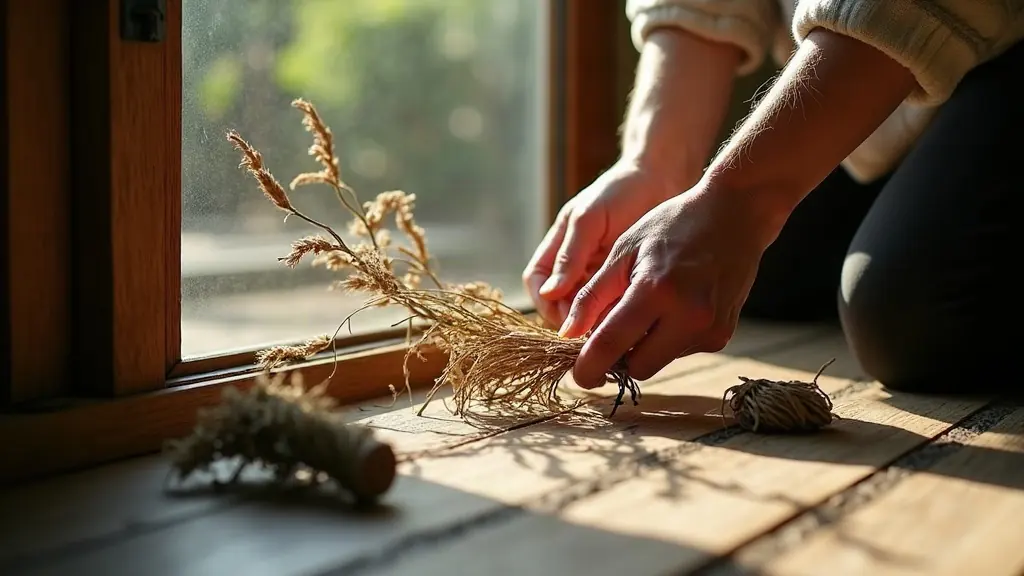
The year ends with a full house clean called oosoji (大掃除), literally "big cleaning". It is not spring cleaning moved to winter. The practice descends from susuharai, the soot sweeping of temples and castles, traditionally done on December 13, and it is still performed in temples today with long bamboo poles. A household version means windows, light fittings, the kitchen hood, the entrance, and anything that has been quietly ignored since summer. The point is that the new year should not start on top of last year's dust, and there is a practical payoff: the house stays presentable through three days of visitors and no cooking. I treat it as the one day I throw out what I kept "just in case", which is where the Kaizen idea of small continuous improvement stops being abstract.
Kadomatsu, shimekazari and kagami mochi at the entrance
Three decorations do three different jobs. The kadomatsu (門松), a pair of pine and cut bamboo arrangements, stands on either side of the entrance and acts as a landing place for the toshigami. The shimekazari (しめ飾り), a twisted rice straw rope with white paper strips, hangs on the door and marks the space inside as purified. The kagami mochi (鏡餅), two stacked round rice cakes topped with a bitter orange called daidai, sits indoors on a shelf or in the tokonoma alcove, the daidai chosen because its name suggests generations continuing. Timing matters more than size. Decorations go up from December 26 to 28, never on December 29, whose reading contains "ku" (suffering), and never on December 31, which is dismissed as ichiya-kazari, one-night decoration. They come down at the end of matsu no uchi: January 7 in the Kanto region around Tokyo, January 15 in much of Kansai. The kagami mochi is cracked open and eaten later, at kagami biraki, commonly on January 11.
Writing one goal on a daruma for the new year
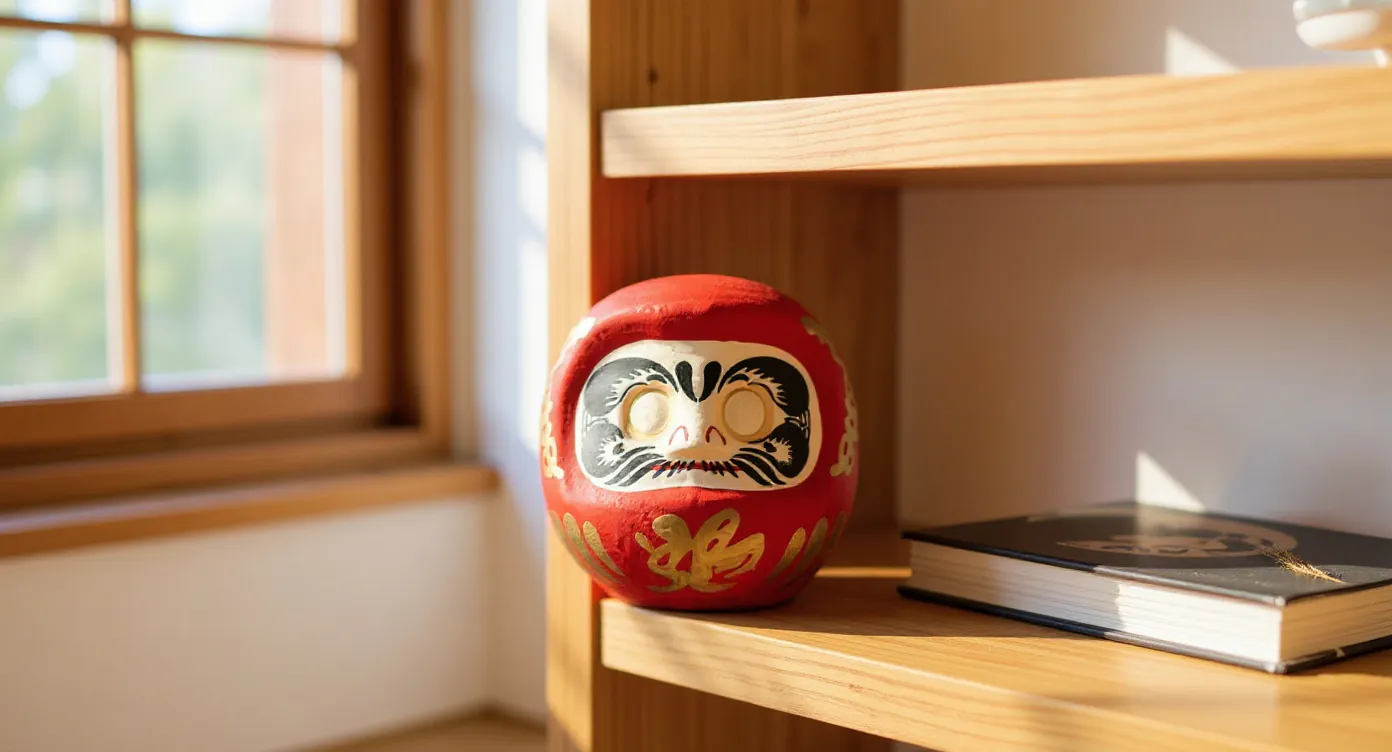
The daruma (達磨) is the New Year object that travels best. These round, red, limbless figures represent Bodhidharma, the monk credited with founding Zen Buddhism, and they are sold by the thousand at January daruma markets, the most famous at Shorinzan Darumaji in Takasaki. The ritual is a two-step contract with yourself. You buy or receive the doll with both eyes blank, then paint in one eye while naming a single concrete goal for the year. The second eye is painted only when the goal is reached, so an unfinished daruma sits there as a visible reminder. Its weighted base makes it right itself when pushed over, which is the source of the saying nanakorobi yaoki, seven falls, eight rises. The red daruma doll I keep on my own shelf is the piece I recommend most often to readers outside Japan, because it is the one tradition here that needs no shrine, no ingredients and no space.
Omisoka: Japanese New Year's Eve, soba and 108 temple bells
Forget the countdown with champagne. December 31, called omisoka (大晦日), is a quiet evening spent at home, usually with immediate family, with the television on and a late bowl of noodles. The noise outside is not fireworks but bells, rolling across neighbourhoods from around 11pm. If you only copy one evening from the Japanese calendar, copy this one, because it costs almost nothing and changes the mood of the night completely.

Toshikoshi soba: why noodles are eaten before midnight
Toshikoshi soba (年越しそば) means "year-crossing buckwheat noodles", and the detail that matters is the timing: they are eaten on the evening of December 31, finished before midnight. Two symbols overlap. The noodles are long, which points to a long life, and buckwheat noodles break easily when bitten, which is read as cutting off the hardships of the year that is closing. Leaving a bowl unfinished past midnight is considered a bad start, so families eat early rather than late. The dish itself is plain: hot dashi broth, soba, and a topping such as tempura shrimp, sliced spring onion, or a raw egg. Buckwheat soba is sold in most supermarkets outside Japan now, so this is the single most reproducible item of the whole holiday.
Joya no kane: the 108 strikes explained
From late evening, Buddhist temples ring their great bells 108 times in a ritual called joya no kane (除夜の鐘). The number comes from the Buddhist count of 108 bonno, the defilements or afflictions that cloud the mind, which Sanskrit texts call kleshas. Each strike is meant to release one. The standard pattern is 107 strikes before midnight and the final one after the new year has begun, so the last affliction is cut in the new year rather than the old. Some temples let members of the public queue to strike the bell, often by ticket or lottery, while at others the task stays with the monks. Zojoji in Tokyo is a well known gathering point on the night. The sound carries a long way, which is why it reaches living rooms rather than only temple grounds.
What a Japanese family actually watches on December 31
Television is part of the ritual, not a distraction from it. NHK broadcasts Kohaku Uta Gassen, a song contest running since 1951 that splits performers into a red team and a white team and has been one of the country's most watched programmes for decades. It ends shortly before midnight and hands over to Yuku Toshi Kuru Toshi, a calm, almost wordless programme showing temple bells being struck across Japan in the dark. Other households watch comedy specials or year-end martial arts broadcasts instead. The shape of the evening is consistent: food first, screen second, then either bed or a night visit to a shrine. Nobody is expected to stay out late, and that restraint is the point.
What do Japanese eat on New Year's Day? Osechi and ozoni
January 1 is built around two dishes with opposite temperatures. Osechi ryori (御節料理) is a set of small, intensely seasoned dishes prepared in advance and eaten cold over the first days. Ozoni (お雑煮) is a hot soup with mochi, made fresh each morning. Both exist because of the same constraint: during sanganichi, the kitchen was traditionally meant to rest, and hearth fires were kept to a minimum out of respect for the kitchen deity.
Inside the jubako: the lucky dishes and what each means
Osechi is served in a jubako box (重箱), a stacked set of lacquered tiers, usually two to five, each holding its own category of food. Every item is a word game or a visual pun on something a family wants more of in the coming year. The preservation methods are not decorative either: heavy sugar, soy, vinegar and salt let the food sit safely for three days without reheating. That is why osechi tastes stronger and sweeter than everyday Japanese cooking, and why it is eaten at room temperature without apology.
Red and white kamaboko fish cake is sliced to suggest the first sunrise, lotus root is included because you can see through its holes into the future, and kohaku namasu, a vinegared daikon and carrot salad, repeats the festive red and white pairing. Families rarely eat all of it with enthusiasm. Children pick at the kurikinton and ignore the kazunoko, and leftovers are still being finished on January 3, which everyone accepts as part of the ritual.
Ozoni soup: mochi, broth and regional differences
Ozoni is the dish that reveals where a Japanese family comes from. It is a soup containing mochi rice cake, vegetables and sometimes chicken or fish, served on the morning of January 1, and its recipe changes across the country. The two reference versions sit on either side of the old capital divide. Beyond those, Kagawa prefecture serves mochi filled with sweet red bean paste in white miso broth, and parts of Kyushu use grilled flying fish broth. Mochi also carries a real risk worth stating plainly: every year the Tokyo Fire Department reports choking incidents around New Year, mostly among older people. Cut the mochi into small pieces, and do not serve it to very young children in large chunks.
Osechi at home: what to cook and what to buy
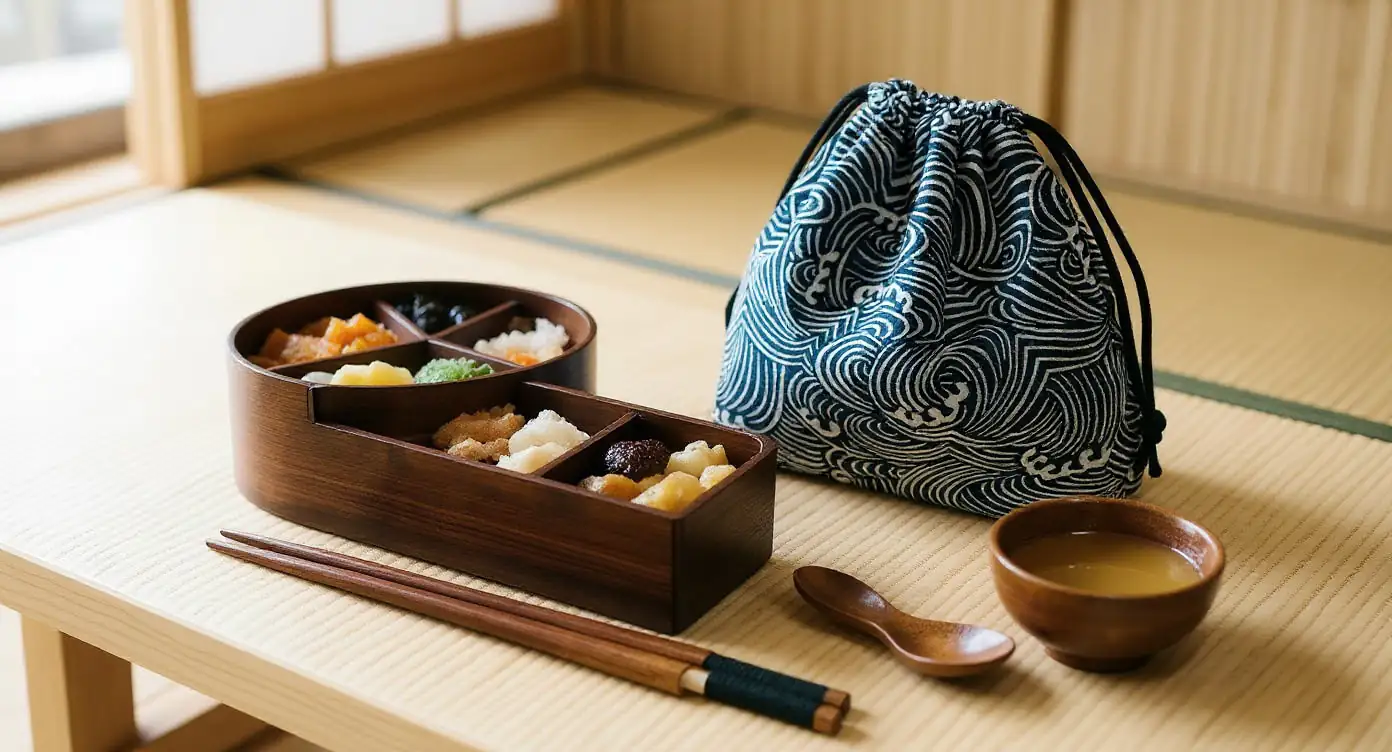
Recreating osechi outside Japan works best as a short list rather than a full set. Three or four dishes fill a box convincingly, and the easiest are kuromame, kurikinton, datemaki and a vinegared daikon and carrot salad, all of which use ingredients available in a normal supermarket. Prawns and kombu rolls come from an Asian grocer if you have one nearby. In Japan itself, most families now order a finished set from a department store or a specialist in November, which tells you something about the effort involved. For the serving vessel, a real five-tier jubako is a large and expensive object to buy for one day a year, so I steer readers towards a compartmented traditional bento box instead. It gives you the same partitioned, lacquered presentation at the table, and unlike a jubako it earns its place in the cupboard for the rest of the year.
Hatsumode and hatsuhinode: Japanese New Year rituals in January
From midnight on January 1, attention moves outdoors. The first shrine or temple visit of the year, hatsumode (初詣), is the single most attended event in the Japanese calendar, and the first sunrise, hatsuhinode (初日の出), draws its own crowds to coasts and high ground. This is the part of Oshogatsu a traveller can join without any invitation, and the part where knowing the sequence of gestures saves you from guessing.

Hatsumode: how a first shrine visit actually works
Timing is a real choice. Going straight after midnight on December 31 gives you the atmosphere, the food stalls and the crowds, with major sites like Meiji Jingu in Tokyo receiving around three million visitors across the first days. Going on January 2 or 3, mid-morning, gets you the same ritual with a fraction of the queue. The gestures at a Shinto shrine follow a fixed order. At the temizuya water basin, take the ladle in your right hand and rinse your left, swap and rinse your right, pour water into your left palm to rinse your mouth, rinse the left hand again, then stand the ladle upright to clean the handle. At the main hall, drop a coin in the offertory box, ring the bell if there is one, then two bows, two claps, a silent wish, one final bow. At a Buddhist temple there is no clapping: you place your palms together, bow once, and keep it quiet.
Omikuji, ema and last year's charms
Three small transactions usually follow the prayer. Omikuji are paper fortunes drawn at random, ranked from daikichi (great blessing) down through chukichi and shokichi to kyo and daikyo (great curse); a good one goes home in your wallet, a bad one is tied to a designated rack or pine branch so the shrine absorbs it. Ema are small wooden plaques where you write a wish and hang it with the others, and January is when the racks are heaviest with exam results and job hopes. The third is a return rather than a purchase: omamori charms bought last year are brought back and left at a collection point, since they are considered to have a one-year working life, and they are burned in a ritual fire. Many communities hold that fire on around January 15, in ceremonies called dondo-yaki or sagicho, where New Year decorations are burned alongside them.
Otoshidama and nengajo: money envelopes and New Year cards
Two customs handle the social side of the holiday. Otoshidama (お年玉) is cash given to children by parents, grandparents, aunts and uncles, presented in small decorated envelopes called pochibukuro. Amounts scale with age and vary by family: roughly ¥1,000 for preschool and early primary children, ¥3,000 to ¥5,000 through primary school, ¥5,000 to ¥10,000 for junior high and above. Use clean, crisp notes and fold them neatly rather than stuffing them. Nengajo (年賀状) are New Year postcards, and the rule is specific: post them by December 25 and Japan Post holds them for delivery on the morning of January 1. If there has been a death in your family during the year, you do not send nengajo; you send a mochu hagaki in early December instead, telling contacts you are in mourning, and they then refrain from sending you one. For a reader planning a January trip, that etiquette layer is where our Japan travel e-book goes deeper than an article can.
How to recreate Japanese New Year traditions at home
None of this needs a Japanese house. The elements that carry the mood abroad are the entrance, the table and what you wear while sitting at it, and honest substitutions work better than expensive approximations. I have done this in a small flat with a pine branch, a supermarket soba packet and four cups, and it held up.
A January 1 table: otoso toast and warm indoor clothes
The day opens with a toast of otoso (お屠蘇), sake or sweet mirin infused with a blend of medicinal herbs called tososan, sold in Japanese pharmacies as a small sachet steeped overnight. Plain warm sake stands in perfectly well. The pour follows age order around the table, and the direction varies: the common version starts with the head of the household and works down to the youngest, while some regions reverse it so elders receive the vitality of the young. Either way it is one small cup each, a greeting, and then the food. The vessel is part of the gesture, which is why I pour from a small sake drinking set with matching cups rather than wine glasses: the cups are tiny, so the toast stays ceremonial instead of becoming a drink. For clothing, January 1 is spent indoors, and the right piece is a hanten (半纏), a padded cotton jacket worn over normal clothes. Jinbei (甚平) is light summer wear and will leave you cold, so save it for August, and a long kimono-style robe over a jumper does the same job for a morning at home.

Decorating a small flat for oshogatsu without a kadomatsu
A commercial kadomatsu is bulky, seasonal and hard to find outside Japan, so build the idea instead of buying the object. A florist will sell you pine, and a garden centre or craft shop will sell you bamboo canes; three canes cut at an angle at different heights, bound with twine beside a few pine sprigs in a simple pot, reads correctly at a doorway. For the shimekazari, a plaited straw wreath with a few folded white paper strips does the work. Kagami mochi is the easiest of all, since two round mochi from an Asian grocer stacked under a small orange is exactly the real thing. Place them where the tradition places them: the pine at the entrance, the rope on the door, the mochi indoors on a shelf. Then take everything down on January 7, which keeps the arrangement a seasonal marker rather than permanent decor, and sits comfortably with the Wabi-Sabi idea that a thing is more beautiful for being temporary.
A three-day plan: December 31 evening to January 2
Here is the sequence compressed into something usable in any country. It assumes no special equipment beyond what is listed above, and it can be cut back to the first evening alone if that is all you have time for.
- December 30 to 31, daytime. Clean the kitchen and the entrance, put up the pine and the rope, set the kagami mochi on a shelf, and prepare two or three osechi dishes to chill overnight.
- December 31, evening. Eat hot soba before midnight, finishing the bowl. Keep the evening at home, put something long and slow on the television, and if you can find a live stream of temple bells, use it.
- January 1, morning. Watch the sunrise if the weather allows, pour one small cup of warm sake in age order, then serve the cold boxes and a hot bowl of mochi soup. Paint the first eye of a daruma and say the goal out loud.
- January 1 or 2. Visit a shrine or temple if there is one nearby, or write a wish on a card and keep it. Give the children their envelopes, and write your New Year cards.
- January 2, afternoon. Do the first calligraphy or first writing of the year, kakizome, and finish the leftovers. Note what you dreamed on the night of January 1, since hatsuyume featuring Mount Fuji, a hawk or an aubergine is counted as the luckiest.
Japanese New Year traditions: your questions answered
These are the questions readers send me most often in December, usually a week before they want to do any of it. Short answers below, with no repetition of the sections above.
Is Japanese New Year the same as Chinese New Year?
No. Japan moved to the Gregorian calendar in 1873 and shifted New Year to January 1, while Chinese New Year follows the lunar calendar and falls between late January and late February. Some Japanese communities, particularly in Okinawa and Amami, still mark the lunar date as well. The customs are also different: osechi, hatsumode and joya no kane have no Chinese equivalent.
What is the 3-day rule in Japan during New Year?
Sanganichi refers to January 1, 2 and 3, the core holiday period when offices, banks and many small businesses close. The convention is that housework and cooking stop, which is why food is prepared before December 31 and eaten cold. Families stay home, receive relatives, and travel back to their hometowns around it.
What are the lucky foods in osechi ryori?
The classics are kuromame for health, kazunoko for fertility, tazukuri for a good harvest, prawns for longevity, kurikinton for prosperity, kobumaki for joy and datemaki for learning. Each one is chosen for a pun or a visual resemblance rather than for taste. Three or four of them are enough to make a credible box at home.
Do people say Happy New Year before January 1 in Japan?
No, the greeting changes at midnight. Before the new year you say yoi otoshi o omukae kudasai, roughly "I hope you welcome a good year", used when parting in late December. From January 1 you switch to akemashite omedetou gozaimasu. Using the second one early sounds genuinely odd to a Japanese ear.
Are shops and temples open during oshogatsu?
Shrines and temples are at their busiest, open late on December 31 and through the first days. Convenience stores and most large shopping centres stay open, and department stores open with hatsuuri sales and fukubukuro lucky bags on January 1 or 2. Banks, post offices and many independent restaurants close from December 31 to January 3, so plan meals accordingly.
If you want to set the scene for your own January 1, the pieces that do the most work are the small ones: a daruma on a shelf, lacquered boxes on the table, a cup for the toast. You will find them among our Japanese decor pieces, handpicked for homes well outside Japan.
Explore the Japanese Decor collection
Daruma dolls, lucky cats and entrance pieces to set up your own Oshogatsu corner at home.
Browse the collection →
