

Dusk in Gion, Kyoto. A woman in a pale blue kimono walks fast down a lane of wooden houses, her wooden sandals clicking on the wet stone. She is not an actress and not a visitor in costume. She is on her way to work.
A geisha (芸者) is a professional Japanese artist. She trains for years in dance, music, song and the art of conversation, then entertains guests at private banquets. The word joins two characters, "art" and "person", so it literally means "person of the arts".
Geisha begin learning Japanese dance early. They also learn the craft of keeping company with guests at places of revelry and entertainment. They are often confused with oiran (花魁), the high-ranking courtesans of the old licensed quarters.
They left their mark on Japanese history through artistic talent and a instantly recognisable Japanese style. They are respected across the archipelago today, and they still attract a great deal of curiosity.
Key points
- A geisha is a trained performer of music, dance and conversation, not a courtesan.
- The profession grew out of the licensed pleasure districts of the Edo period and the ban on female kabuki.
- Training starts in a geisha house, where an apprentice is called a maiko and lives under strict rules.
- Her makeup, kimono, obi and sandals signal her exact rank and years of experience.
- A few hundred geisha still work today, mostly in Kyoto and Tokyo, and they still study the classical arts.
The sections below cover:
- The origin and history of the Geisha
- How does one become a Geisha
- What does the profession of Geisha consist of?
- The Geisha style of dress
- Why do we associate Geishas and prostitution?
- Geisha in the 21st century
Apocalypse of Geisha culture
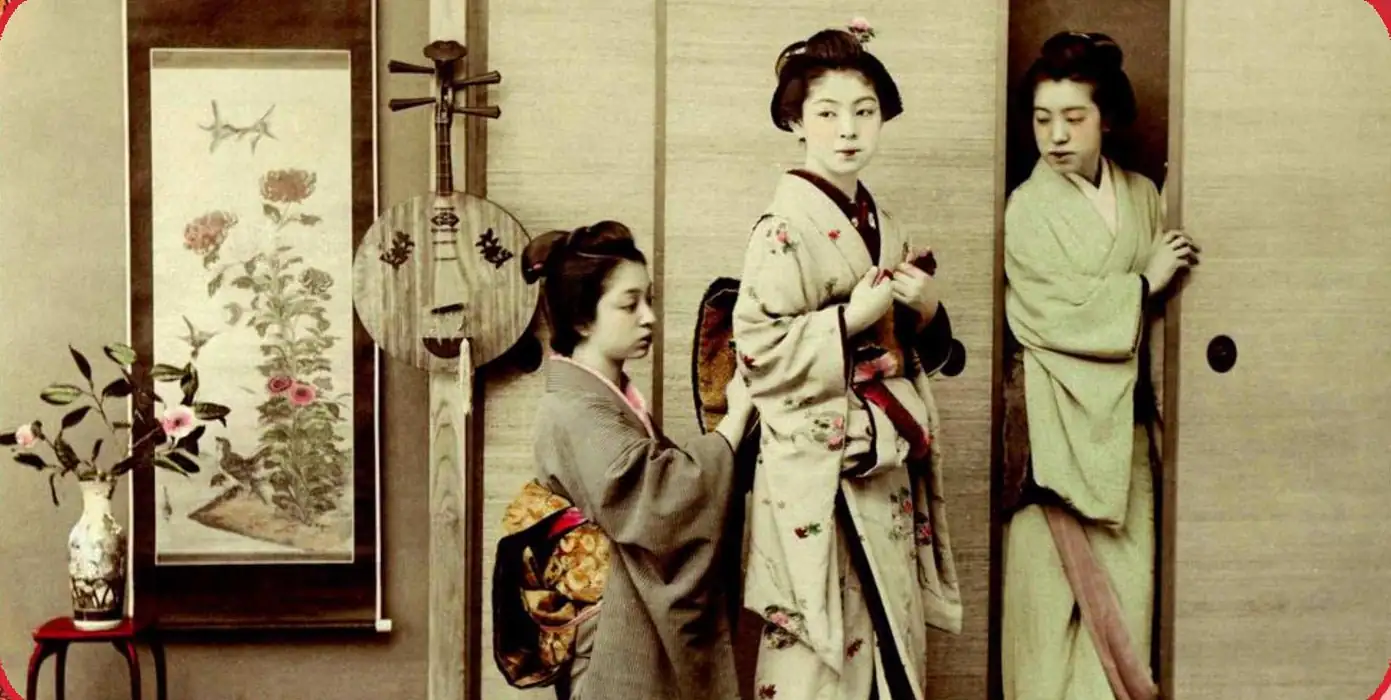
In the major Japanese cities, a geisha was an artist who respected tradition and whose role was to entertain guests at artistic events.
Besides welcoming guests, these young women practised dance, music and poetry. A visitor travelling in Japan could learn a great deal about Japanese culture simply by spending an evening in their company. Over time they became so popular that the activity turned into a full profession with its own districts, schools and rules.
Those districts have a name: hanamachi (花街), the "flower towns". Kyoto still has five of them, Gion Kobu being the best known. Each one works like a small village. A teahouse books the artists, a central office keeps the accounts, dance schools teach the repertoire, and dressers, wigmakers and kimono shops live off the same trade. In Kyoto a fully qualified geisha is called a geiko (芸子), and that is the word you should use there.
The evening itself is called an ozashiki (お座敷), a private banquet in a tatami room. Guests eat, drink and talk. The geiko pours, leads the conversation, performs a dance of a few minutes, plays a drinking game, then moves on to a second party. Nothing is improvised. The seating, the order of the sake cups and the choice of dance all follow a plan.

The first woman called a geisha was a talented singer and a remarkable player of musical instruments. Her fame led many women who sold themselves for money to turn to the profession instead. The golden age of the geisha came in the late eighteenth and early nineteenth centuries, when the hanamachi of Edo and Kyoto counted thousands of registered artists.
Today the numbers are far smaller. A few hundred geisha and maiko still work in Japan, most of them in Kyoto, Tokyo and a handful of hot spring towns. The art has not disappeared. It has become rare, which is a different thing.
The history of the geisha of Japan
Centuries before the word existed, young women already made a living from entertainment, including dancers who performed for the samurai.
Geisha history tells us that the shogun eventually decreed that Kabuki theater should be performed only by adult men, to put an end to fights, love affairs and prostitution rings. Around 1603 the first known Kabuki company recruited its chorus girls among young women of dubious reputation based in the back streets of Kyoto and Edo.
All of the Kabuki theaters came to be performed by men.
Although inspired by the religious folklore of Traditional Japan, their dances were intensely provocative, so much so that spectators who came to Kyoto often ended up fighting over the actresses.
In 1628 the Shogun banned female kabuki, and the female dancers were replaced by young men. The result was the same: fights, love affairs and prostitution rings. It was finally decreed that Kabuki should be performed exclusively by adult men, a rule still in force today.
Licenses were required for everything in the rigid social organisation of the Edo period, including opening a brothel. During the seventeenth century, walled districts devoted entirely to pleasure were built on the edges of Japan's major cities. Yoshiwara served Edo, Shimabara served Kyoto, Shinmachi served Osaka. Gates closed at night, guards checked who came in, and every worker was registered.
The geisha grew up beside that system rather than inside it. The first women to use the title worked in Fukagawa, outside the walls, selling music and wit to merchants who found the official quarters stiff and expensive. Their appeal was novelty. They dressed with restraint, they played the latest songs, and they talked back. That contrast is the root of the whole profession.
How to become a geisha
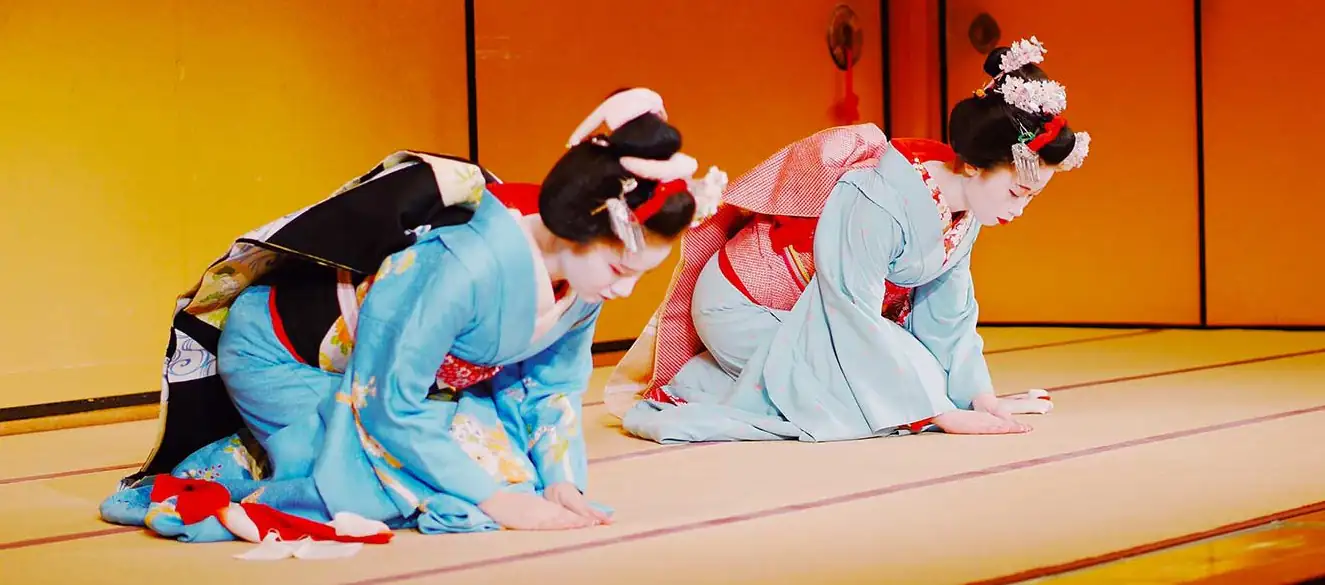
Traditionally, women who wanted to become geisha lived in tea houses. During their apprenticeship they held the title of Maiko (舞妓), "dancing child". They had to follow the many rules that surround the profession. The elders gave them food, shelter and everything their training required, and in return the newcomers helped them through their daily lives.
The house itself is called an okiya (置屋). It is run by a woman the apprentices address as okāsan (お母さん), "mother". She pays for the lessons, the wigs and the kimono, and she recovers that investment from the young woman's future earnings. The path is long and it has clear stages.
- Shikomi: the first months. Housework, errands, lessons, early mornings, no public appearances.
- Minarai: "learning by watching". She attends banquets in full costume and observes in silence.
- Misedashi: her debut as a maiko, announced in the district with her name on wooden plaques.
- Erikae: the "turning of the collar", when the red embroidered collar is replaced by a white one and she becomes a full geiko.
Five to six years usually separate the debut from the turning of the collar. In Kyoto a candidate is normally expected to have finished middle school, which puts most debuts between fifteen and eighteen. She also has to learn the Kyoto dialect, the local greetings and the order in which she must visit each teahouse. The lessons never really stop, and that steady refinement year after year is close to what we call Kaizen: small corrections, repeated for a lifetime.
The curriculum is wide. Classical dance, the shamisen (三味線), the small hand drum, flute, short songs, calligraphy and the tea ceremony all appear on the weekly timetable. The tea ceremony matters more than visitors expect, because it teaches the slow, exact hand movements that dance then reuses.

Geisha and their role in Japanese culture
A geisha does not behave like a housewife. The role society gave her leads her to behave differently. In traditional Japanese culture a woman, and above all a wife, was supposed to be gentle, quiet and modest.
A geisha does the opposite. She shows her talents, states her opinion freely but gracefully, and often surprises her guests with her intelligence and skill.
The daily life of a Japanese man of average or great wealth was ruled by duty and a serious attitude to work. It is no surprise that such men were drawn to a teahouse, where they could relax and enjoy what a geisha could offer: music, attention and a conversation with no stakes.
The Place of Geisha in Society
Geisha created an atmosphere of ease and nonchalance. Each performance, each dance and each piece of music is the result of fascinating work. They were, without question, among the most educated women in their society.
In the world of the geisha, a woman has to be strong and self-reliant. She signs her own contracts, manages her own reputation and chooses her own successor. The place of women in Japanese society has always been debated, and the hanamachi has always been one of the few places where a woman could earn a living from a skill alone.
Rank is visible and it is earned. A maiko is below a geiko. An "older sister", the onee-san, guides a younger one and shares her name with her. In the old licensed quarters, the tayū stood above everyone, an educated courtesan who could refuse a client. Today the senior geiko of a district, and the mother of the okiya, hold that authority.
The social relations of a Geisha
An experienced geisha may have a patron, a danna (旦那). He supports a life that can be very expensive, since kimono, wigs and lessons all cost money.
The presence of a patron does not imply a personal relationship with the geisha. Her private life depends on her alone.
Her reputation has always played a central part in her work. Personal relationships are therefore weighed carefully and never treated lightly. A single rumour can cost a geiko her bookings in a district where every teahouse knows every artist.
The Birth of the Floating World
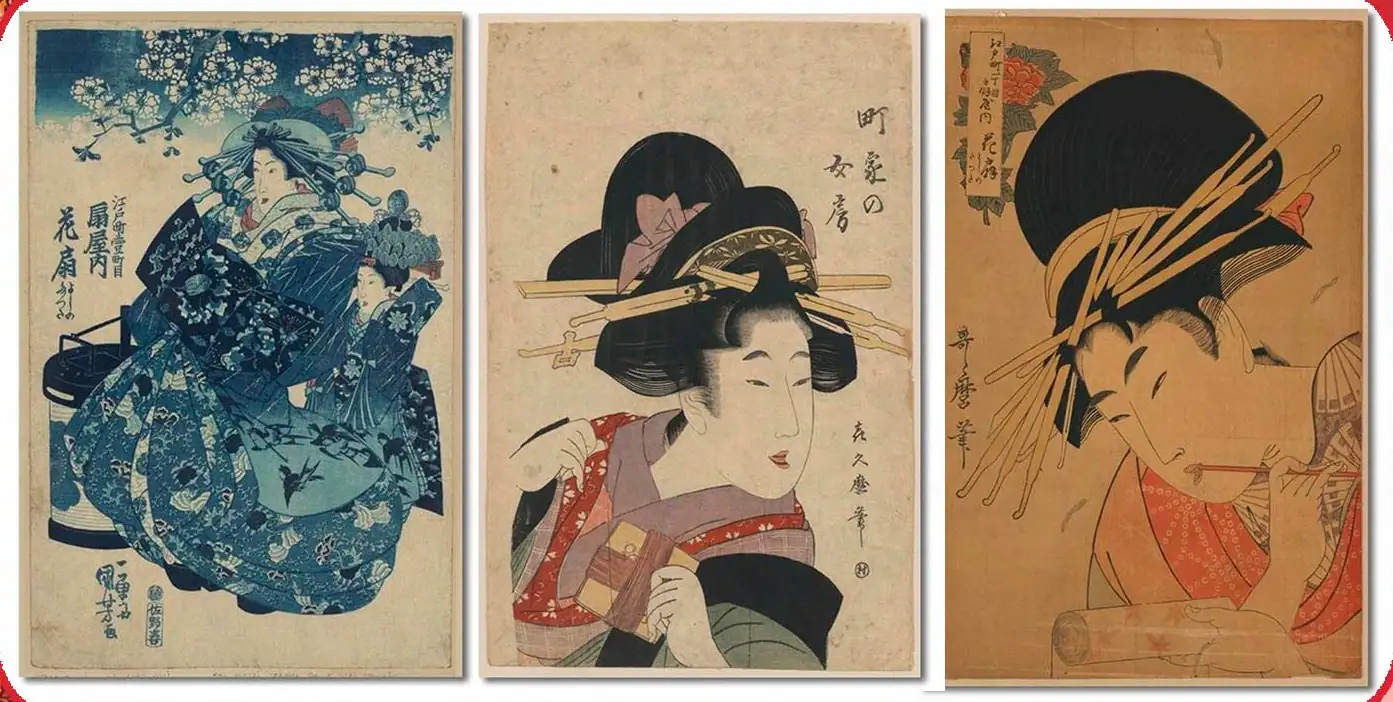
The success of these Japanese districts was overwhelming, thanks to the rise of a new social class, the merchant bourgeoisie. With a firm hand, the Tokugawa shogunate had just ended centuries of skirmishes and civil wars. The Japanese people could finally put their energy into prosperity and development.
On the official scale, merchants ranked below peasants. In practice many of them rivalled noble families in wealth. In daily life they had to look humble, bribe officials and watch their step so their property would not be seized.
In the pleasure districts of Tokyo, by contrast, birth counted for nothing and money counted for everything. For a few hours, commoners lived like lords, flattered and pampered by women dressed like princesses. A way of life built on fleeting illusions, which the writer Ryoi Asai named ukiyo (浮世) in 1661, "the floating world".
That floating world produced the art we still collect. Woodblock prints, called ukiyo-e (浮世絵), sold cheaply on the street and turned dancers, actors and geisha into the first popular stars of Japan. The taste of those districts also produced iki, an ideal of understated chic: a dark kimono, a flash of red lining, nothing shouted. The pleasure of a passing moment, accepted as passing, is also the heart of Wabi-Sabi.
The decline of the Geisha's reputation
By the nineteenth century the geisha profession was practised almost entirely by women. They stood for hope and drew the admiration of older women who had never had the same chance.
During World War II the title lost its value. The hanamachi were closed and the artists were sent to factories. Foreign soldiers arriving afterwards had little knowledge of Nipponese culture, and women who used their charm to seduce Japanese and foreign clients took the opportunity to claim the title of geisha. The English phrase "geisha girl" was born in those years, and it has confused readers ever since.
After the war there were several attempts to revive the profession in its original form and to present Japan to the world again. Teahouses were rebuilt to encourage a return to older customs. The attempt largely failed, because the activity itself had changed. The trade had to adapt to the demands of a new consumer society, where a businessman's evening budget, not a lord's household, paid for the music.
The confusion between Geishas and prostitutes
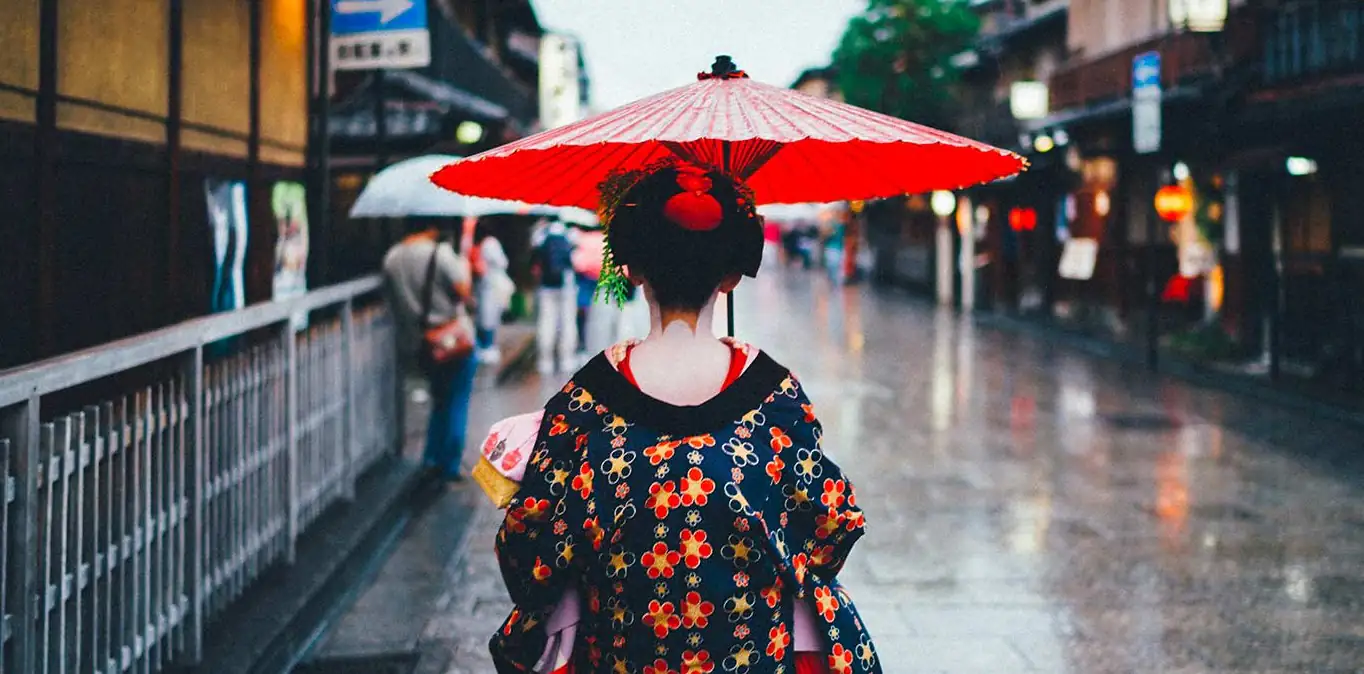
The confusion has a simple source. Geisha and courtesans worked in the same cities, wore kimono, entertained the same men and belonged to the same social margin. They were never the same job.
A courtesan of the licensed quarters sold intimacy under a government licence. A geisha sold a performance. Her fee paid for music, dance and company for the length of a banquet. The two trades were even kept apart by law, and geisha who worked inside the walls of a pleasure quarter were watched closely so they would not compete with the registered courtesans.
The clothes say the same thing. A courtesan tied her obi at the front, which made it easy to undo. A geisha ties hers at the back, which requires a dresser and takes time. One detail, two completely different jobs.
The "selling of a maiko's virginity" that appears in Western novels did exist in parts of the old system, and it was abolished long ago. Modern Japanese law ended licensed prostitution in the 1950s, and today's geiko are salaried artists with contracts, tax numbers and union-style district offices. One of the most famous geiko of Gion publicly disputed the way a bestselling Western novel described her world, which tells you how strongly the profession defends the distinction.
Foreign visitors who booked a banquet expecting more than music left disappointed. That has not changed.
The geisha style
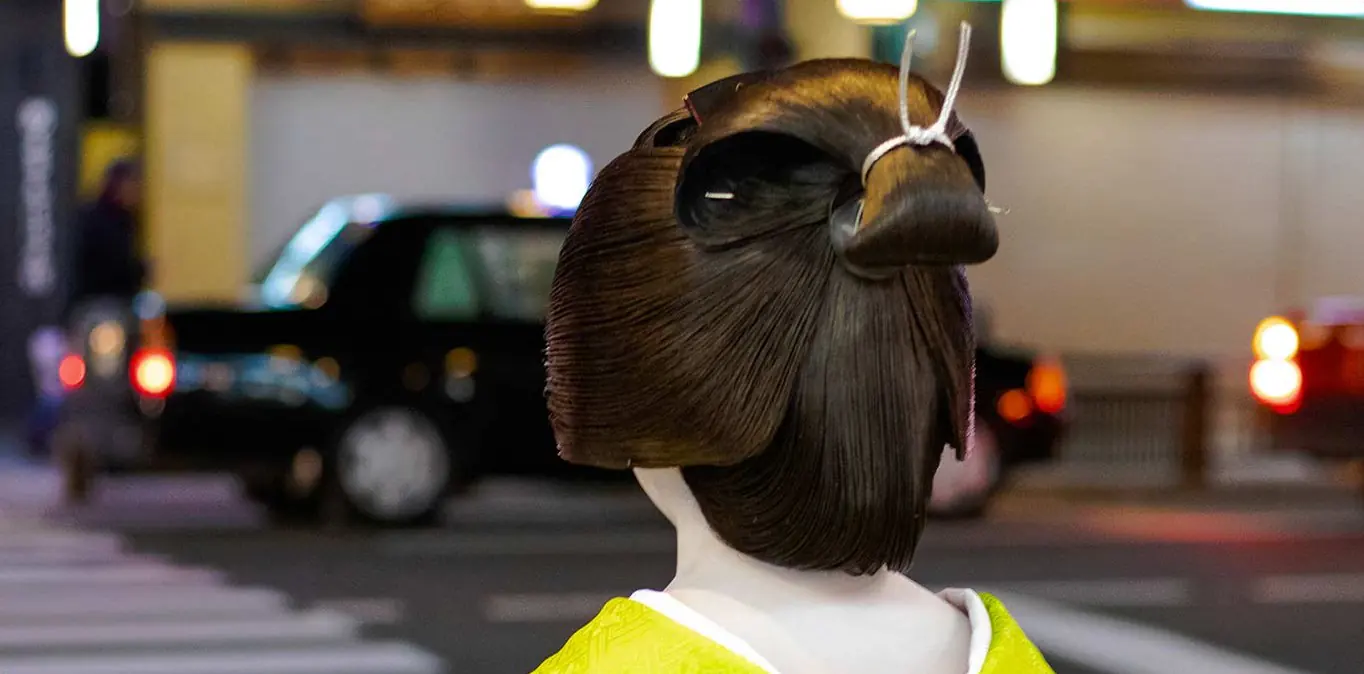
A geisha's career, status and experience can be read from her appearance. A maiko usually wears bright colours and long trailing sleeves. The hairstyle with its elaborate bun, the makeup, every detail of the wardrobe carries meaning, including the geta sandals and the choice to wear a wig or her own hair.
Here is the outfit at a glance:
- Garment: full-length silk kimono (着物), with a trailing hem for formal appearances
- Belt: obi (帯), tied at the back; a maiko wears the long darari obi that hangs almost to the floor
- Collar: red and embroidered for a maiko, plain white for a geiko
- Socks: white tabi, split between the big toe and the others
- Footwear: tall wooden okobo for a maiko, lower geta or zori for a geiko
- Hair: own hair styled by a professional for a maiko, a katsura wig for a geiko
The colours follow the calendar. Cherry motifs in spring, water and fans in summer, maple in autumn, pine and plum in winter. Wearing the wrong season is the one mistake a trained eye notices immediately.
The traditional makeup of a geisha
One of the most striking and recognisable features of a geisha is her makeup. Following tradition, she starts with a thick white layer on the face and neck. The process takes a long time and resembles work on a painting more than a daily routine.
Oil or wax goes on the face first. The result looks like a Japanese mask from Noh theatre, smooth and without a flaw. The white powder is called oshiroi (白粉). The eyebrows are drawn over it, traditionally with a charcoal brush.
The lips are painted with a fine brush for a clean shape. They are visibly smaller than the natural lips, which gives the face an air of youth and softness. A maiko paints only the lower lip in her first year, then both. For the first years the makeup stays heavy. After about three years of experience she moves to a more sober geisha style, and a senior geiko often wears the white face only for stage appearances.
Two details are worth knowing. The nape is left with two or three unpainted points at the hairline, a deliberate contrast praised in classical taste. And the white never goes all the way to the jaw, because the natural skin edge is what makes the painted face read as makeup rather than a mask.
The dress style of a geisha
For clothing, the geisha has always worn a woman's kimono, the traditional Japanese garment above all others. A full formal set can weigh several kilos once the under-robe, the collar, the padding and the obi are in place, and a professional dresser ties it.
The colour, the pattern and the style of the kimono are set by the season and the occasion.
You do not need the full outfit to borrow the idea. A long Japanese kimono dress in a plain colour, worn over black trousers and a white t-shirt, keeps the vertical line and the wide sleeve that make the silhouette work. That bridge between a historic garment and modern clothes is the whole point of our selection.
The main functions of geisha
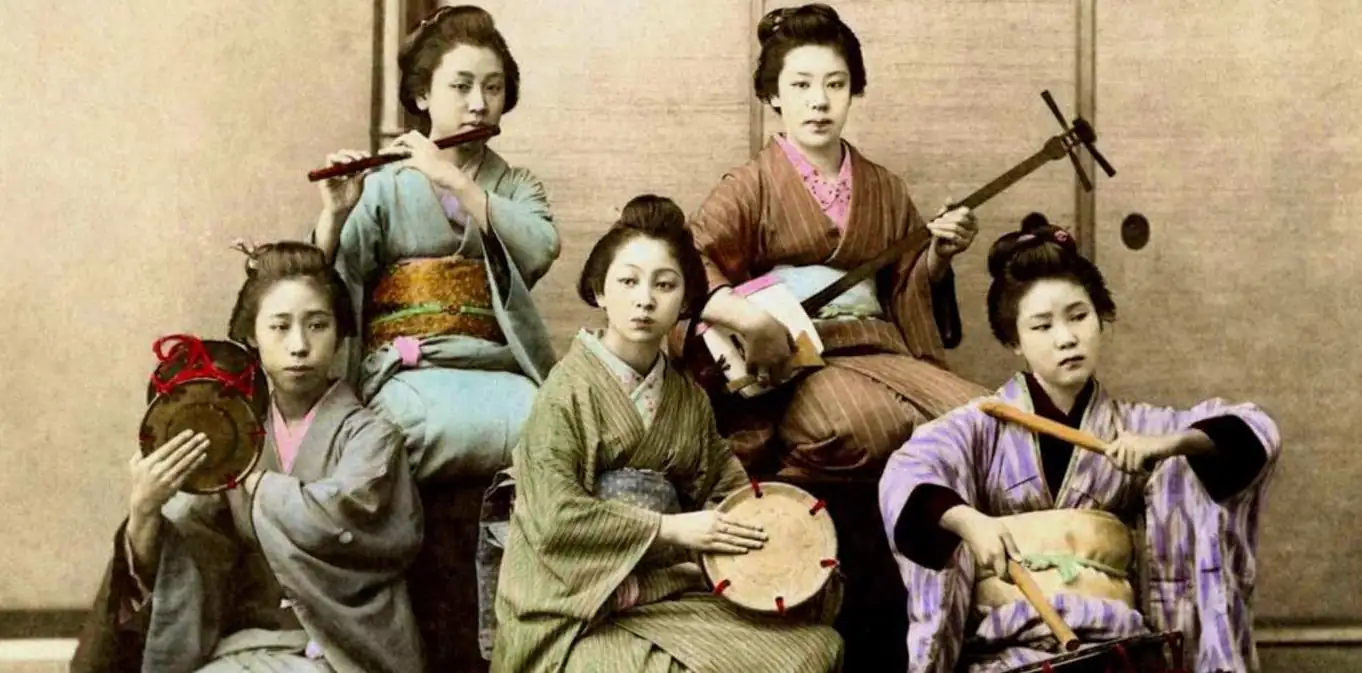
The geisha plays several specific roles within Japanese society. Inside a hanamachi the artists split into two specialities. The tachikata dance and appear in front of the guests. The jikata sit to the side and provide the music. A young woman usually chooses one path and stays with it.
Her time is billed by the hour, under the name hanadai (花代), the "flower fee". The teahouse collects it, the district office records it, and the okiya takes its share. A busy geiko in Kyoto earns a solid professional income, but the costume, the lessons and the hairdresser consume much of it, which is why a patron once mattered so much.
Jikata geiko
A geisha performing songs and shamisen, the three-stringed Japanese lute. She provides musical accompaniment with flute, kotsuzumi hand drum and other instruments in the tatami tea room.
The jikata geiko (地方) are certainly not the ones in the spotlight during a show. Their role is to create, by their presence, a subtle background for the tachikata geiko.
That is why a jikata generally chooses a simple kimono houmongi, natural makeup with no oshiroi, and a plain hairstyle. It remains a matter of personal taste.
A minority of jikata, especially those new to the role or trained in both specialities, prefer to wear the full stage geiko outfit with all its advantages and drawbacks.
Taiko, tea ceremony
Geisha are also known as players of the taiko, the Japanese drum. They bring the tatami tea room to life with dance, imitation, fusuma-gei and similar entertainments.
Drinking games belong to the same repertoire. Konpira fune fune and tora tora look childish on paper and work on anyone after a cup of sake, which is exactly their purpose: they put a shy guest at ease in under a minute.
Several districts also hold public dance seasons, and those performances are the easiest way for a visitor to see the art properly. The best known is the spring programme of Gion, where dozens of geiko and maiko dance on a theatre stage with live musicians. Tickets are sold to anyone, with no introduction needed.
Geisha: myths and reality
Some visitors meet a geisha as a guide, during a castle tour or a museum visit organised by a hotel. Those encounters are arranged, paid and perfectly legitimate.
Compared with Greek hetairas and European royal mistresses, Japanese geisha have fascinated Western readers for centuries. As we have already made clear, geisha are not prostitutes.
Westerners who had the rare privilege of attending a banquet hosted by geisha and hoped for more at the end of the evening were quickly disappointed.
Despite everything, Japanese parents are often reluctant to see their daughters enter the "world of the flower and the willow", the karyūkai (花柳界). The work is elegant, traditional and harmless, and it still carries a faint air of the forbidden.
Two modern myths deserve correcting. First, most of the "geisha" photographed in the streets of Kyoto are tourists in rented costume, from a makeover studio. A real maiko walks quickly, carries nothing and does not pose. Second, she is not public property. Several streets in Gion are privately owned, and photographing people there without permission can now lead to a fine. Watching from a distance, with the camera down, is simply good manners.
The profession of geisha is deeply rooted in Japanese society. It is now more than three hundred years old. Through their dress, their hairstyle, their presence and their sense of hospitality and entertainment, these women have earned respect as artists.
In the modern era the Nipponese art carried by this profession has adapted to a new world rather than disappeared. Geisha still learn the traditional arts: musical instruments, calligraphy, classical Japanese song and dance, the tea ceremony, literature and poetry.
FAQ
What does it take to become a geisha?
You need to join an okiya in a hanamachi, usually after middle school, and accept several years of training in dance, music and etiquette. The house pays for lessons and kimono, and the apprentice repays that through her work. Foreign candidates have been accepted in a few districts, but fluency in Japanese and the local dialect is the real barrier.
Why should you not photograph a geisha in the street?
Because she is a professional on her way to an appointment, not an attraction. Crowds have blocked lanes in Gion, and some private streets now carry signs that forbid photography, with a fine for anyone who ignores them. If you want photographs, book a public dance performance or a tea ceremony where the artists know a camera is present.
Are geisha allowed to marry?
A working geisha traditionally does not marry, and a woman who marries usually retires from the profession. Nothing in modern law prevents it, so the rule is a professional custom rather than a legal one. Some retired geiko marry and then return to the district as teachers or teahouse owners.
What happens to a geisha when she retires?
Many stay inside the same world. A retiring geiko may take over a teahouse, run an okiya as its okāsan, teach dance or shamisen, or work as a dresser. Others leave for an ordinary career and keep the training as a private skill. Retirement age varies widely, and some geiko in Tokyo and Kyoto perform into their eighties.