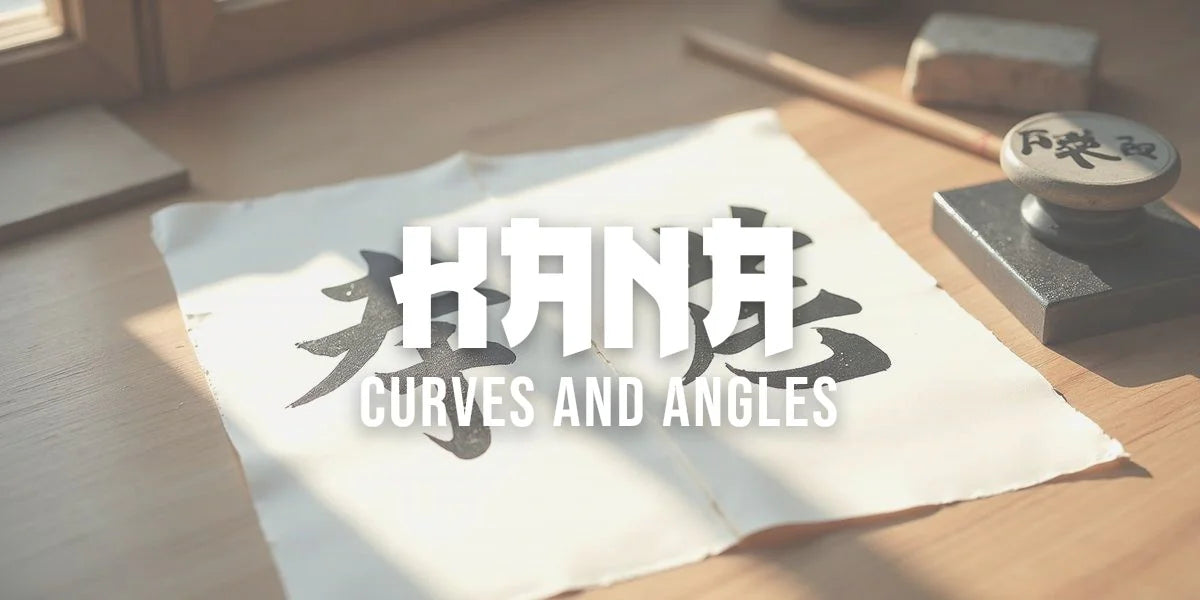
Open any manga page and you will see three different kinds of writing in a single speech bubble. The dense characters, the round ones, the spiky ones. The question of hiragana vs katakana has a short answer: both scripts write exactly the same 46 sounds, but they do different jobs. Hiragana handles native Japanese words and all the grammar, meaning particles and verb endings. Katakana marks foreign loanwords, onomatopoeia, scientific names and words the writer wants to make stand out. Visually, hiragana is round and flowing (ひらがな), katakana is angular and sharp (カタカナ). Japanese then adds kanji (漢字) for the meaning-carrying roots, which is why three scripts coexist in one sentence.
Key points
- Hiragana and katakana cover the same syllable sounds, only their usage and shapes differ.
- Hiragana carries grammar and native vocabulary; katakana flags loanwords, sound effects and emphasis.
- Shape is the fastest tell: hiragana curves, katakana corners.
- A normal Japanese sentence mixes kanji for roots, hiragana for glue and katakana for imported words.
Hiragana vs katakana: the difference in one minute
Think of the two as one alphabet printed in two typefaces with two separate functions. Nothing is lost or gained in sound when you switch between them. The word sakura can be written さくら or サクラ, and a Japanese reader hears the same three syllables either way. What changes is the signal sent to the reader: ordinary Japanese word, or technical, foreign, stylised.
Same 46 sounds, two different alphabets
Each script is a kana syllabary, which means one character equals one syllable rather than one letter. か is ka, not k plus a. Both sets contain the same 46 basic characters in modern standard Japanese: five vowels, forty consonant-vowel pairs, and the final nasal sound ん in hiragana or ン in katakana. Both accept the same two small marks that modify consonants, and both can be stretched with small subscript characters to write sounds like kya or sho. So you are not learning two languages or two sound systems. You are learning one sound inventory twice, with two visual costumes.
Hiragana for grammar, katakana for borrowed words
Hiragana is the working script of the language. It glues words together, conjugates verbs, marks who does what to whom, and spells out native words that have no common kanji or whose kanji would feel heavy. Katakana has a narrower brief. It writes vocabulary imported from English, French, Portuguese, German and beyond, the names of non-Japanese people and places, animal and plant names in scientific writing, brand names, and sound effects. It also works as a visual highlighter, the rough equivalent of italics in English. If you recognise a word in a Japanese text because it sounds like your own language, it is almost certainly sitting in katakana.
Round hiragana, angular katakana: the shape test
Before you know a single character, you can sort the two scripts by silhouette. Hiragana grew out of flowing brush cursive, so its strokes loop, curl and rarely stop abruptly. Katakana was built from fragments of kanji, so its strokes are short, straight and meet at hard angles. Hold a page at arm's length: the soft, bubbly characters are hiragana, the ones that look like tiny scaffolding are katakana. This one trick already lets you guess the function of a word you cannot read yet, which is exactly how beginners start reading signs and menus in Japan.
Hiragana, katakana, kanji: why Japanese uses all three
Three scripts sounds like an accident of history, and partly it is, but the division of labour is genuinely useful. Japanese is written without spaces between words. The constant switching between scripts is what tells your eye where one word ends and the next begins. Kanji carry meaning, kana carry function, and the alternation does the job that spaces do in English.
Where kanji stops and kana takes over
Kanji are characters borrowed from Chinese that represent meaning rather than sound alone. They sit on the root of a word: 飲 for drinking, 山 for mountain, 着 for wearing. But Japanese verbs and adjectives change their endings, and a fixed character cannot bend. So the root stays in kanji and the changing tail is written in hiragana. That trailing hiragana has a name, okurigana, and it is why 飲む (to drink), 飲みます (polite form) and 飲んだ (past) share one kanji with three different kana tails. Once you see this pattern, Japanese stops looking like a wall of symbols and starts looking like roots plus grammar.
Reading one sentence with all three scripts
Take a sentence any beginner learns in week one: 私はコーヒーを飲みます, watashi wa kōhī o nomimasu, "I drink coffee." Four jobs, three scripts, no spaces. 私 is kanji and means "I". は is hiragana, a particle marking the topic, and it is read wa here rather than ha. コーヒー is katakana because coffee is an imported word. を is hiragana, the particle marking the object. 飲みます closes the sentence with a kanji root and a hiragana ending. Nothing in that sentence is decorative. Each script is doing structural work, and reading it slowly once teaches more than memorising a rule.
Furigana: hiragana used to read kanji
There is a fourth thing you will notice in manga and children's books: tiny hiragana printed above or beside a kanji. That is furigana, a pronunciation guide. Because a single kanji can have several readings, writers use furigana whenever the reading is unusual, when the audience is young, or when a character's name is written with rare characters. For a learner this is a gift. A shōnen manga with furigana on every kanji is readable with kana knowledge alone, which is why I always tell people that finishing both kana charts unlocks far more material than they expect. Transcription into the Latin alphabet, called romaji, is a crutch worth dropping as soon as furigana becomes an option.
How to recognize hiragana: curves, grammar and native words
Hiragana is the script you will see most often, simply because grammar appears in every sentence while loanwords do not. A page of Japanese prose is roughly half hiragana by character count. Learning to spot it is less about memorising 46 shapes at once and more about recognising the handful of characters that repeat constantly.
The hiragana particles you see in every sentence
Particles are short grammatical markers that follow a word and define its role. They are always written in hiragana, they are almost always one character long, and the same few recycle endlessly. は marks the topic and is read wa. が marks the subject. を marks the direct object and is read o. に marks a destination or point in time. で marks a location of action or a means. の links two nouns and works like "of" or an apostrophe-s. へ marks direction and is read e. Spot these and you have found the seams of the sentence, which means you can isolate the content words sitting between them even when you cannot read those words yet.
Verb and adjective endings written in hiragana
The second hiragana pattern to train your eye on is the tail. Polite verbs end in ます or ました. Plain verbs end in う, く, す, つ, ぬ, ぶ, む, る. Adjectives end in い and change to かった in the past. Negatives bring ない or ません. All of this lives in hiragana, always after the kanji root. In practice this means the end of a Japanese clause is usually a run of round characters, and that run tells you tense, politeness and whether the statement is positive or negative. Here are native words that sit entirely in hiragana or appear that way in casual writing:
- ねこ (neko) cat
- さくら (sakura) cherry blossom
- ともだち (tomodachi) friend
- たべる (taberu) to eat
- きもの (kimono) the garment, more often written 着物 in kanji
- ありがとう (arigatō) thank you
Hiragana letters beginners confuse: ね / れ / わ
Three hiragana share the same left-hand vertical stroke and differ only in what happens on the right: ね (ne) finishes with a loop that curls inward, れ (re) ends with an open hook that swings out, わ (wa) closes into a soft rounded belly. I mixed these up for weeks until I started writing them as a set of three rather than as separate characters. The other classic pairs are あ (a) and お (o), は (ha) and ほ (ho), る (ru) and ろ (ro), and さ (sa) and き (ki). Correct stroke order helps more than it sounds: when you write in the official order, the shapes come out with the right proportions and the differences become obvious on the page.
How to spot katakana: loanwords, onomatopoeia and emphasis
This is the script that rewards anime and fashion fans immediately. A large share of the Japanese words you already know are katakana, because they came from outside Japan in the first place. Learn katakana and you can suddenly read convention signage, product tags, menu boards and sound effects without knowing much grammar at all.
Loanwords in katakana: コーヒー, アニメ, コスプレ
Imported vocabulary is called gairaigo (外来語), and these loanwords (gairaigo) go in katakana as a matter of convention. The spelling follows Japanese sound rules, so the original word gets reshaped: コーヒー is kōhī for coffee, アニメ is anime, clipped from animation, コスプレ is kosupure, a contraction of costume play, ラーメン is rāmen, テレビ is terebi for television, and パン is pan for bread, borrowed from Portuguese. Fashion vocabulary works the same way. On a Japanese product page you will read 着物 in kanji but ニット for knit and デニム for denim. Decoding katakana is mostly a matter of reading the syllables aloud and letting your ear catch the original word.
One mark belongs almost exclusively to this script. The long vowel mark ー, written as a single horizontal bar, stretches the preceding vowel by one beat. コヒー and コーヒー are not the same word, and the difference is audible. Japanese counts length in units called mora, where each kana equals one beat and ー adds another, so a stretched vowel genuinely changes the rhythm of the word. In vertical writing the bar is drawn vertically, which confuses newcomers who expect a dash. When you see that bar, you are looking at katakana nine times out of ten.
Manga sound effects written in katakana
Japanese has an unusually rich stock of sound and manner words, and manga uses them as graphic elements rather than hiding them in brackets. Onomatopoeia that imitates actual sound, such as ドキドキ for a pounding heartbeat or ゴロゴロ for rumbling thunder, is typically drawn in katakana, often hand-lettered and stretched across a panel. Words that describe a manner or state rather than a noise, such as きらきら for glittering, often appear in hiragana instead. That split is a soft convention rather than a law, and artists break it for effect. If you have ever wondered why the big dramatic letters in a fight scene look spiky, now you know: angular katakana simply reads as loud.
Names, brands and katakana used for emphasis
Non-Japanese names go in katakana, which is why your own name will be rendered that way on forms, hotel registers and convention badges. Japanese companies also choose katakana for their logos when they want a modern, international feel, as トヨタ does. Beyond that, katakana functions as a highlighter inside ordinary text: a writer can take a perfectly native word and switch it to katakana to make it feel clipped, ironic, technical or trendy, which is how かわいい becomes カワイイ in a magazine headline. Historically this script also carried telegrams and the earliest Japanese computer displays, since katakana was easier to encode in limited character sets.
Kana charts and memory tricks to tell hiragana from katakana
Both scripts are organised by the same logic, and that logic is the real shortcut. Once you understand how a kana chart is built, you are memorising a grid of 46 slots rather than 46 unrelated drawings. Most learners who stall are trying to brute-force a list that already has a structure.
Reading a kana chart by row and column
The traditional grid is called gojūon (五十音), the fifty sounds. Across the top sit the five vowels in Japanese order: a, i, u, e, o. Down the side sit the consonants: k, s, t, n, h, m, y, r, w. Every cell is a consonant plus a vowel, so the k row reads ka ki ku ke ko, written かきくけこ in a hiragana chart and カキクケコ in a katakana chart. A few cells are empty because those sounds dropped out of the language, and ん sits alone at the end. Two small marks complete the system: dakuten and handakuten, the two-stroke mark that turns か into が and さ into ざ, and the small circle that turns は into ぱ. Learn the grid and you have learned both scripts in the same shape.
Mnemonics that stick for look-alike kana
Pictures beat repetition for the handful of characters that resist memorisation. キ (ki) is an old-fashioned key. ロ (ro) is a box, and it is also the kanji for mouth. め (me) is an eye with lashes, and me means eye in Japanese. ニ (ni) is simply the kanji 二 for two, which is read ni. The hard pairs are worth drilling together rather than apart: シ (shi) has strokes that sweep from the left, ツ (tsu) has strokes that drop from the top, ソ (so) is two strokes while ン (n) hooks upward from the bottom left. Write each confusable pair side by side ten times instead of writing each one twenty times alone.
A realistic two-week plan to learn both kana
Fourteen days is enough for recognition if you keep the sessions short and daily. Days one to five: five hiragana a day by row, writing each one by hand and reading two or three real words that use it. Days six and seven: review hiragana only, no new characters, and read simple words aloud. Days eight to twelve: the same pace for katakana, which goes faster because the sounds are already in your head. Days thirteen and fourteen: mixed reading, where you hunt for katakana loanwords in menus, packaging and manga panels. Ten focused minutes a day beats one long weekend session, because recognition depends on repeated exposure rather than hours. For structured practice I lean on the Japanese Books for Beginners selection in our catalogue, and the KimuraKami e-book is the one I hand to anyone learning kana before a first trip, since it keeps the vocabulary tied to real situations rather than abstract lists.
There is a quieter reason to learn both scripts, and it matters if you wear or collect Japanese pieces. Calligraphed kana and kanji appear on haori (羽織), the open jacket worn over a kimono, on tenugui cloths, on noren curtains and on the back panels of a sukajan (スカジャン), the souvenir jacket whose own name is katakana. Reading the characters on a garment changes your relationship with it. You stop seeing decoration and start seeing a word someone chose. That is close to what Wabi-Sabi asks of us: attention to the particular, imperfect, handmade detail rather than the overall effect.
FAQ
The questions that surface most often from readers new to kana deserve straightforward answers. I have gathered the common ones here with concise responses that deepen rather than repeat what we have already covered.
Should I learn hiragana or katakana first?
Learn hiragana first if your goal is to read and study Japanese properly, since grammar, textbooks and furigana all run on it. Learn katakana first if your goal is a trip in the next few weeks, because loanwords on menus and signs are what you will actually need to decode. Either way, the second script takes less time than the first.
How long does it take to learn hiragana and katakana?
Two weeks of ten to fifteen minutes a day is a realistic target for reliable recognition of both. Writing them smoothly from memory takes longer, perhaps a month. Fluent, effortless reading comes from volume, so expect it to keep improving for several months after the charts are learned.
Can you write a whole Japanese sentence in hiragana only?
Yes, and children's books do exactly that. It is grammatically correct but slow to read, because Japanese has no spaces and many homophones, so kanji is what separates words and disambiguates meaning at a glance. An all-hiragana sentence is readable the way an all-lowercase English sentence without spaces is readable, which is to say with effort.
Why is my name written in katakana in Japan?
Katakana is the standard script for non-Japanese names and places, so it signals "this is a foreign word" to the reader. Your name gets respelled with Japanese syllables, which can add or shift vowels. It is a convention, not a judgement, and it is the same treatment given to every imported word.
Do Japanese children learn kana before kanji?
Yes. Hiragana comes first in the first year of elementary school, katakana follows closely, and kanji is introduced gradually across the six primary years, with just over a thousand characters taught by the end of them. Learners outside Japan usually follow the same order for the same reason: kana makes everything else readable.
Once the two charts click, Japanese text stops being a pattern and starts being a message, including the characters brushed on the pieces you wear. If that is where you are heading, have a look at the Japanese Books for Beginners selection and the calligraphed kimono, haori and sukajan in our collections, and pick the one whose characters you would be glad to read every time you put it on.