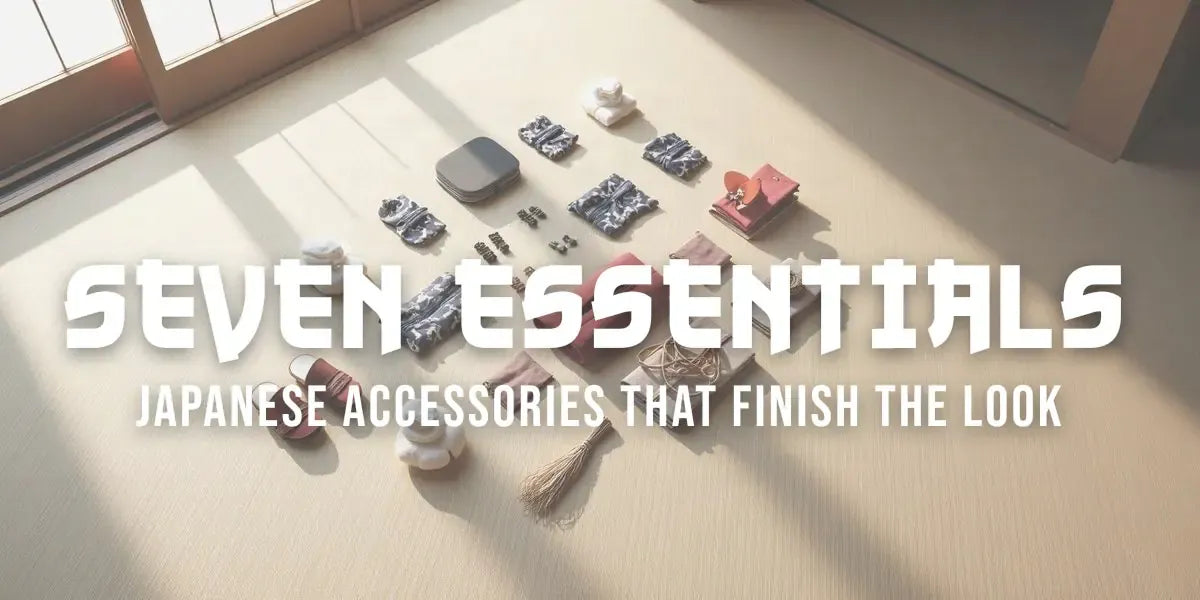
A friend of mine once bought a pair of geta sandals in Kyoto, brought them home, and left them in a box for two years. The reason was simple: no socks to wear with them. Japanese accessories work best when you know how they fit into daily life, so here is my selection of the pieces I actually reach for, and what each one is really for.
Key points
- Tabi socks (足袋) have a split toe, made to sit on either side of a sandal strap.
- Japanese jewelry carries meaning through motifs like dragons, oni masks and kanji.
- The maekake (前掛け) apron comes from merchants and craftsmen, not from kitchens alone.
- Temporary Irezumi tattoos let you test a design before committing to a needle.
- Maneki-neko, Daruma and Omamori are three different kinds of lucky charm, each with its own use.
Japan holds two things at once: deep tradition and fast modernity. Nothing is dropped along the way. That mix is what makes these objects interesting, and it is what guides our selection at KimuraKami.
Our selection of favorite Japanese products:
- The temporary Irezumi tattoo
- The Japanese fan
- The tabi socks
- The Japanese apron
- The Japanese jewelry
- The Maneki-neko lucky charm
- The Japanese cushion
Japanese Tabi Socks

If you already own Geta sandals, tabi socks are the missing half of the outfit. Geta are raised wooden sandals held by a strap called the hanao. That strap passes between the big toe and the second toe, which ordinary socks cannot handle.
Tabi socks (足袋) solve this with a split toe. The fabric divides in two, so the strap sits where it should. No stretched seams, no bunching, no rubbing after twenty minutes of walking.
A few practical points before you order:
- Material: cotton, sometimes with a touch of elastane
- Japanese sizes run about 1x smaller than US and EU sizes
- Care: cold machine wash, air dry to protect the shape of the toe seam
- Style: white for traditional wear, black or patterned for everyday use
I wear mine with geta in summer and with plain leather loafers in autumn. The split toe disappears under trousers, and the fit is closer than a standard sock.

Japanese jewelry

Japanese jewelry is rarely decorative only. The motif carries the message. A pendant shaped like a deity, a dragon bracelet, a kanji engraved on a plate: each one says something about the person wearing it.
The dragon, for instance, is linked to water and to wisdom in Japanese iconography. The oni mask, with its horns and wide mouth, plays the role of a guardian figure rather than a simple monster. Choosing between them is choosing which idea you want to carry.
These pieces also mix easily with a modern wardrobe. A single oni pendant over a white t-shirt is enough. Two or three layered chains with a kanji plate work with black denim. This is the Wabi-Sabi habit of letting one imperfect, characterful object speak instead of covering yourself in metal.
If you have values to convey in a Japanese style, you will display them clearly with traditional Japanese jewelry. Our full range of small pieces sits in the Japanese accessories selection.
Japanese Apron

The maekake (前掛け) is the traditional Japanese apron. It hangs from the waist, tied with a long cord wrapped twice around the body. Sake brewers, rice merchants and blacksmiths wore it as a work uniform, often with the shop name printed across the front.
The trade behind it takes years. Serving sushi as an itamae (板前), a head sushi chef, means seven to ten years of training. Forging a blade worth the name takes longer.
You do not need a professional reason to wear one. A plain indigo maekake over jeans works for cooking at home, for pottery, or for a market stall. The colorful versions and the Maneki-neko prints are easier to pair with casual clothes.
Temporary Irezumi tattoo

Irezumi (入れ墨) is the Japanese art of full-body tattooing. The level of detail on a finished back piece is what draws most people in: dragons, koi, waves, peonies, all composed as a single image rather than separate designs.
In Japan the social reading is different. Tattoos remain associated with banditry and with the yakuza, and many onsen and gyms still refuse entry to visible ink. That context matters if you travel there.
The traditional method, tebori, uses a hand-held bamboo or steel rod rather than a machine. Sessions are long and the pain is part of the reputation. A full suit can take years of appointments.
Temporary Irezumi tattoos give you the visual without any of that. They are useful for two things in particular: testing a design on your own skin before a real appointment, and completing a cosplay or convention outfit for a weekend.

Japanese fan

The sensu (扇子) is the folding Japanese fan, and it is one of the most recognizable objects in the country. Elegance, fine ribs, a shape copied everywhere and rarely matched.
Its uses changed across centuries. It appeared in religious ceremonies, then in traditional dance and in Nō theater. During the Edo period, shoguns and generals carried decorated versions. Later it became a signature accessory of the geisha repertoire, where it is handled as part of the dance rather than as jewelry.
Beyond the practical side, a sensu is a small painted object. The paper or silk leaf shows a landscape, a wave pattern, a branch of plum blossom. Folded, it slips into a sleeve or a bag.
Worn with a kimono (着物) or a yukata, it completes the silhouette for both men and women. Men's sensu are usually larger and plainer.
Japanese lucky charm

You have seen one already. The Maneki-neko (招き猫) is the white cat with a raised, waving paw, sitting at the entrance of shops and restaurants. It is the most widely recognized Japanese lucky charm.
It appears on t-shirts, in manga, on car decks and beside cash registers. The raised paw is a beckoning gesture in Japanese body language, which is where the name comes from: the inviting cat.
The cat does not hold a monopoly. The Daruma (達磨) is a round red statuette sold with blank eyes. You paint one eye when you set a goal and the second when you reach it.
The Omamori (御守) is a third form: a small embroidered fabric amulet, bought at a shrine or temple, attached to keys, a bag or worn around the neck. Its meaning depends on the design. An usagi (rabbit) pattern is associated with success in study.
None of these is a neutral decorative object. Each carries an intention, and each makes a clear gift for someone who cares about Japanese culture.
Japanese Cushion

The last accessory is not worn. The Japanese cushion, or zabuton (座布団), is a flat floor cushion used for sitting at a low table. It is one of our favorite objects for changing the feel of a room.
On a bed, an armchair or a sofa, it adds Japanese pattern without any renovation work. One cushion is often enough to set the tone of a corner.
The range of designs is wide: kawaii characters, manga prints, and authentic patterns such as seigaiha waves or hanko-style stamps. That variety is what lets you match an existing interior rather than build one around the cushion.
Give yourself a treat!
These seven accessories cover the three places Japanese style usually enters a home: what you wear, what you carry, and what you put on a shelf. Tabi socks and fans belong to an outfit. Jewelry and omamori travel with you. Cushions and Maneki-neko stay in the room.
If you were building your own collection, you now have a shortlist. If you were shopping for a friend who is Japanese at heart, the jewelry, the fan and the lucky charms are the safest gifts, because none of them depends on sizing.
Our selection follows the three principles behind KimuraKami: Ikigai for objects with a purpose, Kaizen for a range we keep refining, and Wabi-Sabi for pieces that show the hand that made them.
FAQ
What are the most famous Japanese accessories?
The sensu folding fan, tabi split-toe socks, the obi belt, kanzashi hair ornaments and the Maneki-neko are the ones most people recognize. The fan and the Maneki-neko are the easiest starting points, since neither requires a size.
Which Japanese accessory makes the best gift?
Jewelry and lucky charms, because there is no fit to get wrong. A pendant with an oni mask suits someone who likes bold pieces, a Daruma suits someone starting a project, and an omamori suits students. All three travel well in a small parcel.
Do I need to size up on Japanese accessories?
Yes, for anything worn. Japanese sizes run about 1x smaller than US and EU sizes, so take one size up on tabi socks, geta and clothing. Fans, jewelry, cushions and charms have no sizing to worry about.
Can I wear these accessories with normal clothes?
Every piece here works outside a full traditional outfit. I wear tabi socks with loafers, a single pendant over a plain white t-shirt, and a maekake apron over jeans. The rule I follow is one Japanese element at a time, kept visible.
Explore the Japanese Accessories collection
Take a moment to browse our Japanese Accessories collection and find the piece that fits your own everyday style.
Browse the collection →