The first time I tied a hachimaki with a single large character across the front, a customer asked me what it said. I told her, and she asked the better question: how do you even know? A japanese kanji is a character that carries a meaning, not a sound. 英 means "brilliant, excellent, England" whichever way you pronounce it, while hiragana and katakana only spell out syllables. To read a kanji's sense, you look at the parts it is built from (英 stacks the "grass" radical over a shape once used for a flower in full bloom), then check which reading the surrounding word asks for: ei in 英語 (English), hana in older poetic use. That is the whole trick. Meaning comes from the strokes, pronunciation comes from the context.
Key points
- Japanese writing mixes three scripts at once: kanji for meaning, hiragana for grammar, katakana for foreign and emphatic words.
- Most kanji have at least two readings, on'yomi (borrowed from Chinese) and kun'yomi (native Japanese), chosen by the word and not by the character alone.
- 英 combines the grass radical with a shape linked to a flower at its peak, which is why it came to mean brilliant, outstanding, and by phonetic borrowing, England.
- Before you wear, print or tattoo a kanji, check its readings and name usage: 英 reads ei, hide or hana depending on the word.
What does a Japanese kanji actually mean?
A kanji is a unit of meaning. One character can be a whole word, or a piece of a longer word, but it is never just a letter. 山 means mountain. 水 means water. You can recognise what a text is about before you know how to say a single syllable of it.
Kanji, hiragana and katakana: three scripts, one sentence
Japanese uses three scripts in the same sentence, each with a job. Take 私はコーヒーを飲みます (I drink coffee). 私 is a kanji and means "I". は and を and ます are hiragana, the grammatical glue that marks the subject, the object and the polite ending. コーヒー is katakana, used here because "coffee" came from abroad. 飲 is a kanji carrying the idea of drinking, finished off by hiragana.
On'yomi vs kun'yomi: reading one kanji two ways
Most kanji arrived from China with their Chinese pronunciation, then got attached to the Japanese word that already meant the same thing. A single character ends up with two families of readings. The on'yomi and kun'yomi split is the result: on'yomi is the imported sound, kun'yomi the native one. Japanese readers learn pairs of character and word together, not characters in isolation.
The real inventory is smaller than the internet suggests. The jōyō kanji list set by the Japanese Ministry of Education holds 2,136 characters for everyday use. Roughly 1,026 of them are covered in primary school. Dictionaries catalogue tens of thousands more, but almost all of those are rare, historical or reserved for names.
Radicals: the small parts hiding inside every kanji
Kanji are built from recurring components. A radical (bushu) is the component a dictionary files the character under, and it often hints at the meaning family. 氵 signals water, so you find it in 海 (sea) and 河 (river). 艹 signals grass and plants, so it sits on top of 花 (flower) and 英. Learning twenty or thirty common radicals changes how a wall of text looks. You stop seeing random strokes and start seeing assemblies.
Inside the kanji 英: brilliant, excellent, England
英 is eight strokes and two parts. On top sits 艹, the grass radical. Below sits 央, a character that means centre. Grass above a centre: a plant at its fullest point. That image is the root of everything the character came to mean.
The strokes of 英: grass above a flower in full bloom
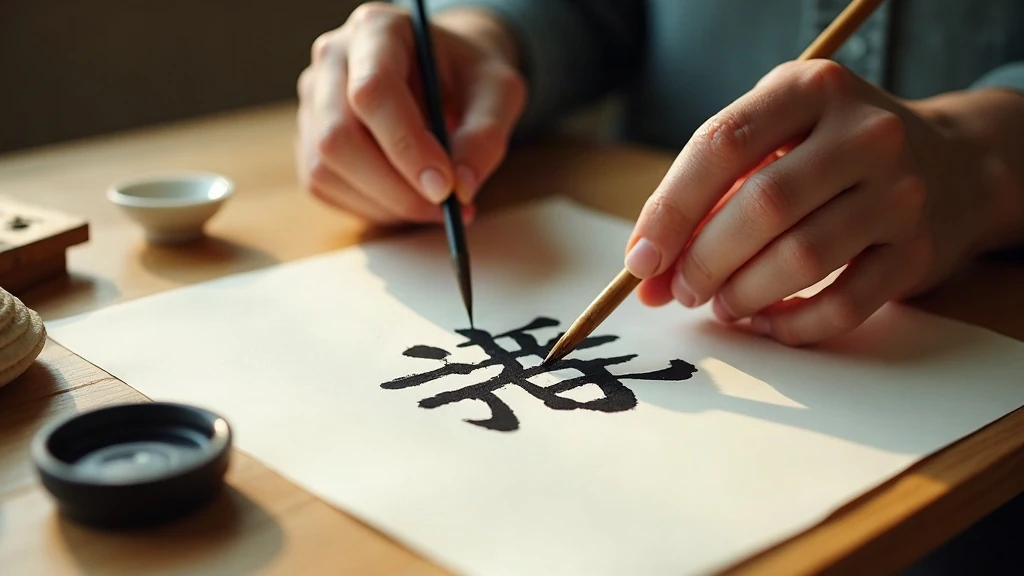
The oldest sense attached to 英 is the flower at its peak. What is at its peak becomes what is outstanding. A person described with 英 is brilliant, gifted, superior in their field. Stroke order for 英 goes top to bottom and left to right: the short horizontal bar of the grass radical, crossed by left and right verticals, then the lower box shape filled in left to right, with a long diagonal sweep at the end. Follow that order and the character balances itself.
Readings of 英: ei, hide or hana
In practice, if you meet 英 inside an ordinary word, read it ei. If you meet it in a personal name, ask.
英 in real words: 英語, 英雄, 英国
The most common word is 英語 (eigo), English, built from 英 plus 語 (language). Then 英雄 (eiyū), hero, literally "brilliant" plus "male". And 英国 (eikoku), the United Kingdom. In 英国 and 英語, 英 was picked because its sound, ei, approximated "England" when the name was transcribed in the nineteenth century. The praise sense of the character is a coincidence in those words.
Japanese kanji you can wear: hachimaki, tees and streetwear
A single character printed large reads as a shape first and a word second. That is also the risk. A character you cannot read is a sentence you did not choose. The pieces worth wearing are the ones where the character is correct, deliberate and worth explaining when someone asks.
The hachimaki: why a kanji sits across the forehead
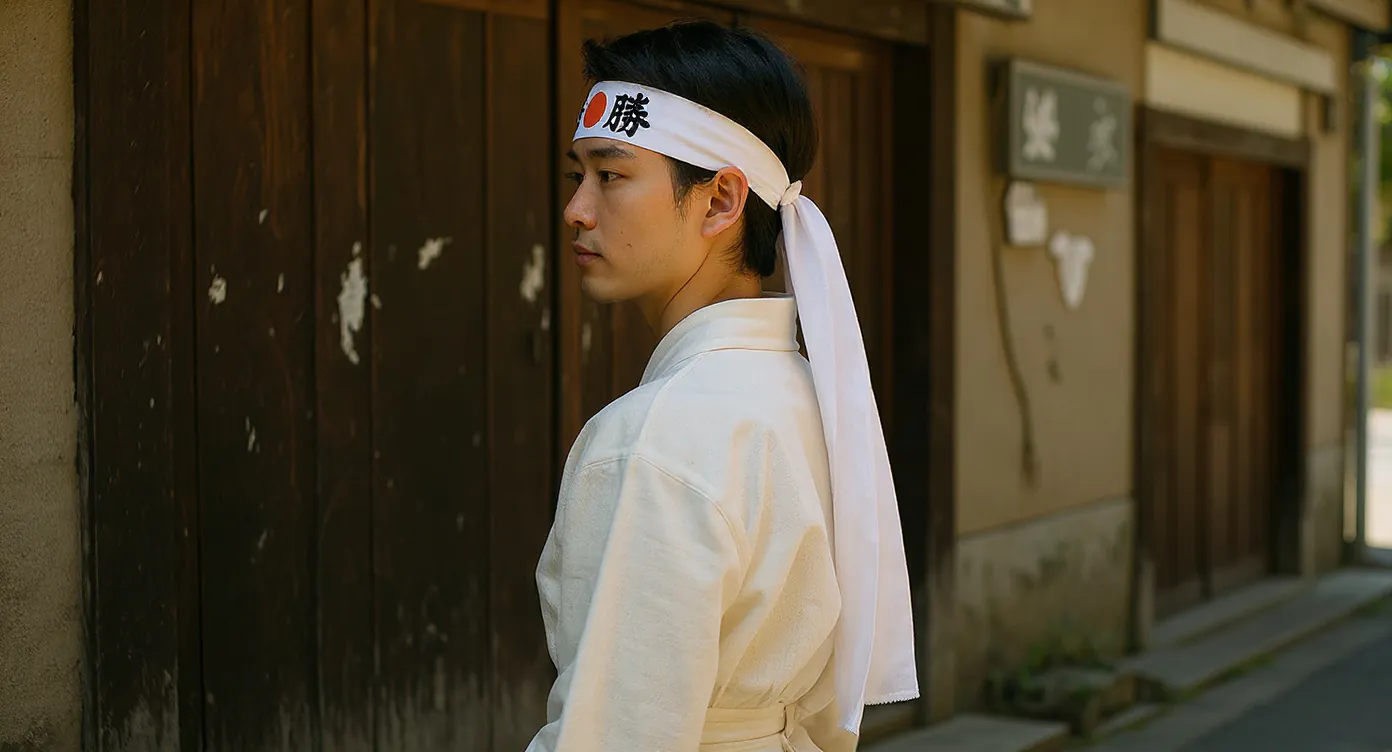
The hachimaki (鉢巻, "bowl wrap") is a cotton headband tied at the back of the head. It belongs to effort and concentration: students revising for exams, cooks behind a counter, men hauling a shrine through the street during a matsuri festival. The characters printed across it are usually short and declarative. I keep a cotton hachimaki with bold kanji in my bag for conventions.
- Material: cotton, soft enough to knot flat.
- Length: long enough to wrap once and leave short tails at the back.
- Care: cold wash, air dry, iron on the reverse.
- Wear: tie just above the eyebrows, not tight enough to mark the skin.
Reading a kanji on a T-shirt before you buy it
Checking a character takes under a minute. Zoom in on the product photo and compare the shape against the same character in a dictionary entry, paying attention to the number of strokes. Three faults show up repeatedly on cheap prints: a mirrored character, a stroke that stops short, and a decorative font that fuses components. If the listing gives you the reading and the meaning, that is a good sign.
Styling one bold kanji with jeans and a white tee
Kanji graphics are loud, so everything else should be quiet. A single character on a black tee, straight-leg indigo jeans, white sneakers. Japanese sizes run about one size smaller than US and EU equivalents, so a Japanese L is closer to a US M. For tees and jackets, take one size up from your usual and check the flat measurements in the listing against a garment you already own.
The kanji 英 in Japanese names and what to check first
Names are where kanji get genuinely unpredictable. Japanese law allows a set list of characters for given names, but parents choose a character for its meaning and attach a reading they like. 英 is a popular choice because the sense of brilliance is flattering and it works for both boys and girls.

英 in given names: Hideo, Eiji, Hanae
Some common combinations: 英雄 read Hideo (brilliant + male), 英二 read Eiji (brilliant + two, often for a second son), 英樹 read Hideki (brilliant + tree), and 英恵 read Hanae (brilliant + blessing, a women's name).
Nanori: the extra readings reserved for names
Nanori name readings are pronunciations a character carries in personal names and almost nowhere else. 英 reading hide is nanori. A dictionary lists them separately from on'yomi and kun'yomi. Business cards in Japan often print furigana above the name for this reason.
Choosing a kanji name or tattoo without a mistranslation
If a character is going on your skin or on an engraved gift, check: Look it up in a proper dictionary and note every reading and sense. Verify the register: some characters are archaic or mostly used in compounds. Check what it sounds like, since Japanese has homophones. Confirm it reads alone and makes sense. Have a native speaker read it back to you. Give a clean reference to your tattooist, not a font sample.
Kanji on your wall: prints, scrolls and calligraphy
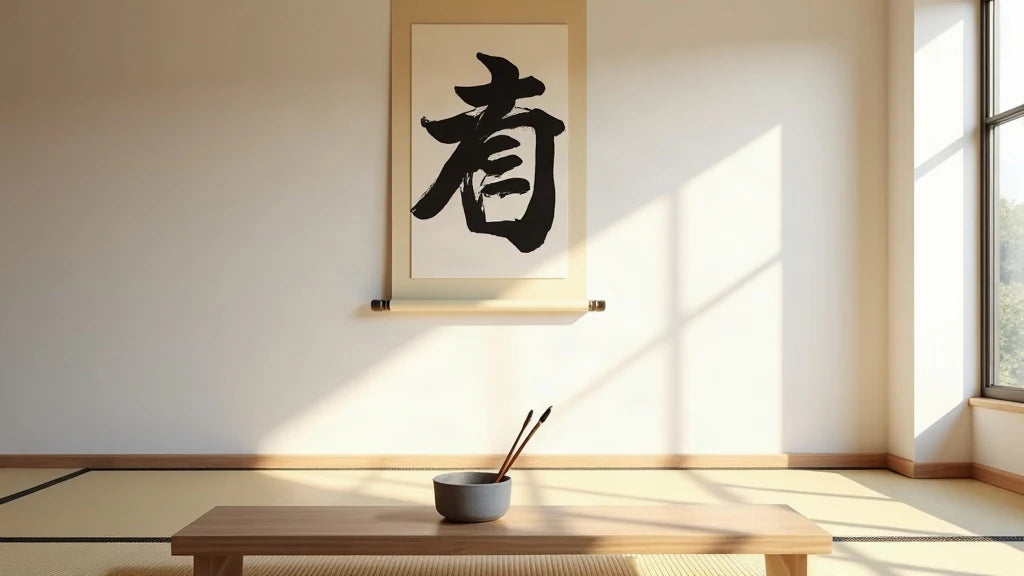
A character on a wall behaves differently from a character on a page. It is not there to be read quickly, it is there to be looked at. That is the whole discipline of shodō calligraphy, the Japanese art of brush writing, where the same character can be composed a hundred ways depending on how the brush moves.
Calligraphy prints: how a brushed kanji is composed
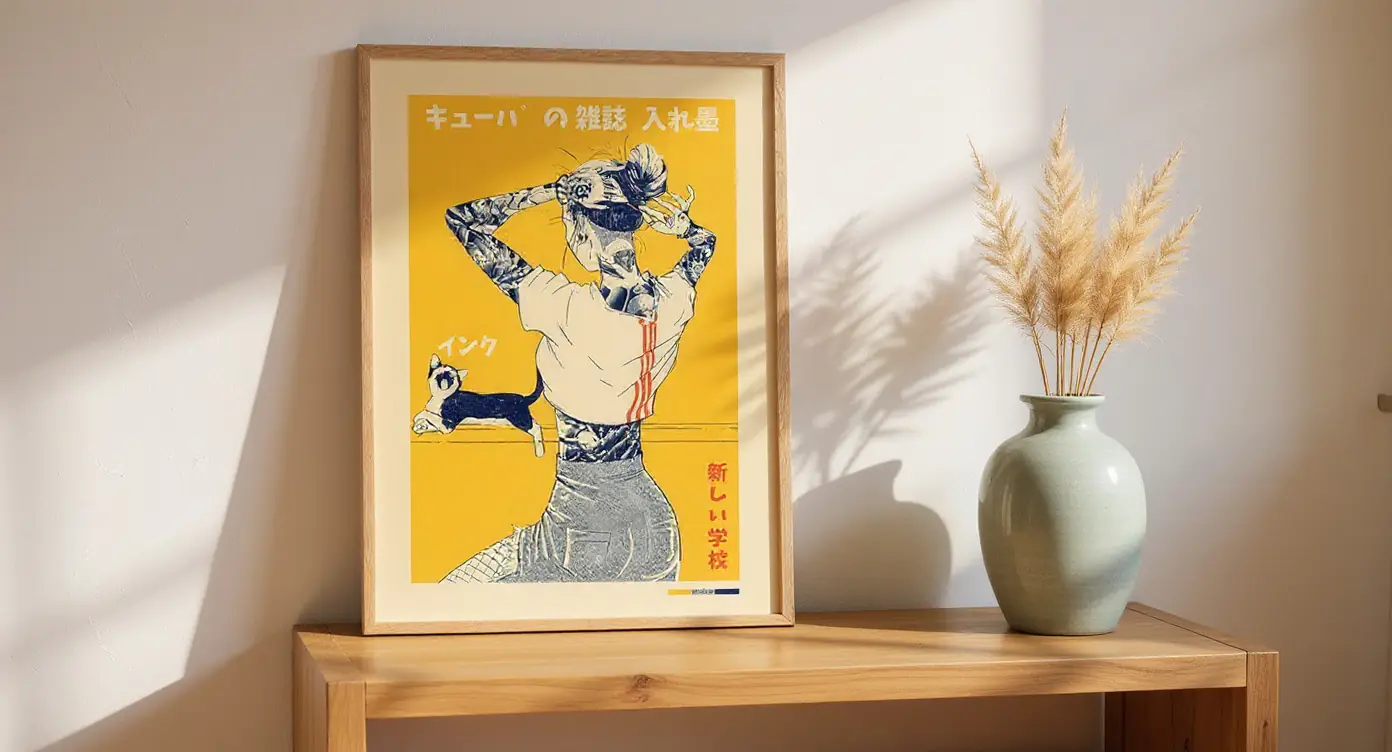
Compare a printed 英 to a brushed one. The printed version has even lines. The brushed version swells where the brush pressed down and thins where it lifted. The white space around the strokes is part of the composition. This is where Wabi-Sabi becomes concrete: the slight irregularity is the point, not a flaw. When choosing something for my own wall, I look at the empty space before the character. If the character sits with room to breathe, it holds a room. The Japanese style prints work well for someone who wants a brushed character without committing to a full hanging scroll.

Where to hang a single-kanji print at home
Hang the centre of the character at eye level, around 145 to 150 cm from the floor. Lower it slightly if the piece faces a sofa or dining table. A single-character print wants one clear wall, not a gallery arrangement. Keep it out of direct sunlight, since ink and paper fade.
Framing and pairing a kanji print with Japanese decor
- Frame: natural wood or matte black, slim profile.
- Mount: white or off-white, at least 5 cm on each side.
- Glass: non-reflective if the wall faces a window.
- Pairing: one print, one ceramic or plant nearby, nothing else on that wall.
Japanese kanji questions readers ask most
Does every kanji have a radical?
Yes. Every character is filed in a dictionary under one radical, even simple characters like 一, which is its own radical.
Can I write Japanese without kanji?
You can, in hiragana only, but it becomes hard to read quickly because Japanese has many homophones and kanji separate them visually.
Are Japanese and Chinese characters the same?
They share an origin and many characters are identical. Readings differ completely, and Japan simplified some characters differently from mainland China.
FAQ
How many kanji do you need to know to read Japanese?
Around 2,000 covers almost everything in general print. The official jōyō set is 2,136 characters. With 1,000 you can read a lot of signage and simple text.
Is kanji the Japanese alphabet?
No. Kanji are characters that carry meaning, not letters that spell sounds. Hiragana and katakana, with 46 basic signs each, are the closest thing Japanese has to an alphabet.
What does the kanji 英 mean?
英 means brilliant, excellent or outstanding, from an older sense of a flower in full bloom. It also stands for England in words like 英国 and 英語, where it was chosen for its sound. Its readings are ei, and hide or hana in names.
What is the easiest kanji to write?
一, meaning one, is a single horizontal stroke. 二 (two) and 三 (three) follow with two and three strokes. 口 (mouth) and 山 (mountain) are simple and easy to recognise.
How do I look up a kanji I can't read?
Identify the radical and search by radical in a kanji dictionary. Handwriting input on a phone or a dictionary app is faster if you can copy the strokes. Camera lookup works on printed text.
If a brushed character or a traditional print would suit a wall in your home, take a look through our Japanese decor collection. There is something quietly satisfying about living with a character you can actually read.
Explore the Japanese Decor collection
Browse our Japanese decor selection for prints, calligraphy-style wall art and pieces that put a single character at the centre of a room.
Browse the collection →