
A woman in a surgical mask stops you on a quiet street and asks if she is pretty. There is no safe answer, and every Japanese schoolchild in the 1980s knew it. Creepy Japanese urban legends still grip the country because they are not really about ghosts: they are rumours built from everyday places, a school toilet, a train platform, the walk home after dark, and they inherited a 400-year-old vocabulary of yokai, yurei and onryo that Japanese audiences already know how to read. Kuchisake-onna, Hanako-san, Teke Teke and Aka Manto spread by word of mouth among children in the 1970s and 80s, and each one puts a face on a real anxiety of its decade. That is also why they resurface every summer in ghost-story season, and every autumn in cosplay, behind a Hannya, Noh or Oni mask.
Key points
- Four legends dominate: Kuchisake-onna, Hanako-san, Teke Teke and Aka Manto, all set in ordinary, inescapable places.
- Each is a modern rewrite of older folklore: the vengeful onryo of Noh theatre and the yokai of Edo-period kaidan.
- Japan tells its scariest stories in summer, not at Halloween, through kimodameshi and kaidan gatherings.
- The fears underneath are social: school pressure, commuter trains, public toilets and the judgement of women's faces.
Yokai, yurei and onryo: where Japanese urban legends begin
The modern urban legend does not stand alone. It borrows a 400-year vocabulary from kaidan and folk belief, and knowing how Japanese horror sorts its creatures helps you understand what each story really says.
From Edo kaidan to today's Japanese urban legends
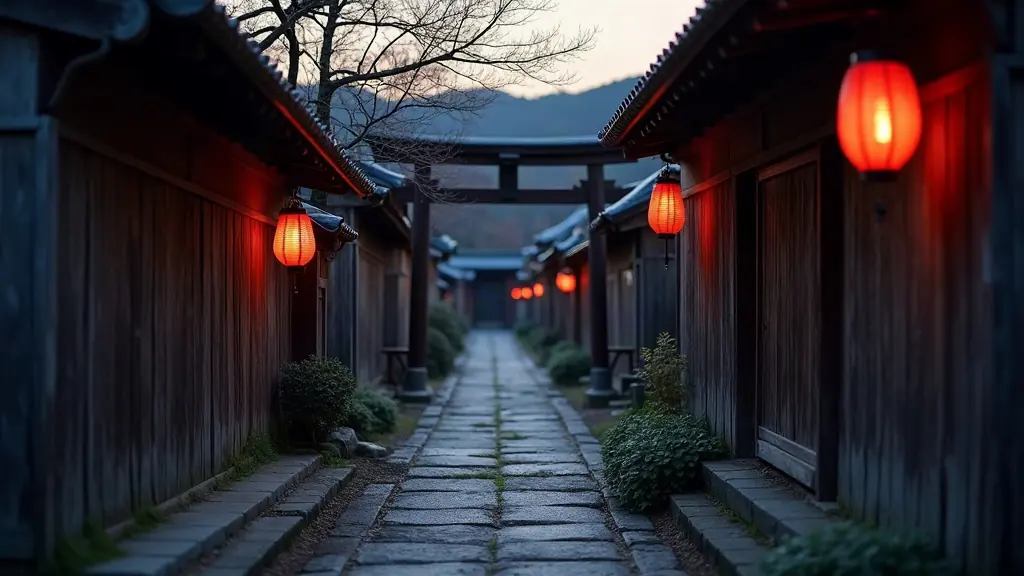
During the Edo period (1603 to 1868), ghost stories became popular entertainment. They were called kaidan (怪談), meaning strange tales, and were printed, painted and staged. Modern urban legends work the same way, with one change of setting: the haunted bridge becomes a pedestrian underpass, the lonely mountain pass becomes the last train. The structure is identical—an ordinary place, a figure who asks something, and a rule you did not know you were breaking.
The Hannya and Noh masks behind Japan's vengeful women
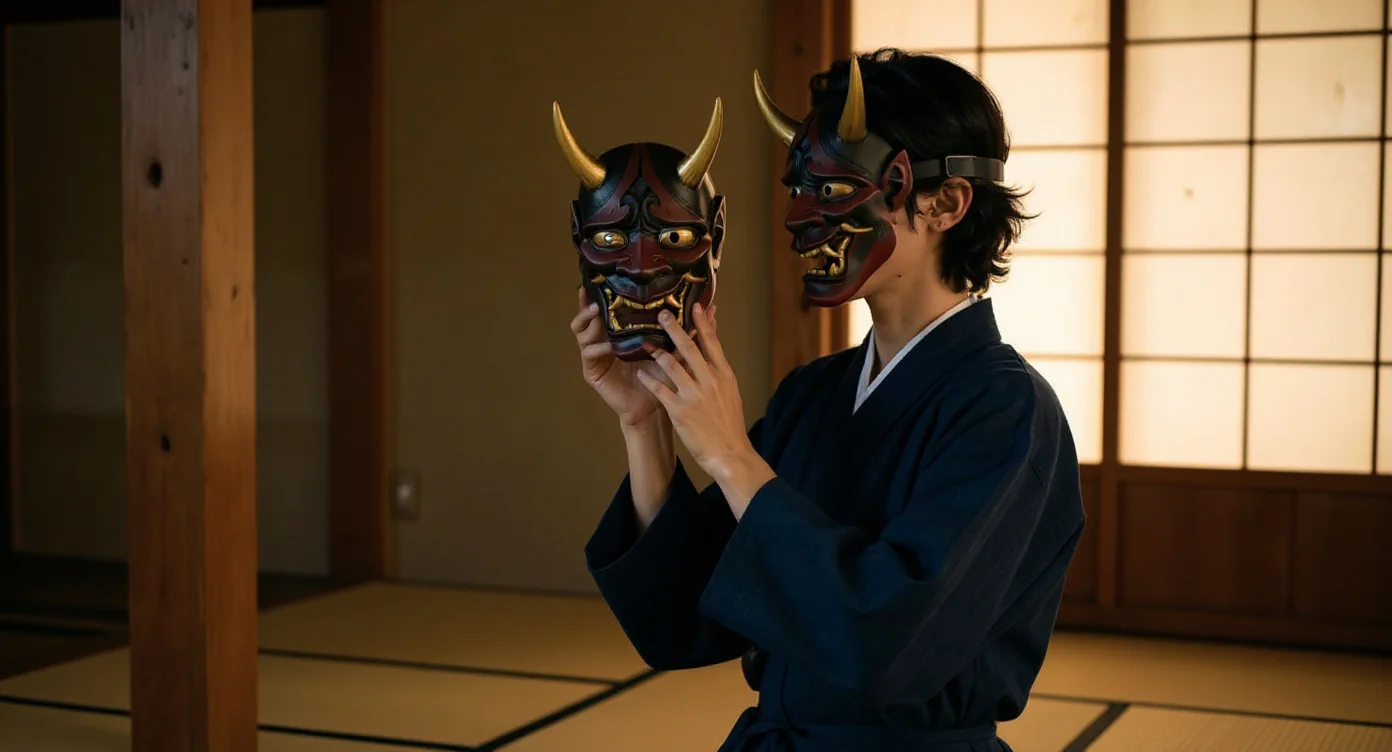
Noh theatre, formalised in the fourteenth century, uses carved masks called nōmen. The actor's own face stays still, and the mask carries the emotion. The most famous of them is the Hannya (般若): a woman whose jealousy has hardened into something demonic, with horns, metal-bright eyes and a mouth pulled wide open.
Noh stages that transformation as a sequence. A woman's face becomes a half-demon, then a full serpent. The Hannya is the middle stage, the moment grief turns into grudge. That is exactly the shape of Kuchisake-onna, who hides a ruined mouth behind a mask and then shows it. If you want to see the ancestor of the slit-mouthed woman, I would start with a handcrafted Hannya mask, because the horns and the twisted mouth explain in one look what three paragraphs cannot.

Yurei vs yokai: who actually haunts these legends
Yokai (妖怪) are the strange beings of the natural and material world: shape-shifting foxes, river creatures, umbrellas that grow an eye after a hundred years. Yurei are human dead who did not leave, usually because something was unfinished. Onryo are the angriest subcategory of yurei, spirits driven by a specific grudge against the living.
All four great urban legends are yurei, and three of them behave like onryo. That distinction changes how the stories feel: a yokai belongs to the forest, while a yurei follows you into the building.
Four creepy Japanese urban legends every school repeats
Four stories dominate. Each one spread between children through schools and summer camps, each slightly different each time, but all built from the same centre: an ordinary place, a question, and a way out.
Kuchisake-onna and Teke Teke: legends of the walk home
Kuchisake-onna (口裂け女), the slit-mouthed woman, became a national rumour in 1979. She appears as a woman in a long coat and surgical mask, and she asks a single question: "Am I pretty?" If you say yes, she removes the mask to show a mouth cut open from ear to ear. If you say no, that ends badly too. The panic was real enough that schools in several areas organised group walks home.
The escape children taught each other was to refuse the game. Answer that she looks average or "so-so", and her logic stalls long enough for you to leave. Another variant says the word "pomade" drives her off, because the smell is linked to the doctor who disfigured her. Both answers break the yes-or-no trap.
Teke Teke is the other legend of the road home. She is a young woman cut in half, usually by a train, who moves on her elbows with a dry scraping sound. The name is that sound. She is faster than any person expects, and she is said to cut her victims in half at the waist. She has no documented origin, which is unusual among these stories.
Hanako-san and Aka Manto: legends of the school toilet
Hanako-san (花子さん) lives in the third stall of the girls' toilet, often on the third floor. You knock three times, call her name and ask her to come out. She is a girl in a red skirt with bobbed hair. Versions of the story circulate from the 1950s onward, with widespread spread in the late 1980s and early 1990s.
Aka Manto (赤マント), the red cloak, is crueller because it offers a trap with no escape. A voice in the stall asks whether you want red paper or blue paper. Red means death; blue means being drained of blood. The way out is to name a third colour or refuse to answer.
The four legends compared: place, question, way out
| Legend | Place | Question asked | Way out | Spread |
|---|---|---|---|---|
| Kuchisake-onna | Street, walk home | "Am I pretty?" | Answer "average", or say "pomade" | 1979 panic |
| Teke Teke | Station, level crossing, night road | None, she simply pursues | Outrun her, which the story says you cannot | Late 20th century |
| Hanako-san | Third stall, school toilet | You call her, she answers | Do not knock, do not ask | 1950s, boom in the 1980s |
| Aka Manto | Public or school toilet | "Red paper or blue paper?" | Name a third colour, or refuse | Pre-war rumour, postwar school version |
Why Japan tells its urban legends in summer, not October
These stories belong to August, not October. The season comes from religious calendar and practical truth: summer is when the dead return, and a shiver is a way to cool down.
Obon and the season when Japanese ghost stories return
Obon, usually observed around mid-August, is when ancestors are welcomed home. Families clean graves, light lanterns and set out offerings, treating the boundary between living and dead as thin for a few days. This is the natural moment for kaidan; Kabuki theatres have staged ghost plays in summer for two centuries, including the 1825 classic Yotsuya Kaidan, still one of the most performed ghost stories in Japan.
Kimodameshi: the test of courage behind these legends
A kimodameshi (肝試し) is a test of courage. Groups walk at night through a tunnel, a cemetery, a closed school or a forest path, often in pairs with one torch. Schools, clubs and summer camps run them. This is how urban legends get verified socially: somebody goes to the third-floor toilet, and somebody else swears they heard an answer.
A hundred candles: the kaidan game that fed the legends
The hyakumonogatari kaidankai (百物語怪談会), the gathering of a hundred tales, was popular from the Edo period. A hundred candles are lit; each person tells one frightening story and extinguishes one light. The room darkens story by story. To run this at home, keep lights low and at floor level, order stories from shortest to quietest, and stop at ninety-nine before relighting the room.
The real fears behind Japan's modern urban legends
Each legend carries the anxiety of its decade. The stories children whispered in the 1970s and 80s show what that society feared: scrutiny of women's faces, isolation of school toilets, the unavoidable railway platform.

Japanese urban legends about women, beauty and the mask
Kuchisake-onna arrives with a question about her appearance, and her injury is often explained as cosmetic surgery gone wrong. She appeared in the late 1970s, as beauty clinics and the public scrutiny of women's faces were expanding. Her power is that she forces you to judge her out loud, then punishes the judgement either way.
The surgical mask is the other half of the horror. In Japan it is a completely ordinary object, worn for colds, pollen and courtesy. A mask makes a face unreadable while leaving the eyes fully present. The legend takes a polite, invisible everyday item and turns it into a lid.
School toilets and trains: the geography of these legends
Hanako-san haunts a school toilet, which for a child is the only place in the building with a closed door and no supervision. Aka Manto uses the same room in its public version, where you are alone, seated and cannot leave quickly. Teke Teke belongs to the railway, in a country where millions of people stand close to the edge of a platform every morning.
None of these places can be avoided. That is the design. A haunted mansion is optional; the toilet at school, at nine in the morning, is not.
Rumour, cram schools and the postwar spread of the legends
The 1970s and 80s gave these stories a perfect transmission network. Children moved daily between school, cram school and the walk home in dense suburbs; magazines and television reported rumours as trends. The legends travelled these routes, and that is why the settings are always institutional rather than domestic.
Japanese urban legends in cosplay: masks and Halloween looks
These figures work as costumes because each one is built from recognisable objects rather than a full character kit. The effect comes from choosing the right mask and silhouette.
Hannya, Oni and Noh masks for urban legend cosplay
There are two different families of Japanese mask, and mixing them up is the most common mistake I see. Theatre masks, Noh and Hannya, show a human emotion at its extreme. Folk masks, Oni and Tengu, show a being that was never human.
| Mask | Origin | What it reads as | Best for |
|---|---|---|---|
| Hannya (般若) | Noh theatre | Jealousy turned demonic | Onryo and vengeful-woman looks |
| Noh woman mask | Noh theatre | Calm, almost blank human face | The too-still ghost |
| Oni (鬼) | Folk belief, Setsubun | Demon, raw force | Group costumes, loud entrances |
| Kitsune (狐) | Fox imagery of Shinto shrines | Trickster, shrine festival | Lighter, festival-style looks |
Dressing as Kuchisake-onna or Hanako-san without a costume kit
For Kuchisake-onna, the effect comes from three things: a long coat, long dark hair and a plain mask. Keep colours flat and anything theatrical minimal.
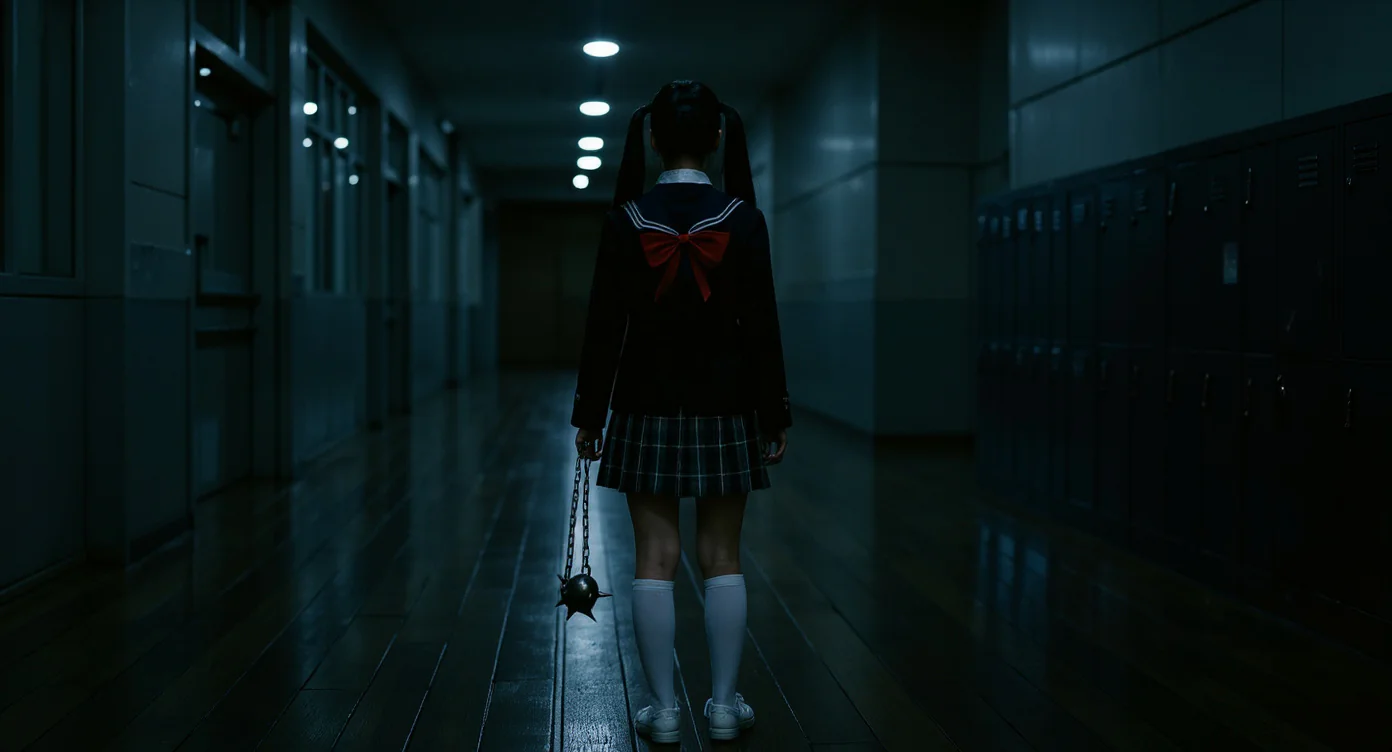
Hanako-san is a schoolgirl ghost, so start with a Japanese high school uniform and add a carved mask instead of heavy make-up. The contrast between a neat uniform and a fixed face does the work. Japanese cuts are slim, so size up if you layer underneath.

Mask fit, breathing and wearing it at a convention
A few practical points:
- Fit: check strap length and ensure the mask sits above your chin.
- Breathing: plan drinks and short breaks.
- Vision: turn your head rather than your eyes.
- Care: wipe the inside after wearing and store it flat or hung.
Creepy Japanese urban legends: your questions answered
The same questions return each summer: which legend is scariest, which one is real, why these stories grip Japan the way they do. Here are the answers.
What is the scariest Japanese urban legend?
Kuchisake-onna is the usual answer, and the 1979 panic supports it. Her question has no safe reply, which is what unsettles people. Aka Manto runs a close second for the same reason.
Is Teke Teke real or fake?
Folklore. No incident has ever been documented behind her, and the story has no verifiable origin, date or location. What is real is the anxiety she borrows from, railway accidents and crowded platforms.
Which yokai are the most feared in Japan?
Among true yokai, Oni and Tengu carry the strongest reputation, and the shape-shifting fox and tanuki are the most widely told. The figures in these urban legends are not yokai at all, they are yurei, which is why they behave so differently.
Why does Japan have so many scary urban legends?
Three reasons combine. A long literary tradition of kaidan gave storytellers a shared cast, Obon keeps a season dedicated to the returning dead, and dense postwar schooling gave rumours a fast network of children to travel through.
Why do Japanese people say "oi oi oi" in scary stories?
This is mostly an internet habit rather than a folklore tradition. "Oi" (おい) simply means "hey", a blunt way to call someone, and in a ghost story it is the voice behind you, the one you are not supposed to answer. The repeated version comes from horror clips and memes, not from classical kaidan.
If one of these faces stayed with you, the carved masks are where the legends become objects you can hold. Take a look at our Japanese mask collection and see which expression you recognise.
Explore the Japanese Mask collection
Hannya, Noh, Oni and Tengu masks made by Japanese artisans, with fit and wearing notes for conventions, Halloween nights and wall display.
Browse the collection →