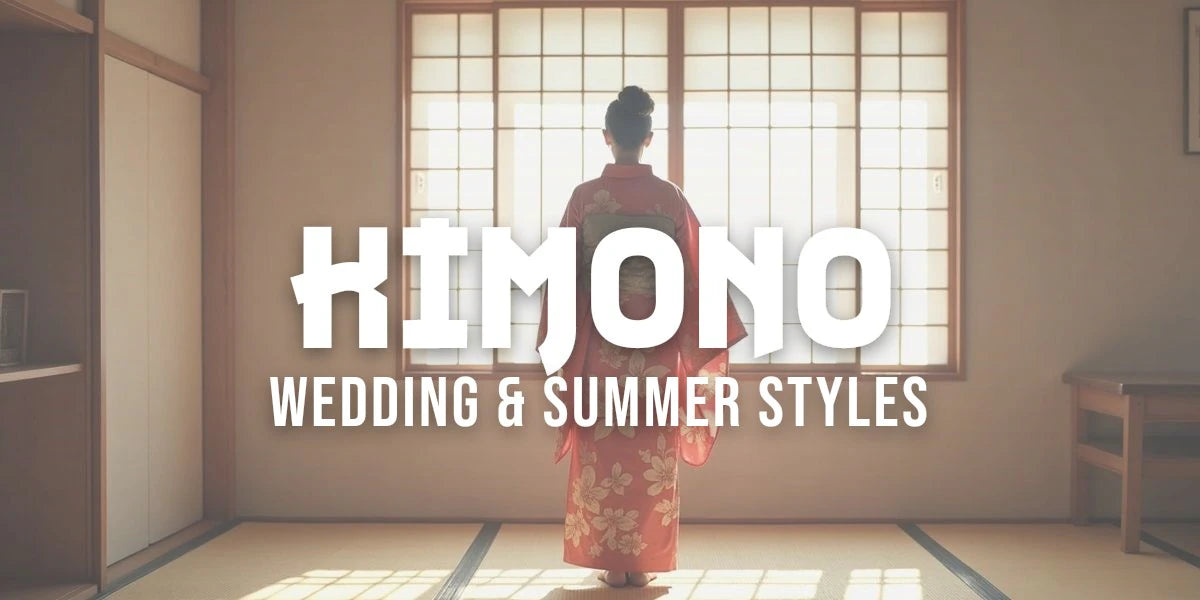
At a garden reception two summers ago, I watched a guest arrive in a floor-length indigo kimono dress with a tiny repeated sakura print, and she looked more considered than half the room in cocktail dresses. The question I get most often before an event is whether a japanese kimono dress for wedding season is acceptable at all. Yes, you can wear one as a guest. The rule is simply to stay below the bride: no white or ivory, no head-to-toe gold embroidery, and nothing with the sweeping sleeves of a bridal furisode. For a ceremony, a long silhouette in a smooth, matte-sheen fabric with a small repeated motif reads formal. For a summer reception or garden party, a short modern kimono dress in cotton or a light crepe keeps you cool and still photographs beautifully. Everything else, sleeve length, obi belt, geta sandals, sizing, follows from those two choices.
Key points
- Avoid white, ivory and heavy gold brocade: those belong to the bride's shiromuku or uchikake.
- Long silhouette and small repeated motifs for the ceremony; short modern cut for receptions and summer parties.
- Cotton and light crepe beat lined satin above 28 °C, and a thin nagajuban layer stops sweat marks on photos.
- Size a kimono dress by bust and height first, then check hem length for a seated reception.
Can you wear a kimono dress to a wedding as a guest?
You can, and in Japan guests do wear wafuku to weddings all the time. What changes is the register. A guest never wears the bride's garments, and never competes with her palette. Once you know which pieces are reserved for the bride, the rest of the decision becomes easy.
What a Japanese wedding kimono is, and why guests never wear it
A traditional Japanese bride wears a shiromuku (白無垢), an all-white silk ensemble worn for the Shinto ceremony. Over it, or for the reception, she may wear an uchikake (打掛), a heavily embroidered outer robe that is never belted and trails on the floor. Underneath sits the kakeshita (掛下), the long trailing kimono the uchikake covers. These three pieces are bridal costume in the same way a white gown and veil are bridal in the West.
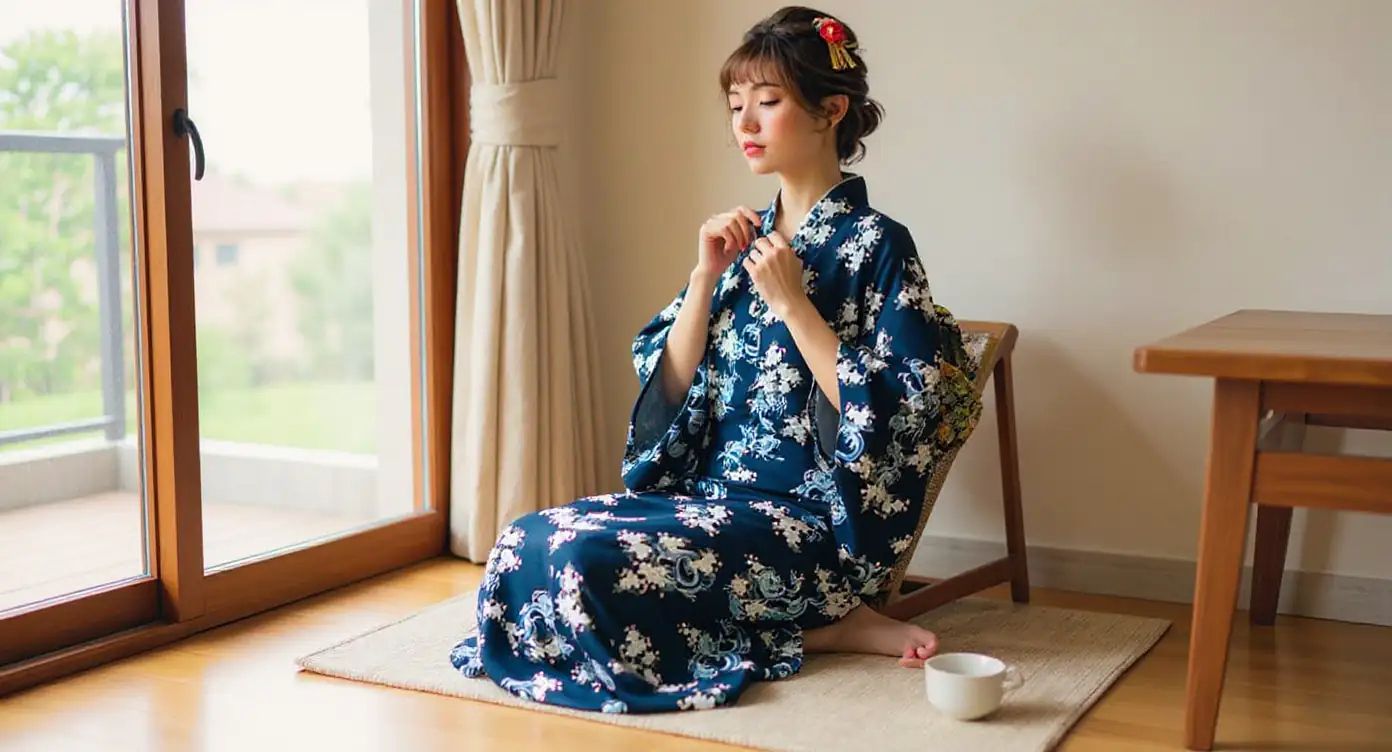
Unmarried young women attending as guests traditionally wear a furisode (振袖), a kimono with very long hanging sleeves. Married women wear a tomesode, with short sleeves and motifs placed below the waist. A modern kimono dress sits outside this system. It borrows the crossed front, the wide sleeve and the drape, and turns them into a dress you can wear with a belt and shoes. That is exactly why it works for a foreign guest: you are not claiming a ceremonial rank you do not hold.
Sleeve length on a kimono dress and the formality it signals
Sleeve length is the fastest formality signal in the whole garment. The longer and deeper the sleeve, the more ceremonial the piece reads. Furisode sleeves hang almost to the ankle and belong to young unmarried women at formal events, or to brides in a hikifurisode. On a kimono dress, you want something between: a wide sleeve that falls to the wrist or mid-forearm.
- Short or capped sleeve: casual, good for summer parties, reads closer to a day dress.
- Wrist-length wide sleeve: the safest guest option, dressy without being bridal.
- Deep hanging sleeve past the hip: striking, but photographs as costume at a civil wedding and catches on chair arms at dinner.
Colors and motifs to avoid when the bride wears a kimono
White and ivory are out, including off-white and cream that photograph white under flash. Skip solid red if the bride wears an iro-uchikake, since deep red is her second color. Avoid all-over metallic gold or silver brocade, and avoid large placed cranes or phoenixes spreading across the chest and skirt, because scale and placement are what mark bridal garments.
On cultural respect, my honest position is simple. A kimono-inspired dress worn properly, in your size, with the left side crossed over the right, a tidy belt and real shoes, reads as appreciation. The same piece worn open like a bathrobe over shorts, or with the right side crossed over the left as the dead are dressed, reads as a costume. The difference is care, not nationality.
How to pick a Japanese kimono dress for a wedding ceremony
A ceremony asks for length, restraint and a fabric that behaves under indoor light. This is where most guests overshoot, choosing the brightest piece in the shop and then feeling conspicuous in the photos. Three criteria decide it: silhouette, pattern scale, and sheen.
Long kimono dress silhouettes that read formal on photos
Mid-calf to ankle is the formal range. A hem that stops at the ankle bone keeps the vertical line of a kimono robe silhouette intact, which is what makes the garment look intentional rather than improvised. Look for a straight or very slightly A-line cut, a crossed front that stays closed when you raise your arm, and a belt or sash at the natural waist.
When a client wants the dressiest piece we carry, I point her to the long long geisha-style kimono I keep for formal evenings, because its full length and dense repeated pattern show exactly the level of formality a ceremony asks for. It is the piece I would choose for an evening reception in a hotel, not for a beach ceremony.
- Cut: full length, straight silhouette, crossed front
- Sleeve: wide, long, falls over the wrist
- Pattern: dense and repeated rather than one large placed panel
- Best for: indoor ceremonies, evening receptions, formal dinners
- Styled with: a contrasting obi belt and flat zōri or closed heels
Pattern scale and placement: small repeats vs large panels
Formality in Japanese dress is carried by placement as much as by motif. A small motif repeated evenly across the cloth, a komon-style print, is versatile and quiet. A single large design placed at the hem and sleeve, as on a tomesode, is the most formal arrangement, and also the one most likely to look bridal on a guest. If you are unsure, choose the small repeat.
Fabric sheen: what looks dressy under indoor lighting
High-gloss satin blows out under a flash and turns into a white patch in the photos. A matte or softly satin fabric holds its color and shows the drape. Safe guest colors that photograph well indoors: indigo, plum, deep green, burgundy, charcoal, and dusty rose. For a civil wedding at the town hall followed by lunch, a full-length dense-pattern piece is often too dressy. Drop to mid-calf, keep the small motif, and lose the metallic thread.
Short modern kimono dress for receptions and summer parties
The short cut is the one people actually wear more than once. It suits receptions, cocktails, garden parties and summer events with a looser dress code, and it travels in a carry-on without drama. The thing to test before you buy is not how it looks standing in front of a mirror, but how it behaves when you sit down.

Hem length that stays decent through a seated dinner
A wrap-style hem rides up roughly 5 to 8 cm when you sit, and a kimono dress opens along the front overlap rather than along a side seam. That is the classic trap. Above-the-knee hems that look fine standing can gap across the thigh at a long dinner. My rule: for a seated event, choose a hem that reaches the knee or just below, and check that the overlap is secured at the waist, not only held by the belt.
Pairing a short kimono dress with heels, flats or sandals
Ground surface decides the shoe, not the dress. Grass swallows a stiletto, gravel ruins a thin sole, and a stone courtyard makes wooden soles noisy. For a summer reception I wear the short kimono-style dress I pack for warm receptions with flat leather sandals, and I carry closed heels for the evening when the party moves indoors.

- Cut: short, crossed front, wide short sleeve
- Material: light woven fabric, unlined
- Hem: knee area, best with a secured overlap
- Best for: receptions, cocktails, summer parties, convention evenings
- Styled with: a narrow obi belt, flat sandals on grass, block heels indoors
When a kimono jacket over a plain dress works better
If a full kimono dress feels like too much for a conservative family wedding, invert the formula. Wear a plain midi dress in a solid color and add a kimono jacket or a haori (羽織), the open short coat worn over a kimono. You get the sleeve line and the pattern, you keep a familiar silhouette, and you can take the layer off when the room heats up. This is also the easiest version for a guest who has never worn wafuku before.
Flower yukata vs silk-look kimono dress in summer heat
Above 28 °C, fabric choice stops being an aesthetic question. A lined satin dress traps heat at the back and under the arms, while cotton moves air and dries. The trade-off is formality: the more breathable the cloth, the more casual it reads. Here is the honest comparison.
Cotton yukata for outdoor ceremonies above 28 °C
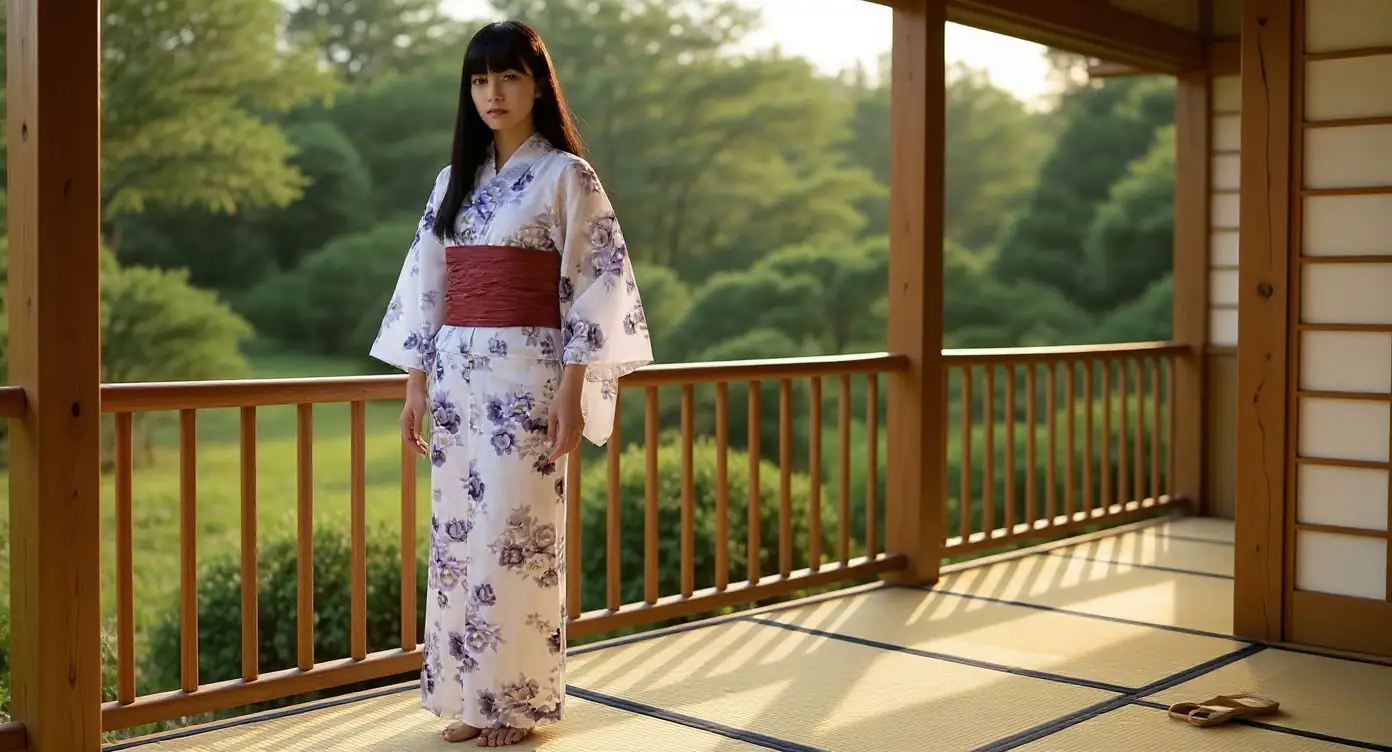
The yukata (浴衣) is an unlined cotton garment worn in summer, historically after the bath, which is where its name comes from. It is the most comfortable thing you can wear in August. It is also, in Japanese terms, informal: a yukata belongs to a matsuri, a fireworks evening, a ryokan, a very relaxed outdoor wedding or a summer garden party. It is not right for an indoor ceremony or a formal dinner.
For a hot outdoor afternoon, the cotton floral yukata I reach for in real heat is what I would take over any lined piece, with the one caveat that a pale floral ground needs checking against the bride's palette before you commit.

- Material: cotton
- Lining: none
- Sleeve: wide, open under the arm
- Best for: matsuri, summer parties, casual outdoor events
- Care: iron on reverse, hang immediately after wearing
Lined satin pieces: where the heat really builds up
Heat collects in three places: the upper back where the lining sits flat against skin, the overlap at the chest where two layers cross, and the waist under the belt where three or four layers stack. A lined satin dress plus a wide stiff obi puts the thickest construction exactly where you sweat most. If the event is outdoors and hot, keep the formal fabric and swap to a narrower belt, or keep the wide belt and move to crepe.
Breathability, wrinkles and travel: the honest trade-off
Cotton breathes and creases. Crepe resists creasing because its crinkled surface breaks up the fold, which makes it the best choice if the dress spends six hours in a suitcase. Satin holds a press but shows every seatbelt mark. A matte surface also hides perspiration far better than a glossy one, because gloss turns damp fabric into a visible dark patch. That single fact has saved more of my summer photos than any styling trick.
Obi belt, nagajuban and geta to finish a kimono dress
A kimono dress on its own can look flat, because the cut is essentially two straight panels. The accessories are what give it waist, movement and credibility. Three items do almost all the work: the belt, the underlayer and the shoes.
Tying an obi belt over a kimono dress without help
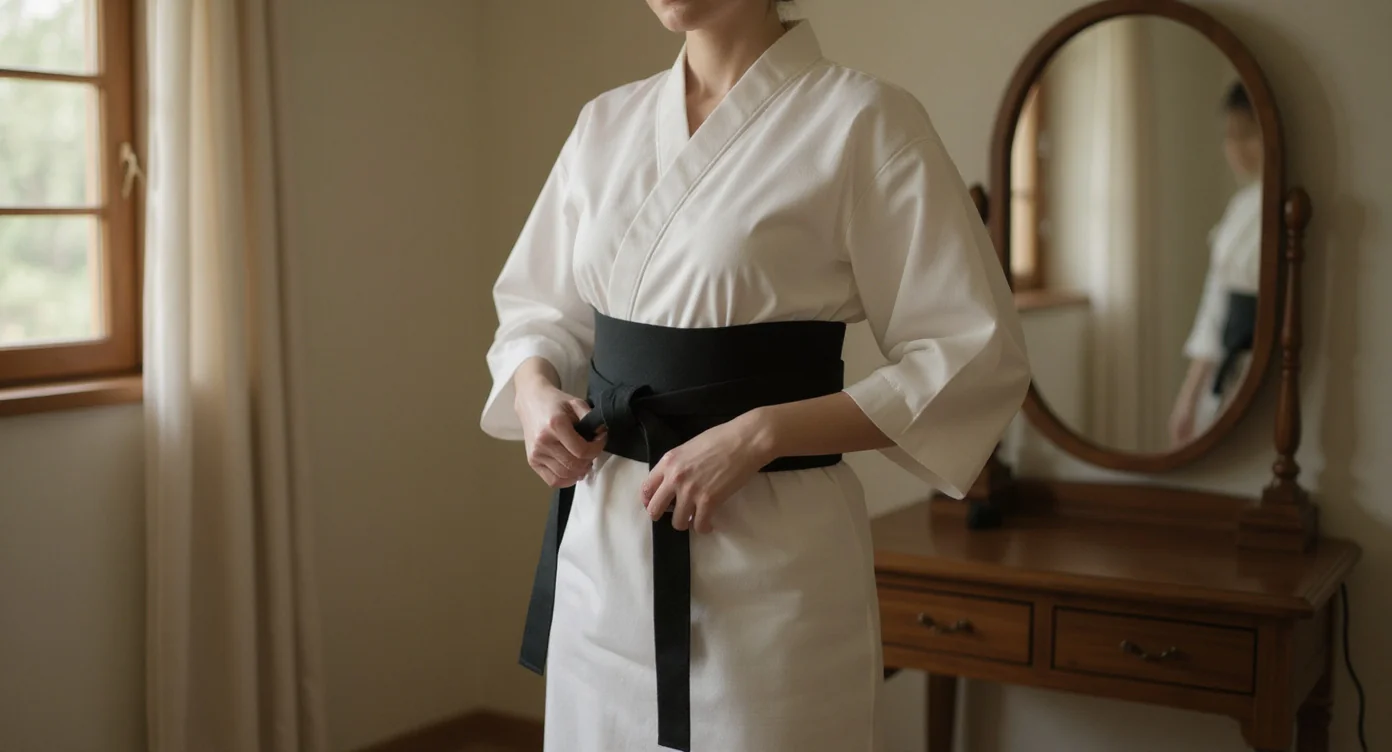
The obi belt (帯) is the sash worn at the waist. On a modern dress you do not need a full nagoya-obi construction with pillows and cords. A simple wide sash wrapped twice and tied in a flat bow at the back, or slightly off-centre at the hip, holds all evening and survives sitting down. Keep the knot flat rather than bulky if you will lean against a chair back for two hours.
A black sash is the piece I recommend most often because it defines the waist on a straight-cut dress and goes with every pattern, which is why I keep a plain black obi belt as my default rather than a matching one.

- Placement: natural waist, slightly higher than a Western belt
- Wrap: two turns for a dress, flat knot at the back
- Width: narrow for short cuts, wider for long formal silhouettes
- Color: black, charcoal or a tone picked from the dress pattern
Why a thin nagajuban layer changes the drape
A nagajuban underlayer (長襦袢) is the thin robe worn under a kimono. It does two things on a dress: it stops the outer fabric from clinging to damp skin, and it gives the panels a smooth surface to fall over, so the drape hangs clean instead of catching. For a summer wedding I would not go without a light nagajuban under a kimono dress, both for the drape and because it absorbs perspiration before it ever reaches the outer layer and the photographs.

Geta sandals and tabi socks for a summer wedding
Geta sandals (下駄) are wooden-soled sandals raised on supports, traditionally worn with a yukata and worn barefoot. They are lovely and they are loud: on a wood floor or a stone hall they announce every step, and the raised sole is genuinely unstable on lawn. My advice for a wedding is to wear geta only for an outdoor, casual summer event on a firm surface, and to bring a flat alternative for the ceremony itself.
If you want tabi socks, the split-toe socks worn with traditional footwear, pair them with flat zōri rather than geta, since geta are conventionally worn with bare feet. Tabi plus zōri is also the more comfortable choice for a three-hour ceremony and makes more sense with a long formal dress than wooden soles do.
Sizing a kimono dress by bust and height, plus a checklist
Japanese sizing runs roughly one size smaller than US and EU equivalents, so your usual letter size is not a reliable guide. A crossed-front garment also fits differently from a fitted dress: the waist is forgiving, the chest and shoulders are not. Measure before you order, and always compare against the measurement chart on the specific product rather than the letter alone.
Bust and shoulder: the two measurements that decide the fit
In a wrap cut, the overlap has to reach across your chest and stay there. If the bust measurement is tight, the front gaps and the collar pulls open. The shoulder seam matters second: a kimono-style sleeve is cut wide and straight, so a seam sitting too far in restricts the arm when you raise a glass. Waist is the least critical measurement, because the belt resolves it.
Treat these as indicative. If you fall between two sizes, size up for a long formal piece, where drape matters, and stay true to size on a short cut, where extra fabric makes the overlap gap.
Height, hem and sleeve: adjusting a kimono dress silhouette
Height moves two things. A dress described as mid-calf sits at the ankle on a shorter wearer and above the calf on a taller one, so check the stated garment length against your own floor-to-ankle measurement. Sleeve fall changes too: on a taller frame, a wide sleeve lands higher on the forearm and looks less dramatic. If a long piece is too long, a tailor can shorten the hem of a straight-cut dress easily. Shortening a patterned sleeve is harder and rarely worth it.
The full kimono dress outfit checklist before you leave
- The dress, pressed, with the left side crossing over the right
- Obi belt or sash, tied flat and tested while seated
- Thin underlayer, collar showing about one centimetre
- Shoes matched to the ground: flats or zōri for grass, closed heels indoors
- Tabi socks if you are wearing zōri, bare feet with geta
- A folding fan for an outdoor ceremony in summer
- A small clutch, since there are no pockets
- Two flat safety pins for the overlap
- A light haori or jacket for an evening that cools down
Work through the list in order and you will know exactly what is missing before you order, rather than the night before the wedding.
FAQ
The questions I answer most before someone orders a piece for a wedding fall into six categories: terminology, etiquette, cost, cultural respect, and practicalities that matter on the day. Here are the answers I give when a client chooses their first dress in wafuku.
What is a Japanese wedding kimono called?
The white ensemble worn for the Shinto ceremony is a shiromuku. The embroidered outer robe worn over it or at the reception is an uchikake, and the kimono underneath is a kakeshita. A colored version of the outer robe is called an iro-uchikake. All of these are bridal garments, so guests do not wear them.
Can you wear a kimono to a wedding as a guest?
Yes. In Japan it is normal for guests to attend in wafuku, and a kimono-inspired dress is a reasonable choice for a guest anywhere else. Keep away from white, ivory and heavy gold brocade, skip bridal-length hanging sleeves, and check the couple's dress code first if the wedding is traditional.
How much does a real Japanese kimono cost?
The range is very wide. Secondhand cotton yukata and simple vintage kimono are inexpensive, while a new hand-dyed formal silk kimono made by a Japanese artisan can run into the thousands, and a bridal uchikake higher still, which is why many families rent instead of buying. A modern kimono dress is a different category of garment and sits far below handmade silk.
Is it okay for a non-Japanese person to wear a kimono dress?
Generally yes, when it is worn with care. Wear it in your size, cross the left side over the right, belt it properly and treat it as clothing rather than a costume. Avoid pieces reserved for specific ceremonial roles, and avoid combining the garment with stereotyped props or makeup.
What shoes go with a kimono dress at a summer wedding?
Match the shoe to the ground. Flat zōri or leather sandals for lawn and gravel, block or closed heels for an indoor reception, and geta only for a casual outdoor event on a firm surface. Wear tabi socks with zōri, and keep geta for bare feet.
If you are choosing a piece for a ceremony this season, the long matte-sheen silhouettes and the shorter summer cuts sit side by side in our Japanese kimono dress collection. Take your bust and height measurements with you, and start from the occasion rather than the pattern.