My first online kimono arrived folded in rice paper, the indigo exactly as I hoped, and completely unwearable: the sleeve ended two fingers above my wrist bone. Nothing was wrong with the garment. I had ordered a letter size instead of measuring. So, before ordering a kimono online you need four numbers: your height (which sets the garment length, or mitake, 身丈), your wingspan from the middle of your back to your wrist bone (yuki, 裄), your bust and your hips. Take them with a soft tape measure over light clothing, then compare them to the garment's flat measurements rather than to a letter size. Japanese sizing runs roughly one size smaller than US/EU, so an M in Tokyo often fits like a US S. That is really all there is to how to measure yourself for a kimono order.
In short
- Height decides kimono length: a traditional women's kimono (着物) should be close to your height, never much shorter.
- Yuki, measured from the center of your back to your wrist bone, matters more than a letter size, because it is what makes the sleeves sit right.
- Japanese kimono sizes run about one size smaller than US/EU, so size up when you are between two.
- Measure your hips and add the wrap allowance: the panel width must overlap comfortably at the front.
What measurements do you need before ordering a kimono?
A kimono is cut from straight panels of fabric. No darts, no waist shaping, no curved armhole. The garment adapts to the body by wrapping, folding and tying, not by tailoring. That is why the numbers that matter differ from the ones you use to buy a shirt.

Height: the number that sets kimono length
A woman's kimono is designed to be close to your total height. The extra fabric is folded at the waist and hidden under the belt. A man's kimono is cut to the ankle with no fold, so height is even less forgiving. Measure barefoot, back to a wall, and note the figure in centimeters as well as inches. Japanese charts are written in centimeters.
Yuki: from center back to wrist bone
Yuki is the distance from the prominent vertebra at the base of your neck to your wrist bone. It covers shoulder width and sleeve width in one measurement, because a kimono sleeve is attached along a straight vertical seam. Sode-take, the depth of the sleeve pouch, is a separate figure and depends on the style of the garment, not on your body. If yuki is too short, the sleeve rides up every time you raise your arm and nothing can be done about it.
Bust and hips: the wrap allowance nobody mentions
Your exact waist and your leg length are irrelevant here. Your hip measurement is not. The front panels cross over each other at the hip, and you need roughly 15 to 20 cm of overlap so the garment stays closed when you walk. A bust measurement helps too, mostly for modern kimono dresses cut with a fitted upper body. On a product page, read the flat measurements rather than the letter: the Japanese Kimono Style Dress is the piece I point to most often, because its length, yuki and bust are listed per size and you can check them against your own tape in two minutes.

How to measure yourself for a kimono order, step by step
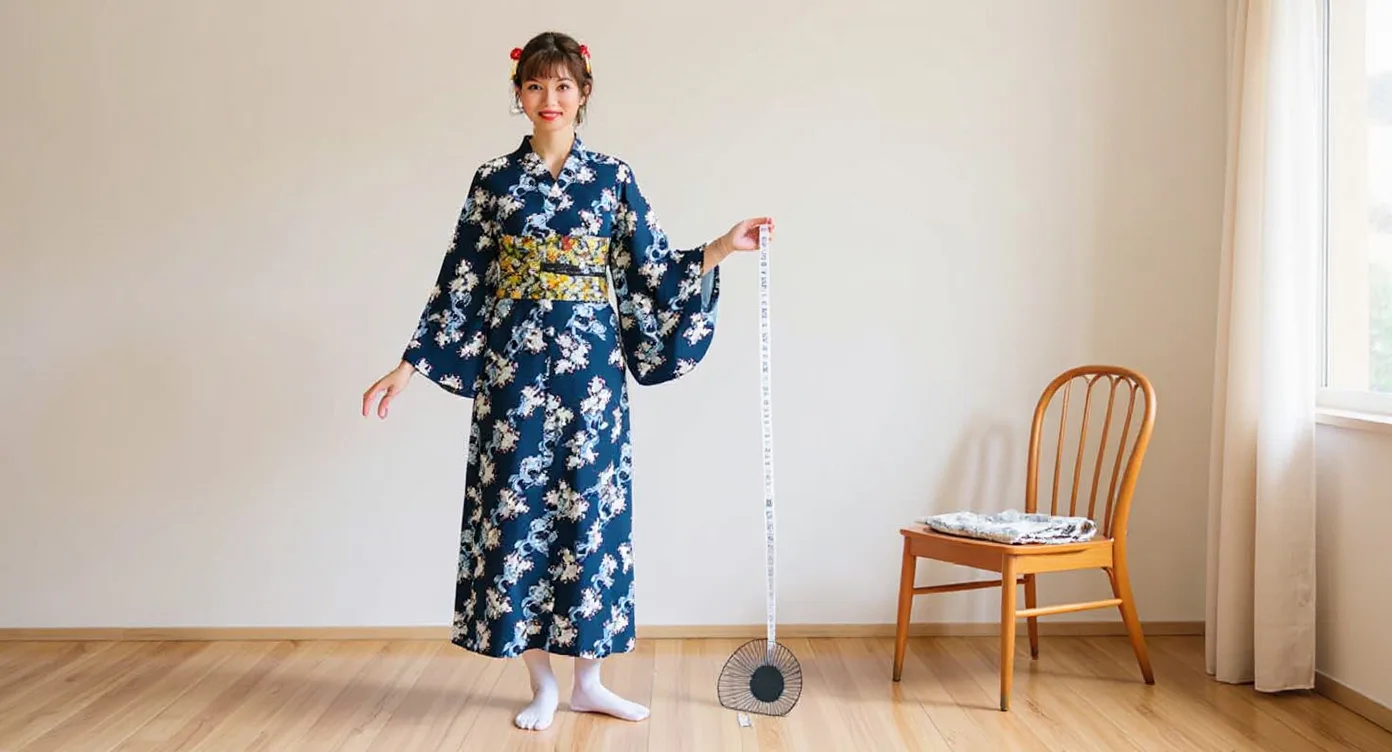
Use a soft tape measure, the kind used for sewing. A metal builder's tape will not follow the curve of your shoulder and will give you a yuki that is several centimeters short. Wear a thin t-shirt, stand naturally, and write each number down as you go.
Measuring kimono length from shoulder to heel
Stand straight, shoes off. Place the end of the tape on the top of your shoulder, next to the neck, and let it fall to the floor along your side. For a woman's kimono, expect that figure to be close to your full height. For a man's kimono, the target is the ankle bone. Common mistake: leaning to read the tape. Ask someone to read it for you, or work in front of a full length mirror.
Measuring yuki with your arm at 45 degrees
Tilt your head forward and find the bump at the base of your neck. That vertebra is your starting point. Hold the tape there, run it across the shoulder, then down to the wrist bone, arm held out and down at about 45 degrees. Do not pull the tape tight against the skin. Let it follow the shoulder curve. Typical adult yuki values sit between 64 and 72 cm.
Measuring hips over the layers you will actually wear
Take the hips at the widest point, usually around the top of the thighs, with the tape level all the way around. Measure over the layers you plan to wear underneath, including a slip. Add about 15 cm: that is the minimum width the garment needs at the hip for a clean overlap. Below that, the front opens with every step and no belt will save it.
Japanese kimono sizes vs US and EU: read the chart right
Japanese ready-to-wear is drafted for a Japanese average build, slimmer and shorter than European and North American averages. The practical result is simple: shift one size up when converting. The figures below are indicative values used across makers. Always check the flat measurements of the specific piece.
| Japanese size | Height | Yuki | US / EU |
|---|---|---|---|
| S | 150-158 cm (4'11"-5'2") | 63-65 cm | US XS / EU 34-36 |
| M | 155-165 cm (5'1"-5'5") | 66-67 cm | US S / EU 38 |
| L | 163-172 cm (5'4"-5'8") | 68-70 cm | US M / EU 40 |
| XL (LL) | 170-180 cm (5'7"-5'11") | 70-72 cm | US L / EU 42-44 |
Japanese S, M and L and the one-size-down rule
A Japanese label reads one size smaller than what you are used to. Your usual EU 40 is a Japanese L, not a Japanese M. Between two sizes, take the larger one. A kimono that is slightly too wide is adjusted with the obi belt (帯) and the depth of the wrap. A kimono that is too narrow at the hip cannot be fixed.
What Japanese XL really means in US and EU terms
Japanese XL is closer to a US L than to a US XL. For men, this matters most for length, since a men's kimono is worn at its exact cut length. For tall customers I usually send them to the men's Japanese kimono page and ask them to compare the listed length and yuki to the two numbers they just took, rather than trusting the letter.

Free size kimono: when one size does fit most
Some pieces are sold as free size. That works for haori (羽織), casual yukata and modern kimono robes, because these are open jackets or loosely belted layers. It works less well for a full length kimono, where 5 cm of yuki changes the whole silhouette. A free size piece is a good first purchase if you plan to wear it open over jeans and a white t-shirt.
Men's kimono vs women's kimono: what changes in the fit
The two garments look similar on the hanger and are sized on completely different logic. Understanding this one difference removes most sizing hesitation.
Kitake: why a men's kimono is cut to the ankle
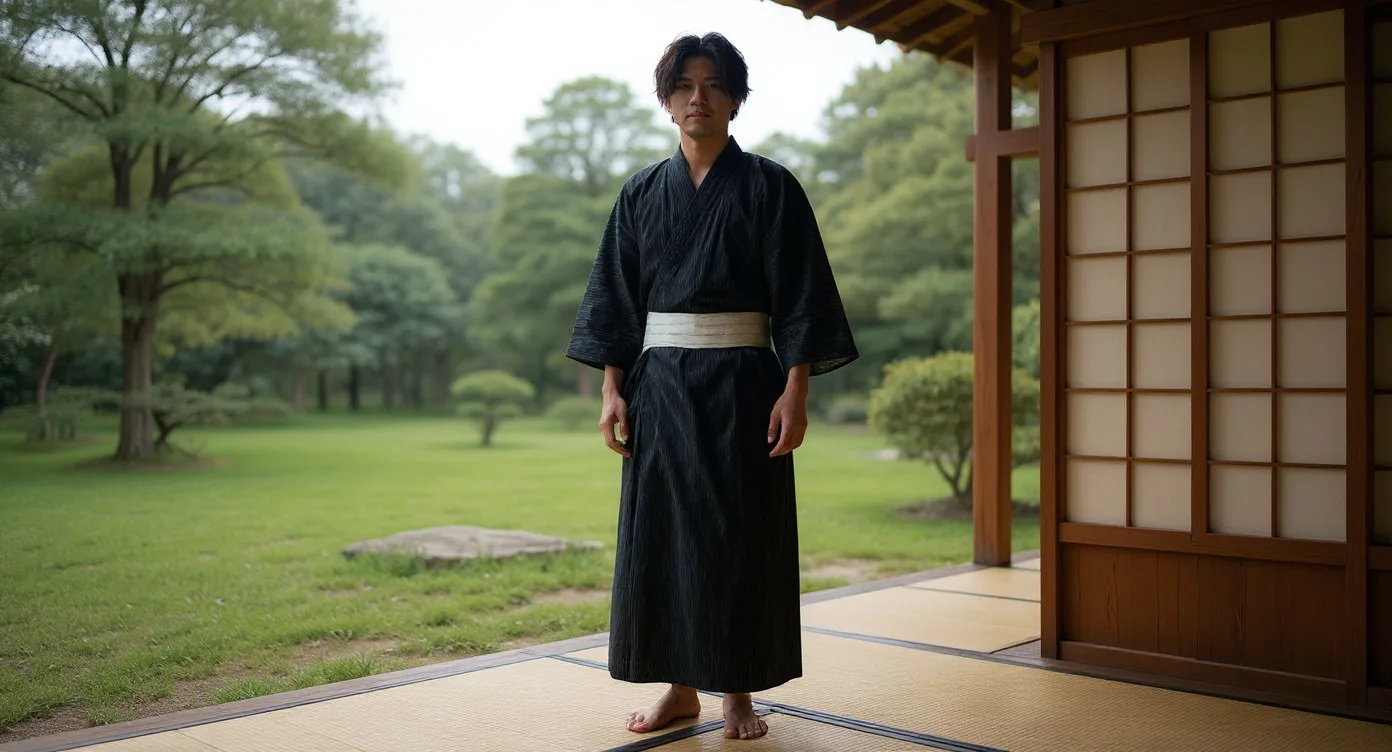
Kitake (着丈) is the worn length, from shoulder to hem. On a men's kimono, worn length and cut length are the same. The garment reaches the ankle bone and the belt sits low on the hips without creating a fold. Measure shoulder to ankle and match that figure.
Ohashori: the fold that makes women's length adjustable
A woman's kimono is cut longer than the body on purpose. The surplus is folded over at the waist and held by the belt, forming a neat horizontal tuck called the ohashori fold (おはしょり). This is why a women's chart lists heights in ranges: a few centimeters disappear into the fold. Too short, and there is nothing left to fold.
| Point | Women's kimono | Men's kimono |
|---|---|---|
| Target length | Close to your full height | Shoulder to ankle bone |
| Length adjustment | Ohashori fold at the waist | None, fixed length |
| Belt position | Waist | Low on the hips |
Choosing a kimono dress when you want a fixed length
Modern kimono dresses skip the fold. They are cut at a set length, often mid calf or ankle, with a fitted bust. If you want to wear the piece with sneakers and no belt training, this is the easier route. Check the bust and the total length, and ignore the height ranges used for traditional pieces.
Kimono too short or too tight? Fixes before you reorder
Not every fit problem needs a return. Some are solved by how you tie and wear the piece. Others are structural, and it is honest to say so.
Sleeves ending above the wrist: adjust or resize
Short yuki is the one thing you cannot cheat. Wearing the shoulder line slightly further back gains one or two centimeters and gives a softer neckline, but that is the limit. If the sleeve ends more than 3 cm above your wrist bone, size up.
Hem too high: wearing a short kimono as a robe or haori style
A kimono that stops mid calf was drafted for someone shorter. Rather than forcing it closed, wear it open, like a long jacket, over black jeans and a plain t-shirt. Tie the belt lower to lengthen the visual line. This is how most of our customers outside Japan wear their pieces day to day, and it looks intentional.
Layering a nagajuban without losing room
The underlayer should be slightly shorter and narrower than the outer kimono, so it never peeks out at the hem. Only the eri, the collar band, is meant to show, as a thin white line at the neck. If your outer piece already fits close at the hip, choose a light cotton underlayer rather than a padded one.
Kimono sizing questions we get before every order
These five come up almost daily in our inbox. Short answers, no detours.
Do I measure over underwear or over clothes?
Over light clothing, never over a sweater. A thick knit adds 3 to 5 cm to the bust and hips and will push you into the wrong size.
What if my height and my hips point to different sizes?
Follow the hips for the wrap and check that the length still works. Width errors are unfixable, length errors are often wearable.
Can a kimono be shortened?
Yes, by a tailor familiar with straight-cut garments, and only at the hem or through the waist tuck. Sleeve width is a different job entirely.
Does the obi change the size I need?
Not the size, only the fit. A wide obi consumes vertical space at the waist, so a woman's kimono needs enough length to fold under it.
Is a yukata sized like a kimono?
Almost. A yukata uses the same charts but is unlined, so it feels slightly roomier at the same measurement.
FAQ
Here are the questions that come back once the tape measure is put away. They cover size conversion, the logic behind kimono length, what to wear underneath, and the two rules of etiquette worth knowing before your first outing. Each answer is short and practical.
What size is a Japanese XL in US sizing?
A Japanese XL usually corresponds to a US L, around EU 42 to 44. The height range is typically 170 to 180 cm. Compare the listed yuki and hip width to your own numbers before deciding, because the letter alone is not reliable across makers.
Should a kimono be longer than my height?
For a traditional women's kimono, yes, slightly. The surplus is folded at the waist to form the ohashori. A men's kimono is the opposite: it is cut to end at the ankle and is never folded.
Do you wear a bra under a kimono?
Traditional dressing aims for a smooth, straight torso line, so a wireless or dedicated kimono bra is common, and some people add a thin towel at the waist to even out the silhouette. An underwired push-up bra creates curves that fight the straight cut of the garment. For a modern kimono dress worn casually, wear whatever you normally would.
Why is a kimono always worn left over right?
Left panel over right is the standard for everyone, men and women. The reverse, right over left, is reserved for dressing the deceased for burial. It is the single rule worth memorizing before your first outing.
Can I wear a kimono if I'm not Japanese?
Yes. Wearing a kimono with care and correct dressing is widely received as appreciation, not appropriation, and shops in Japan rent them to visitors every day. Respect the basics: left over right, a tidy collar, and an occasion that suits the formality of the piece.
Take your four numbers, keep them in your phone, and the rest becomes simple. You can browse our Japanese kimono dress collection with your tape measure next to you and pick with confidence.
Explore the Japanese Kimono Dress collection
Every kimono in the collection lists its flat length, sleeve span and width, so you can match them to the numbers you just wrote down.
Browse the collection →