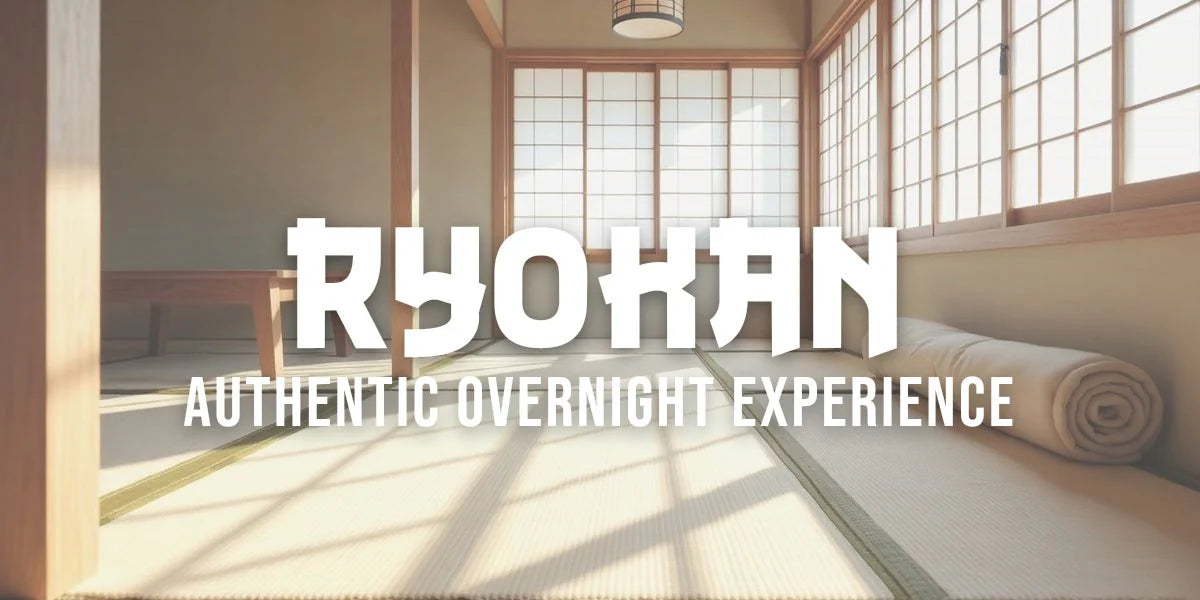
The sound I remember from my first night in a Kyoto inn was not a temple bell. It was the soft slap of a futon being unfolded in the next room while I was still finishing dinner. A ryokan (旅館) is a traditional Japanese inn where you sleep on a futon laid over tatami, bathe in a communal or private bath, and are served a multi-course kaiseki dinner. In Kyoto, the best ryokan in Kyoto for you depends on your budget and your reason for coming: a family-run inn near Kyoto Station from around 12,000 yen, a restored machiya townhouse in Gion for atmosphere, a garden-view room near Nanzenji for calm, or a century-old house like Tawaraya or Hiiragiya for the full ceremony. One night is usually enough to understand why people remember it for years.
Key points
- A ryokan is an inn, not a hotel: room, meals, bath and service come as one package, priced per person per night.
- Kyoto splits into three realistic tiers: simple family inns, mid-range ryokan with kaiseki dinner, and historic houses that need booking months ahead.
- Choose by what you actually want: a private open-air bath, machiya architecture in Gion, or a quiet garden view in the eastern hills.
- The etiquette is easy once explained: wash before entering the bath, left side of the yukata over the right, slippers off on tatami.
What is a ryokan and how it differs from a Kyoto hotel
A ryokan sells an evening, not a bed. You arrive in the late afternoon, change into the cotton robe left in your room, bathe, eat at a set hour, and sleep on bedding that was not in the room when you checked in. The building is usually wooden, often small, sometimes a few centuries old. Nothing about it is designed around a suitcase, a desk or a late night out.
That single difference explains most of the surprises first-timers report. A hotel room is a container you use when convenient. A ryokan room is a space that is prepared, served and reset around a schedule. Understanding the schedule is what turns the stay from confusing into memorable.
Ryokan, minshuku or machiya inn: the real differences
Three kinds of lodging in Kyoto get called "traditional", and they are not the same product. A ryokan has staff, set meal times and a bath that is part of the experience. A minshuku is closer to a family guesthouse: tatami rooms, home cooking, shared bathroom, far less service and a much lower rate. A rented machiya is a whole townhouse with a kitchen and no meals at all, which suits families and anyone who wants to cook with Nishiki market produce.
Kyoto also has shukubo, temple lodgings, where the meal is shojin ryori, the vegetarian cooking of Buddhist monasteries. A few temples in the Myoshinji complex and in the north of the city accept guests. The rooms are plainer than a ryokan and the morning starts with a service, not a bath. It is a different experience, worth knowing about before you assume a ryokan is the only traditional option.
Tatami, shoji and futon: what a ryokan room actually holds
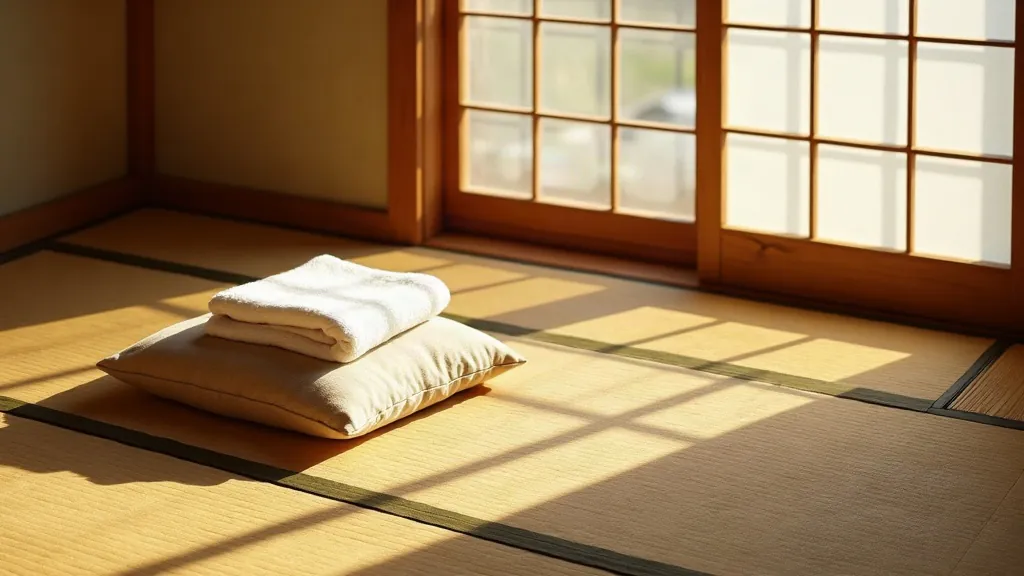
Open the sliding door and the room looks almost empty. The floor is tatami, woven rush over a firm core, and it is measured in mats rather than square metres. There is a low table, flat cushions called zabuton, sometimes a legless chair called a zaisu with a back but no legs. One wall holds a tokonoma, a shallow alcove with a hanging scroll and a single seasonal flower. Paper shoji screens filter the light from the garden or the street.
The bedding lives in a closet behind sliding fusuma panels during the day. Staff lay it out while you are at dinner, which is why a ryokan dinner has a fixed start time. The futon itself is a cotton or wool-filled mattress with a thick quilt, and it is firmer than most Western visitors expect. If your back dislikes firm floors, ask whether the inn can stack two mattresses. Many will, without any fuss.
Practical details worth checking before you book:
- Bathroom: older inns often have a toilet in the room but no private shower, because bathing happens in the house bath.
- Stairs: wooden houses rarely have lifts, and the steps are steep and narrow.
- Luggage: forwarding your suitcase by takkyubin and arriving with a small bag makes those stairs much easier.
- Curfew: small family inns sometimes lock the front door around 23:00.
- Payment: a few long-established houses still prefer cash, so confirm when you reserve.
What a ryokan rate includes: dinner, breakfast and service
Rates are quoted per person per night, not per room, and the standard package is called ippaku nishoku (一泊二食): one night, two meals. A room for two at 30,000 yen per person is a 60,000 yen night. This is the single most common booking mistake I see, and it catches people who compare a ryokan page against a hotel page without reading the small print.
The dinner is usually a kaiseki dinner, a sequence of small courses built around what is in season. A typical progression runs from sakizuke, a tiny opening dish, through clear soup, sashimi, a grilled course, a simmered course, then rice, pickles and miso before fruit or a light sweet. Kyoto's version leans on vegetables, yuba, tofu and river fish rather than heavy seafood, because the city sits inland. Breakfast is grilled fish, rice, miso soup, pickles and often a small hot pot of tofu.
Service is the part no price list captures. The okami, the woman who runs the house, greets guests, sets the tone and often remembers what you drank last time. A room attendant brings each course, explains it, and clears quietly. In Kyoto there is no tipping; attentiveness is included. What is not always included is the city lodging tax, charged per person per night and collected separately, so budget a little beyond the quoted rate.
Best ryokan in Kyoto by budget: three honest tiers
Kyoto has hundreds of inns and three realistic price brackets. Nothing useful is gained by ranking them against each other, because a 12,000 yen inn and a 100,000 yen house are not competing for the same evening. What matters is matching the tier to how many nights you can give it, how early you can book, and whether the meal is the point of the trip or an expense you would rather skip.
Two dates break these rules. Cherry blossom season, late March into the first days of April, and the autumn colour weeks of mid to late November sell out earliest and cost the most. If your trip falls in either window, treat every lead time above as doubled.
Budget ryokan in Kyoto under 15,000 yen per night
The cluster of small inns south and east of Kyoto Station, around Shichijō and Higashi Honganji, is the practical answer for travellers who want tatami and a futon without a kaiseki budget. Ryokan Shimizu and Matsubaya Ryokan are long-running family houses in that area, both within walking distance of the station and the subway. Expect a clean tatami room, a shared or small private bath, Japanese or Western breakfast as an option, and no dinner service.
What you trade away is the evening ritual. Nobody lays your futon while you eat, because you will be eating out. That is not a loss in Kyoto, where the obanzai counters and standing sake bars around Kiyamachi and Nishiki are half the pleasure of the city. Inns in this tier also tend to allow single occupancy without a surcharge, which matters if you travel alone.
Look slightly outside the centre for better value. Fushimi, with its sake breweries, and Ohara, up in the northern hills, both have simple inns at low rates. Ohara in particular gives you mountain air and an early-morning walk to Sanzen-in before any tour bus arrives.
Mid-range Kyoto ryokan with kaiseki dinner included
This is the tier I recommend most often, because it delivers the full sequence without the ceremony of a famous house. Seikoro, near Gojō by the Kamo river, has been in business since the 1830s and mixes tatami rooms with antique Western furniture. Kinmata, on a narrow lane off Shijō, is a small early-nineteenth-century house with its own kitchen and a kaiseki reputation that outlasts its size. Gion Hatanaka, a short walk from Yasaka Shrine, is known for evenings where maiko perform and talk with guests over dinner.
Check the solo policy before you fall in love with a room. Many ryokan price per person but apply a single-occupancy supplement, and a few decline solo bookings on kaiseki plans entirely, because the kitchen builds courses in pairs. Policies on young children vary just as much. A direct email usually gets a clearer answer than a booking platform.
One more detail that the big listicles skip: arrival time is a hard constraint, not a suggestion. If dinner is served at 18:00 and the futon goes down at 20:00, checking in at 21:00 means the kitchen cannot serve you. Plan your last temple of the day accordingly.
Historic luxury ryokan: Tawaraya, Hiiragiya and booking reality
Two houses stand slightly apart in Kyoto, on the same quiet street in the Nakagyō district. Tawaraya has been run by the same family for roughly three centuries and has never needed to advertise. Hiiragiya opened in 1818 and has hosted writers, including Kawabata Yasunari, and visiting film figures such as Charlie Chaplin. Both offer a handful of rooms, meals served in your room, cedar or cypress bathtubs, and a level of quiet attention that is the actual product.
The reality of booking them is simple. Reserve three to six months out, longer for blossom and autumn dates, and contact the house directly or through a concierge rather than a discount site. Tawaraya in particular has long preferred quiet word of mouth and returning guests. If the answer is no, Hiiragiya's annex, the Bekkan, is a more modest building at a lower rate and still run by the same family.
A third option sits in the eastern hills: Yoshida Sanso, built in the 1930s as a private residence for a member of the imperial family, now a very small inn below Yoshida hill near Ginkaku-ji. It has a café in the old garage and a garden that justifies an unhurried morning. Across all three, the thing you pay for is not a bigger room. It is the number of staff per guest and the age of the woodwork.
Private onsen, machiya or garden view: which ryokan fits
Once the budget is set, the choice is about appetite rather than stars. Three desires pull in different directions in Kyoto, and no single inn satisfies all of them. A real hot spring means leaving the city centre. Machiya character means accepting thin walls. A garden view means paying for a room that faces the right way. Decide which one you would miss most, and the shortlist writes itself.
Kyoto ryokan with a private open-air bath (rotenburo)
Here is the honest version that most Kyoto lists avoid: central Kyoto sits on groundwater, not on geothermal springs. When a city-centre inn advertises an onsen, the water is often heated well water or a deep-drilled source, and sometimes simply a beautiful hot bath. That is not a scandal, but it is worth knowing before you book a stay specifically for the water.
For genuine spring water within reach of Kyoto, look north and west. The Kurama area, at the end of the Eizan railway line, has a long-standing hot spring and a mountain setting; confirm current opening before you plan around it, as the facilities there have changed in recent years. Arashiyama has riverside inns with hot spring baths, including Rangetsu on the Hozu river. Further out, Yunohana near Kameoka and the Ohara valley give you mountain inns within an hour of the city.
If what you really want is privacy rather than mineral water, book a room with a rotenburo (private open-air bath) attached. This solves several problems at once: no shared changing room, no schedule, and no issue with tattoos, which are still refused at some public baths in Japan. Rooms with their own outdoor tub carry a clear supplement, usually in the range of 10,000 to 30,000 yen per person over the standard room, and they are the first category to sell out.
Machiya ryokan in Gion and Nishijin: sleeping in a townhouse
A machiya is a wooden merchant townhouse: narrow at the street, deep at the back, with a lattice facade, an earthen entrance passage and a small interior garden called a tsuboniwa. Sleeping in one is the closest thing to living in old Kyoto. Several have been restored as tiny inns in the Gion district, around Ishibei-kōji and the lanes behind Yasaka Shrine, and in Nishijin, the weaving quarter in the north-west where looms still run behind some of those lattices.
The compromise is physical. Machiya were built for airflow in humid summers, so walls are thin, floors creak and sound carries between rooms. Staircases are steep and sometimes closer to a ladder than a stair. Winter can be cold, because these houses were never designed for central heating. In exchange you get a building with one or two rooms, a garden you can hear rain fall into, and a street that empties after dark.
Ryokan Motonago and Ryokan Uemura, both in the stone lanes near Kōdai-ji, show what the small end of this category looks like: a few rooms, a short walk to Kiyomizu-dera before the crowds, and an early-evening quiet that central hotels cannot offer. Book the ground floor if stairs are a concern, and ask whether the inn faces a bar street before you commit to a weekend night.
Garden-view ryokan rooms near Nanzenji and the Higashiyama hills
The eastern edge of the city, from Nanzen-ji up toward Ginkaku-ji, is where Kyoto keeps its water. Meiji-era villa gardens there were built around channels from the Lake Biwa canal, and several inns inherited those gardens. Yachiyo, at the Nanzen-ji gate, and the small inns along the temple approach have rooms that look directly onto moss, stone and maple.
A garden room costs more than an interior room in the same house, sometimes considerably more, and the reason is simple arithmetic: one garden, a few windows. If you are staying one night only, I think the supplement is the best money in this whole article. You will spend four or five waking hours in that room, in a yukata, with tea, watching light move across stone. That is the memory people describe years later.
Two seasonal notes. Autumn turns these gardens red in the second half of November and the rates follow. In the rainy weeks of June the moss is at its most saturated green, prices soften, and the same room feels like a different country. The eastern hills also put you walking distance from yudofu, the simmered tofu Nanzen-ji is known for, so dinner outside the inn is no sacrifice.
Ryokan etiquette: yukata, geta and bath rules explained
Nothing here is difficult, and no inn expects foreign guests to perform Japanese customs flawlessly. What staff appreciate is that you tried, and that you did not walk on tatami in outdoor shoes or step into the bath unwashed. The rules follow one logic: the floor you sleep on stays clean, and the water everyone shares stays clean. Learn those two and the rest is detail.
Footwear works in three zones. Shoes come off at the genkan, the sunken entrance, and go into a rack. Slippers are for wooden corridors. Slippers come off at the edge of the tatami, where you walk in socks or bare feet. There is a separate pair of slippers inside the toilet, and leaving the room in them is the classic visitor mistake.
How to wear the yukata your ryokan leaves in the room
The cotton robe folded on your futon or in the closet is a yukata, and it is yours to wear all evening: in the corridors, at dinner, at breakfast, and in many neighbourhoods out onto the street. Put it on after your bath, with nothing or very little underneath. Then follow three steps.
- Hold both front panels and wrap the right panel against your body first.
- Bring the left panel over the top, so the left side sits outside. Right over left is used only for the dead, which is why staff may quietly correct you.
- Tie the sash over the overlap. Men wear it low on the hips; women wear it higher, at the natural waist, with any excess length folded up under the sash.
In winter the inn adds a tanzen, a padded over-robe, on top of the yukata, and sometimes a haori (羽織), a short open jacket. In July and August some houses hand out a jinbei (甚平) instead: a two-piece set of short-sleeved top and loose shorts in cotton or linen, originally menswear and now worn by everyone for summer evenings. It is the most comfortable thing I own in humid weather, and the reason I keep a jinbei in my own summer drawer rather than a full-length robe.
Sizes are worth a word. Japanese sizing runs about one size smaller than US or EU equivalents, and ryokan yukata are cut for average Japanese height. If you are tall, ask at check-in for the long size, usually called L or LL. Most inns keep a few.
Washing before the bath: ofuro and onsen rules step by step
The bath, the ofuro, is for soaking in clean water, never for washing. The sequence is fixed and takes two minutes to learn.
- Undress completely in the changing room and leave clothes in a basket. Swimsuits are not worn.
- Take the small towel with you and the larger one stays in the changing room.
- Sit on the low stool at a shower station and wash thoroughly, hair included. Rinse all soap away.
- Enter the tub slowly. The water is often 40°C to 42°C.
- Keep the small towel out of the water. Fold it on your head or rest it on the rim.
- Do not drain the tub. The same water serves the next guest.
Long hair goes up and out of the water. Alcohol and very hot baths are a poor combination, so the beer belongs after the soak, not before. Baths at small inns are often used one party at a time, with a sign you flip to show the room is occupied; at larger houses, men's and women's baths sometimes swap sides in the morning, which is why the curtain colour changes overnight.
Tattoos remain an obstacle at some public baths and a few ryokan, though attitudes are shifting and Kyoto is more relaxed than many regions. If you have visible work, your options are a room with its own bath, a private family bath that can be booked by the hour, or simply asking the inn in advance. A clear question gets a clear answer and avoids an uncomfortable moment in a changing room.
Walking the ryokan corridors and garden in geta sandals
Geta are the raised wooden sandals kept by the door for going outside: to the garden, to the shop on the corner, to a summer festival. Indoors you stay in slippers or socks, and on tatami in neither. The thong sits between the big toe and the second toe, and the correct fit leaves your heel slightly over the back edge, which feels wrong for about ten minutes and then stops being noticeable.
Walk flat-footed and in short steps rather than striding. On the stone lanes of Higashiyama the sound they make is part of the street, and in Gion it is one of the oldest sounds in the city. For a first pair, I would choose a simple paulownia wood pair of geta with a dark strap, because it works with a yukata in the evening and with cropped trousers in July without looking like a costume.
Two cautions from experience. Wet stone and new geta are a bad match, so slow down after rain. And geta are not walking shoes; they are for a few hundred metres, not a day of temples. The inn will not mind at all if you put your trainers back on for the walk to Kiyomizu-dera.
Recreating the ryokan evening at home after Kyoto
What makes a ryokan night memorable is not the building. It is the order of events: a hot bath early, loose clothing, dinner before eight, low light, no screens, sleep close to the floor. That sequence is portable. I rebuilt it in my own flat after a stay near Nanzen-ji, and it survived the return home better than any souvenir I carried back.

The three principles behind the pieces I select at KimuraKami line up with this naturally. Ikigai is the reason to keep an evening ritual at all. Kaizen is the small improvement each week, one habit at a time. Wabi-Sabi is why a slightly uneven tea bowl is better company than a perfect one.
Trading the ryokan yukata for kimono pajamas
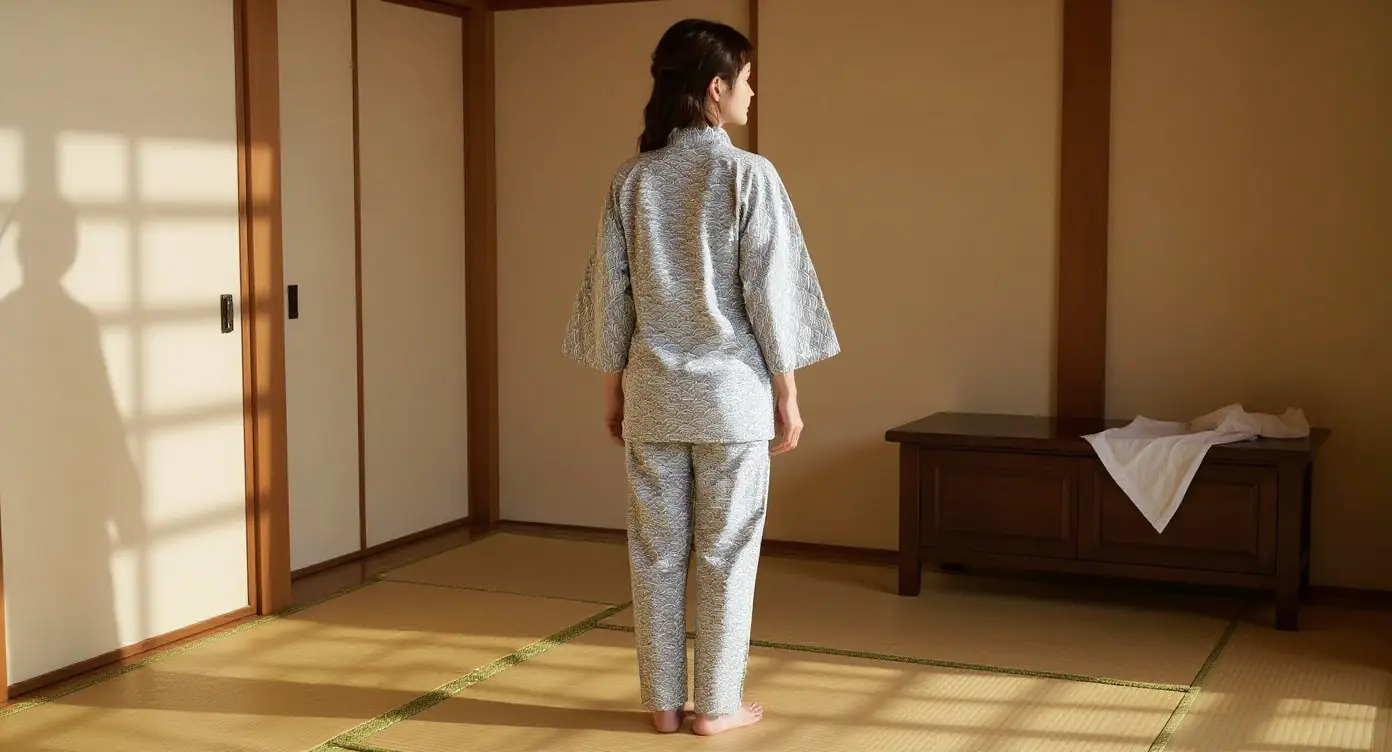
The first and easiest change is to stop staying in daytime clothes after the bath. A ryokan hands you a wide cotton robe for a reason: loose fabric and a sash tell your body the working part of the day is over. At home that means something you change into on purpose, not whatever is nearest.
For winter evenings in a cold flat I reach for a two-piece set rather than a single robe, because a robe gapes the moment you sit on the floor. The kimono pajamas I keep for autumn nights are the pair I recommend most often to customers who came back from Japan missing the ryokan feeling: kimono-style crossed front, wide sleeves, a sash that ties instead of elastic. Features to look for:

- Material: cotton, or a cotton blend with a little stretch for sleeping.
- Cut: crossed front closed left over right, like a real yukata.
- Fastening: a tie sash, not buttons, so it adjusts as you move.
- Care: machine wash cold, line dry, iron on low if you want crisp collars.
- Sizing: Japanese sizes run about one size smaller than US and EU, so size up if you are between two.
The slow ryokan morning: matcha, rice and no screens
Ryokan breakfast works because it is warm, savoury and unhurried. You do not need grilled fish at 7 a.m. to borrow the structure. Rice or miso soup if you have them, otherwise tea prepared properly and drunk sitting down, away from a phone. Fifteen minutes is enough to change the shape of a morning.
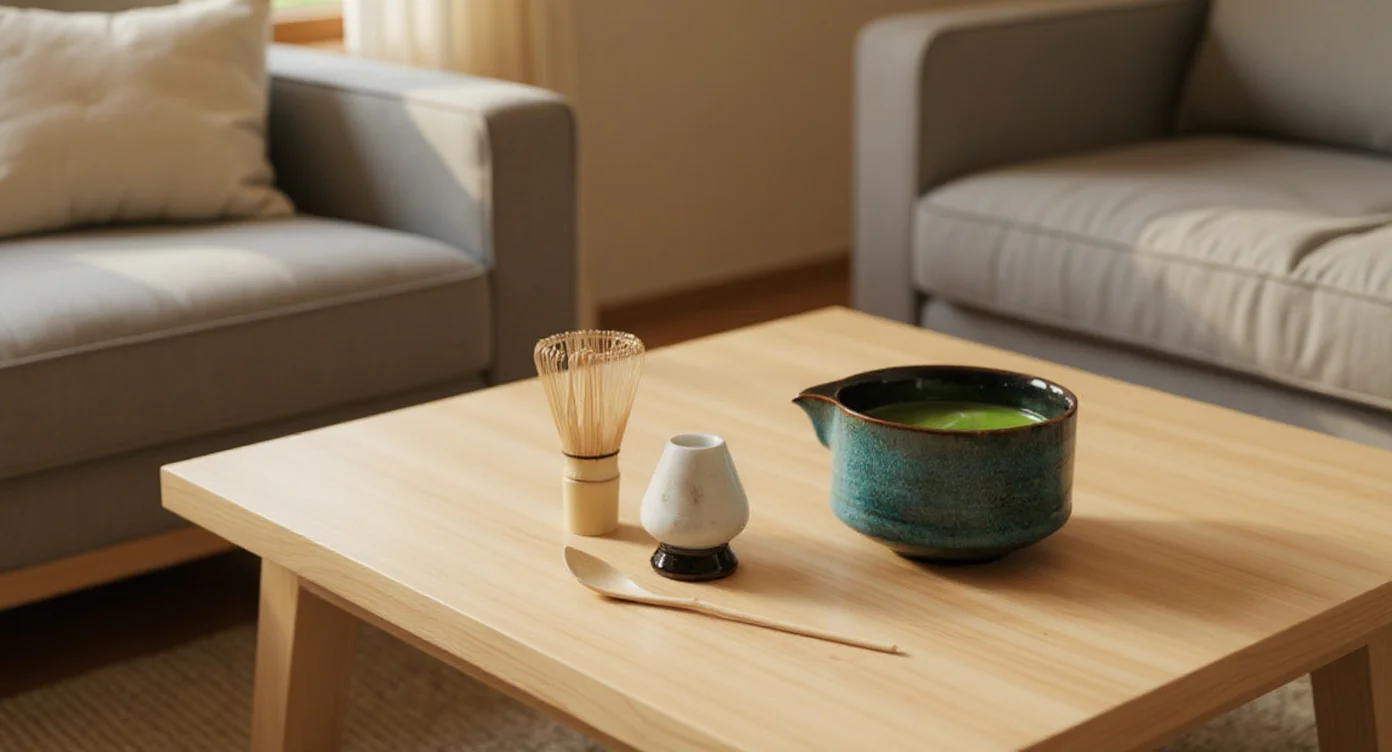
Whisked matcha is the version I keep up most consistently, because the preparation is the point: sift the powder, pour water at roughly 70 to 80°C, whisk in a brisk W motion with the bamboo chasen until the surface holds a fine foam. A cheap electric frother will not give you the same result, and more importantly it removes the thirty seconds of attention that make the ritual worth doing. If you are starting from nothing, a matcha set with bowl and chasen is the one object I would buy first, since the bowl's width is what lets the whisk work at all.

One honest note: matcha is tea, not medicine. I drink it because the ten minutes belong to me and the taste is good, and that is reason enough.
Low furniture, soft light and a futon-style sleep setup
Height and light do most of the work in a ryokan room. Everything sits low, so your eye line drops and the ceiling feels generous. Light comes from the side, through paper, never from overhead. You can approximate both without renovating anything.
Start with one corner rather than a whole room. A low table, two floor cushions, a lamp at knee or hip height with a warm bulb, and a single seasonal object on a shelf: one branch, one stone, one bowl. Switch the ceiling light off in the evening and use the lamp only. The change in how the room feels is immediate and costs almost nothing.
For sleep, a full futon on a hard floor suits some bodies and punishes others. A Japanese-style mattress on a low wooden slat base is the practical compromise, and airing the bedding in sunlight once a week is the habit that keeps it fresh, which is exactly what inns do on their balconies on fine mornings. Keep bedding out of sight during the day if you can. A room that is not visibly a bedroom is easier to relax in at night.
Kyoto ryokan questions first-timers ask
These are the questions that arrive most often, from customers and from friends planning a first trip. Short answers, with the figures and neighbourhoods that actually decide the booking.
How much does a ryokan in Kyoto cost per night?
Plan on 8,000 to 15,000 yen per person for a family inn without dinner, 25,000 to 55,000 yen per person for a mid-range ryokan with kaiseki and breakfast, and from around 80,000 yen per person upward at a historic house. Remember that the figure is per person, so double it for a couple. Kyoto's lodging tax is added separately at check-out.
Is one night in a ryokan enough?
One night is enough to experience the full sequence of bath, dinner, futon and breakfast, and it is what most visitors book. Two nights change the feeling, because the second evening you stop watching yourself and simply settle in. If budget forces a choice, I would take one night at a good mid-range inn over two at a basic one.
Do Kyoto ryokan accept guests who don't speak Japanese?
Yes. Kyoto has hosted foreign guests for well over a century, and inns in every tier are used to English, written menus and gestures. Smaller family houses may have limited English on the phone, so email or a booking platform is easier than calling. Learning two words, onegaishimasu and arigatou gozaimasu, covers most of a stay.
Should I stay in Gion or near Kyoto Station?
Gion and the eastern lanes give you atmosphere, early access to Kiyomizu-dera and quiet streets after dark, at a higher rate. The Kyoto Station area gives you cheaper inns, every train and bus line, and easy day trips to Nara or Osaka, with far less charm at night. For a first visit of two or three nights, I would pay more and sleep east of the river.
Do all ryokan in Kyoto have an onsen?
No, and most city-centre inns do not. Central Kyoto has very little natural hot spring water, so a beautiful cypress bath is common and a true onsen is not. For genuine spring water, stay in Arashiyama, Kurama or the Ohara valley, or out toward Yunohana near Kameoka.
If the part of the stay you miss most is the cotton robe and the slow hour after the bath, that is the easiest piece to bring home. Our Japanese pajamas collection is where I would start looking.
Explore the Japanese Pajamas collection
Yukata-style kimono pajamas, jinbei sets and cotton night kimono, cut for sleeping and lounging the way a ryokan evening goes.
Browse the collection →