
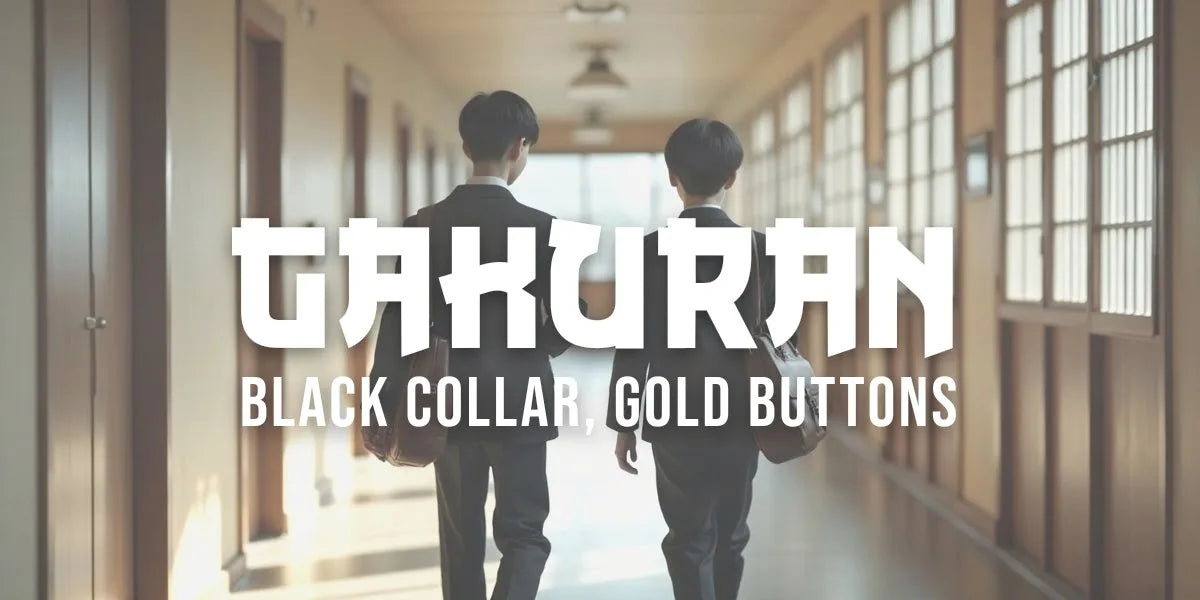
The gakuran (学ラン) is the black, stand-collar uniform that Japanese middle and high school boys have worn since the late 19th century. It is still worn in many schools today, and it has also become a fixture of manga, rock fashion and cosplay.
The gakuran is the male counterpart of the girls' uniform, the sailor fuku (セーラー服), literally "sailor clothes". Below: how the outfit is put together, where its name comes from, the second-button tradition, and how students reinvented it.
Key points
- Gakuran means "student of the West", after the European military cut that inspired it.
- The set is a stand-collar jacket with school-crest buttons, straight black trousers and a belt.
- Giving away the second button of the jacket at graduation is a love confession.
- Delinquent subcultures like the bosozoku reshaped the uniform into a streetwear statement.
- Japanese sizes run about one size smaller than US and EU sizes.
The history of the Gakuran
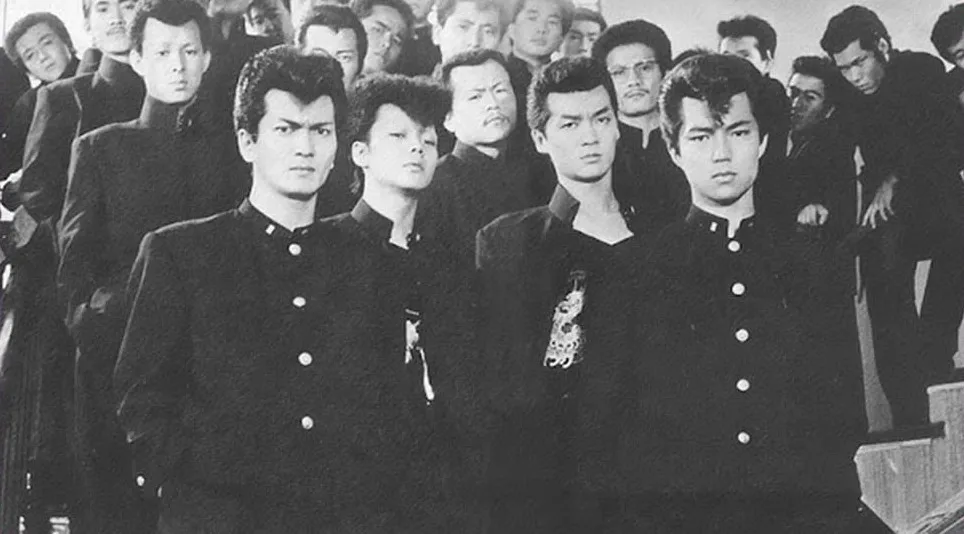
The first appearance of the Japanese student uniform Gakuran was in 1879 in Tokyo, at the Imperial Family School. Six years later, it was adopted by Teikoku University in Tokyo, then by almost all other educational institutions, colleges and high schools. Its design was inspired by the uniforms of the former Prussian army.
The term itself is worth unpacking. "Gaku" means student, "ran" means West. The word therefore reads as "student of the West". It carries that name because the navy jacket also borrowed from the French military dress of the period. France was taken as a model, as its training system was considered the best in the world.
That double origin is the whole charm of the piece. A European silhouette, cut and worn with Japanese discipline. It is the same logic I love in a haori (羽織), the short traditional jacket: a form that travels and gets reinterpreted rather than copied.

How is the Gakuran composed?
The Japanese gakuran uniform is worn with:
- a loose fitting navy blue organic cotton shirt,
- a long-sleeved suit jacket with a round or stand-up collar that buttons up and down.
- The buttons are always specific to the school emblem. It is a sign of respect to the institution.
- a classic black pant with a straight cut and high waist, to which is added a black belt.
- shoes are not part of the uniform. So the choice is free if you wish to sport a beautiful costume cosplay.
Students in Japan sometimes wear loafers, pumps, or low top sneakers in rare cases. Schools sometimes ask students to wear a pin at the collar to indicate their year (freshman, senior). In the past, a matching cap was mandatory.
Care is simple. Cold wash, hang dry, iron the collar on low heat so the interfacing keeps its shape. A gakuran jacket that has softened at the elbows tells its own story, which is very much the wabi-sabi idea: beauty in what has been used.
Bosozoku style and Japanese uniform
Over time, many derivatives of the Gakuran emerged. Students appropriated this strict uniform and reworked it to their taste, or as a sign of protest.
The clearest example is the Bosozoku style, a Japanese streetwear look. It grew out of the bosozoku gangs. A bosozoku is a delinquent, often a student, who rode motorcycles at high speed. Their jackets were lengthened, the collars raised, the trousers ballooned. Many Japanese rock bands adopted the look, KISHIDAN being the best known, from 1997.
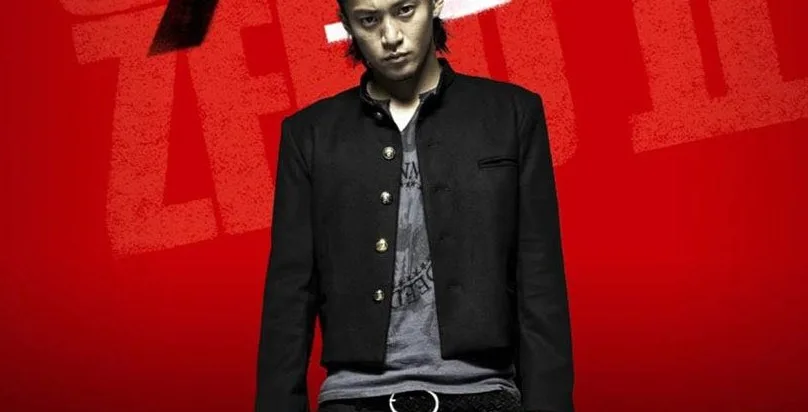
In the Japanese film Crows Zero, we follow young students who face each other in fist fights, uniforms open and sleeves rolled.
The tradition of Gakuran second button
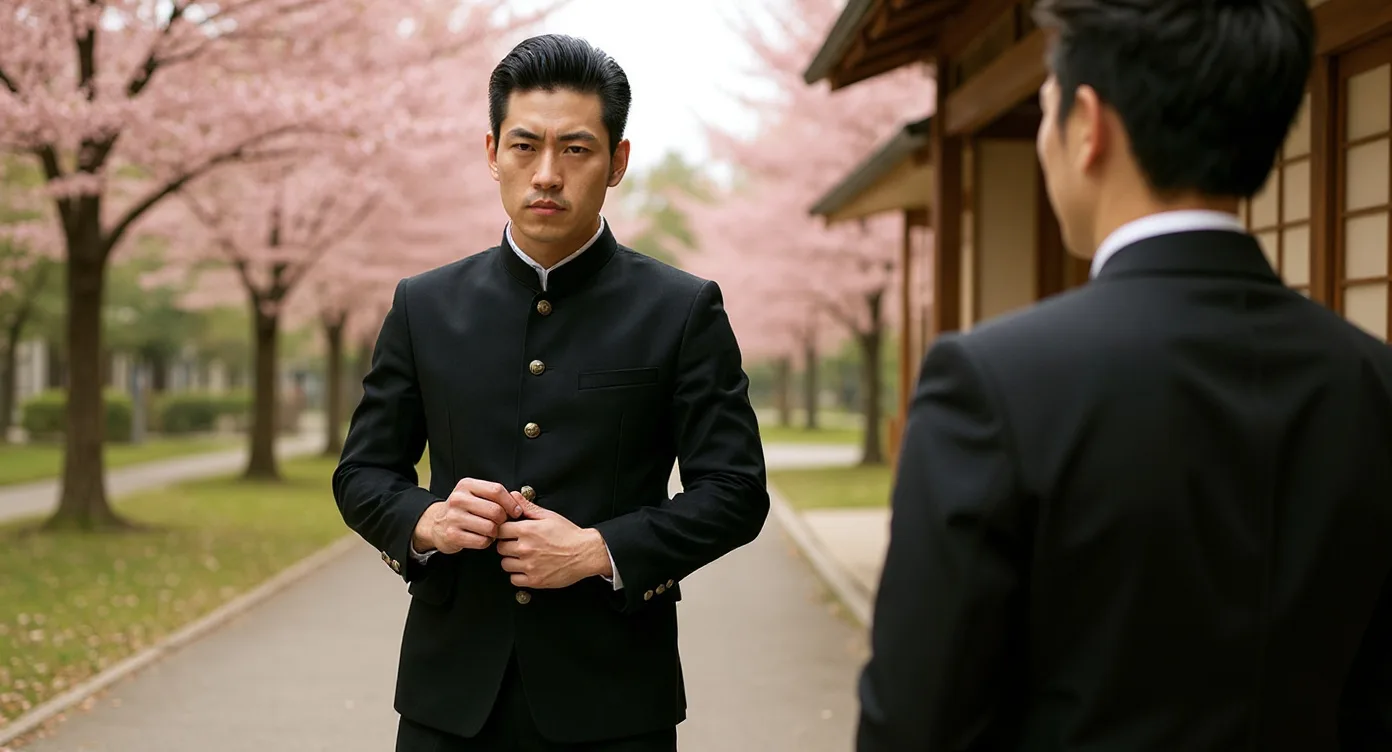
Japanese students have a very particular way of declaring their feelings. On graduation day, one tradition is to give the second button of the jacket to the person you love.
The custom is often traced to a novel by the writer Taijun Takeda, in which a similar scene occurs.
Another theory places the origin in the Second World War. Soldiers gave the second button of their military uniform to their loved ones, leaving a keepsake in case they did not return.
The gender jumping gakuran
The men's uniform has also found a feminine form. Japanese retail chain Village Vanguard created a garment named the Seishun Gakuran One-Piece. It is aimed at girls who want an adapted version of the gakuran. It keeps the men's design with one change: it is cut as a dress covering the whole upper body.
It is a good reminder that the uniform is a shape, not a gender. I have seen it styled with thick socks and loafers, and with black tights and boots for a colder day.
The gakuran for girls: Sailor fuku
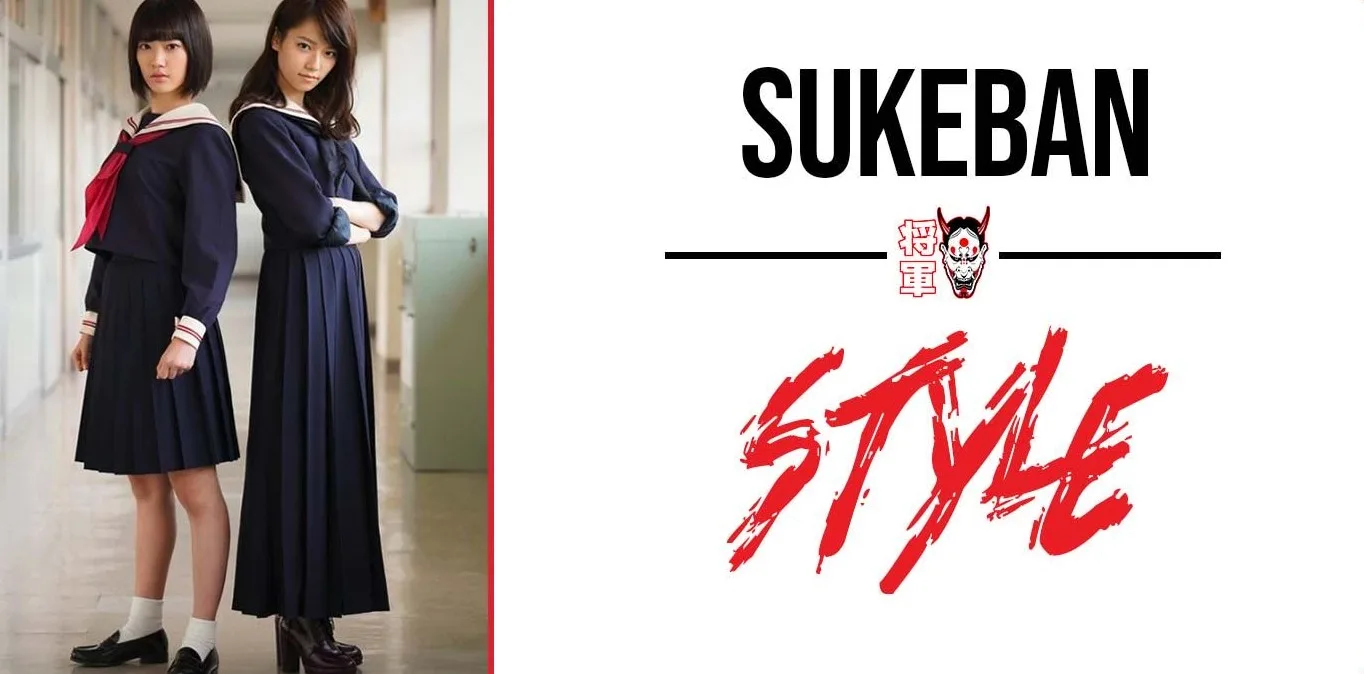
The same reinvention happened on the girls' side with the Sukeban gangs. These students modified their traditional uniform, whose classic version is called sailor fuku: skirts lengthened to the ankle, sailor tops shortened, collars embroidered.
One of them appears in Quentin Tarantino's Kill Bill Volume 1. During the fight scene, the character Gogo Yubari wields a chain and ball, a weapon associated with sukeban imagery.
The modern version pairs pleated skirts with sailor blouses, and it remains the most requested piece in our Japanese School Uniforms selection.

The gakuran uniform in manga and Japanese anime
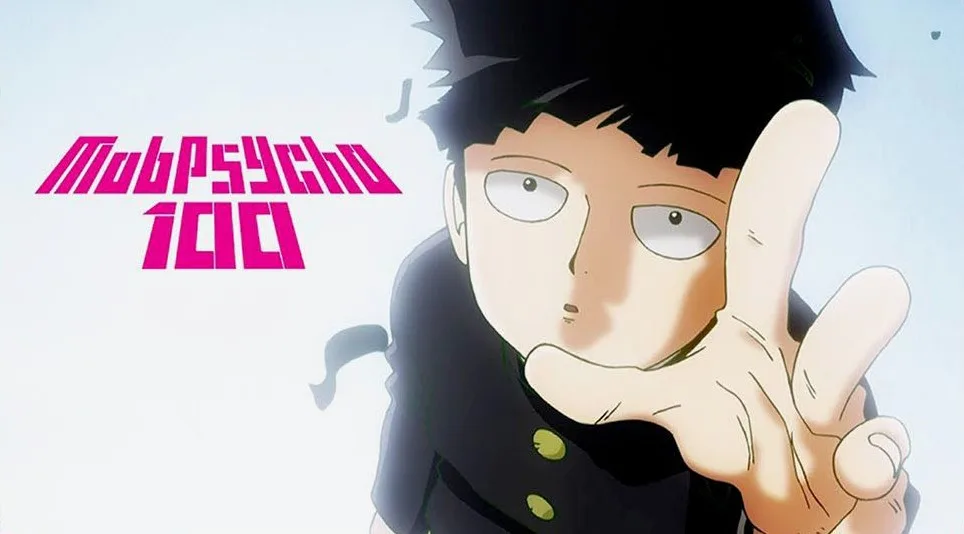
Japan has many manga built around high school heroes, and the gakuran appears constantly. Two well known examples are School Rumble and Kuroko's Basketball.
We can also mention Yusuke Urameshi, the main character of Yu Yu Hakusho, and Mob Psycho 100, whose hero is a high school student with immense telekinetic power.
Studios often take liberties with the colours. On screen the gakuran can be black and white, multi-coloured, beige, khaki, or printed with stripes. For cosplay, that freedom is useful: match the silhouette first, then the shade.
FAQ
The questions I receive most often about the gakuran, answered plainly.
Are gakuran still worn in Japan today?
Yes. Many public and private middle and high schools still use the gakuran as their boys' uniform. Others have moved to blazer-and-tie sets, so the two styles now coexist across the country.
What does the word gakuran mean?
It combines "gaku", student, and "ran", an old term referring to the West. The name points to the European military cut that inspired the jacket in the 1870s.
What size should I order?
Japanese sizing runs about one size smaller than US and EU sizing. Order one size up from your usual, and check the shoulder and chest measurements on the product page before choosing.
Can a gakuran be worn outside of cosplay?
It can. The jacket works as a standalone piece over a white t-shirt with black jeans and plain sneakers. Leave the collar hook open and it reads as a minimalist stand-collar jacket rather than a costume.
Explore the Japanese School Uniforms collection
Take a look at our Japanese School Uniforms collection and find the piece that fits your style, from the classic gakuran to the sailor fuku.
Browse the collection →