
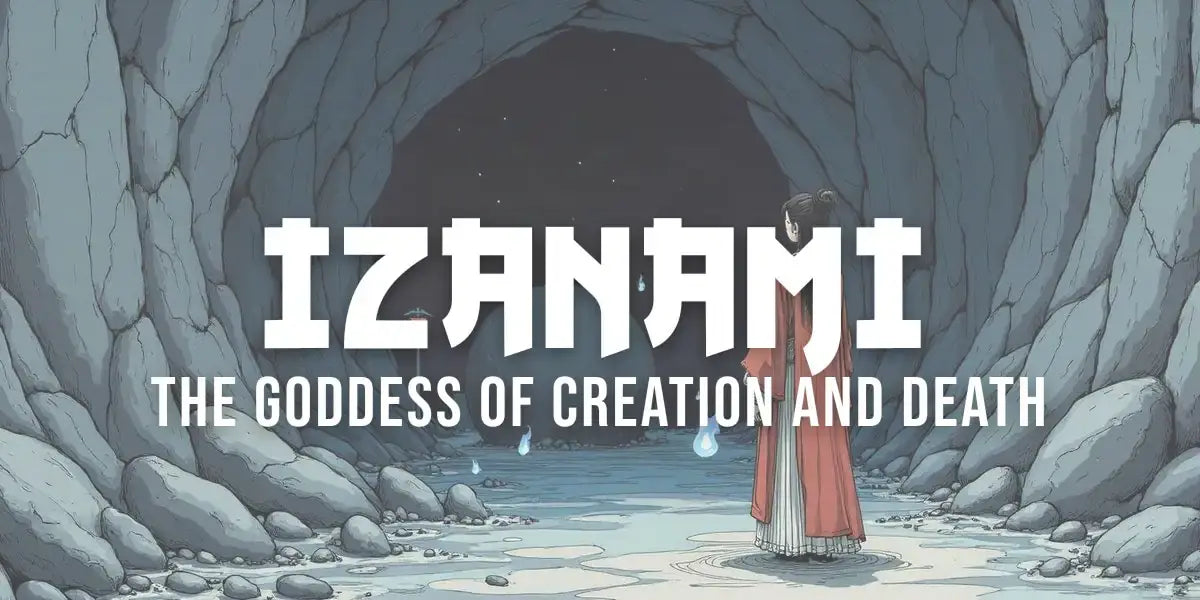
Izanami (伊邪那美, "she who invites") is the Shinto goddess of creation and, later, of death. With her husband Izanagi she shaped the islands of Japan, then became the ruler of Yomi, the land of the dead.
Her story begins with a jeweled spear stirring the ocean and ends behind a boulder sealing the underworld. It is one of the oldest narratives recorded in Japanese mythology, and it still feeds manga, video games and mask carving today.
We will begin with the tale of her legend, from her golden age to her fall into darkness. Then we will introduce the works and characters directly inspired by this deity. We will finish by explaining why this Japanese tale is at the center of the appearance of all the gods of Japanese legends.
Key points
- Izanami is the goddess of creation first, then the goddess of death after she dies giving birth to fire.
- Her name means "she who invites"; Izanagi (伊邪那岐) means "he who invites".
- Yomi (黄泉), the underworld, is where she becomes Yomotsu Okami, ruler of the dead.
- The three noble children, Amaterasu, Tsukuyomi and Susanoo, are born from Izanagi's purification, not from Izanami's womb.
- In Naruto, Izanami is a genjutsu technique inspired by the myth, not the goddess herself.
Izanami and Izanagi, the origin of the creation of Japan
In Japanese spirituality, it is the heavenly kami (神, divine spirits) who are at work in the earthly creation. In order not to leave the world empty, these protective deities gave birth to two new gods: Izanami and Izanagi. The responsibilities of this cosmic couple are titanic. Their duty is to spread the life of the Japanese people all over the globe. Before they appeared, only the earth and the sky existed. They were also required to shape the territories and landscapes.
To ensure the success of this ambitious task, this duo was given an object with monumental power. This was a spear adorned with countless precious jewels. It contained a tremendous creative power. Simply pointing the spear at the desired location was enough to create an island. This is exactly what happened when, from a celestial bridge, our two protagonists brought into existence the very first land of Japan: the Onogoro island.
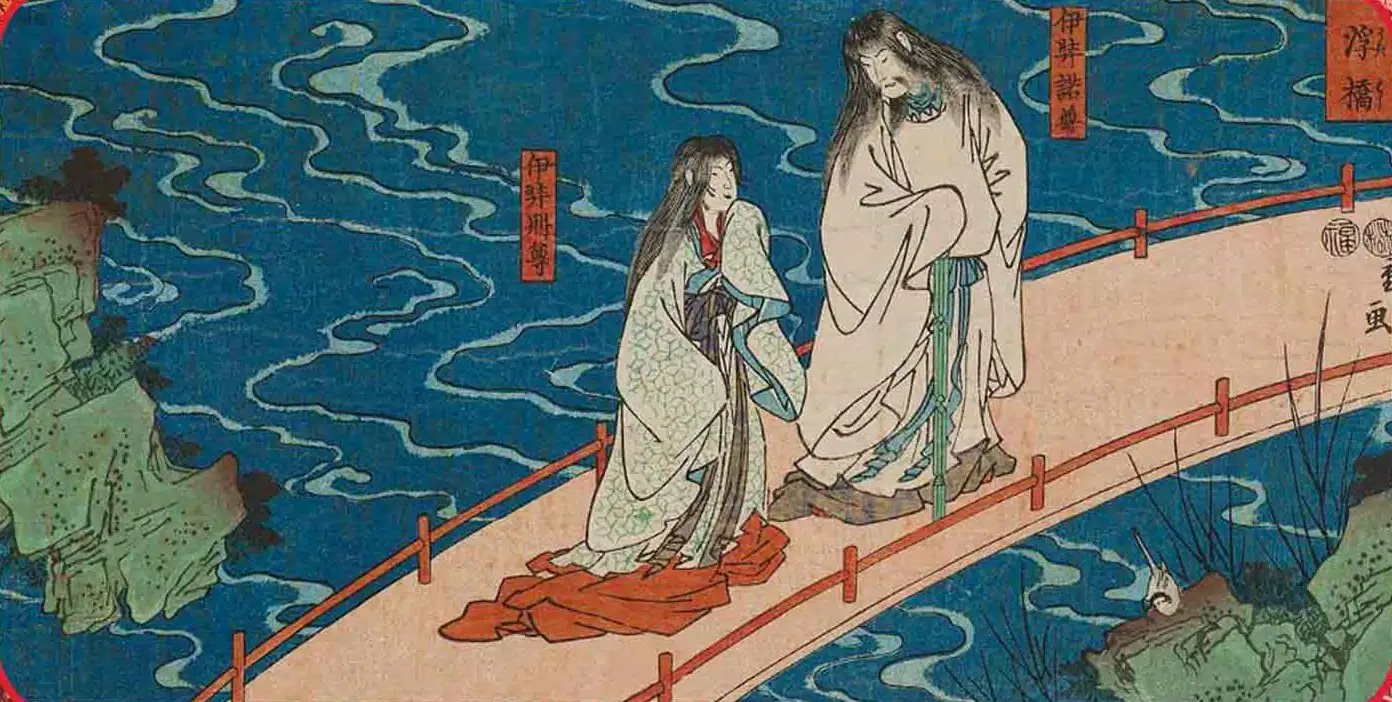
Working hand in hand established a fusional bond between the two builders. Eventually they fell in love with each other. The goddess Izanami then wanted to invite her beloved to conceive a majestic bloodline. They did, but the nuptial episode quickly turned into a disaster.
The union gave birth to three ill-formed creatures. This was read as a divine punishment. It was not the role of the female deity to speak first during the ritual. They tried a second time, drawing the right lesson from their failure. With the gods no longer angry, a whole new generation of deities was born. Izanami became pregnant again. On the day of the birth, an unfortunate incident occurred.
Her double nature, creation on one side, decay on the other, is exactly the kind of story we like to see printed on fabric. Yokai motifs carry that same tension between beauty and the uncanny.

Yomi, the world of the dead: the tragic tilt
At the end of the childbirth, the god Kagutsuchi (迦具土) came into the world. He is the deity of fire. The birth of this fiery being caused the immediate death of his mother.
After this misadventure, the deceased went to Yomi after her funeral. This is a subterranean world where one is found after death. Still in love, Izanagi refused to accept this fate. He made the decision to go on a quest for her, with the goal of bringing her back among the living. He did not know what to expect when he set foot in this place. Once there, he quickly realized that everything was hellish. Monstrous and immortal hags called Shikome populate this dark land. Other creatures such as the Yokai haunt this unclean place.
Following several hours of walking, the lover finally found his soul mate. She was in the dark. It was impossible for Izanagi to make out her features. As a solution, he illuminated her by pointing his lamp in her direction. The light revealed a new nightmare. His wife was in a serious state of decomposition. The odor was obliterating the divine character that once animated this noble body. If she was condemned to such a fate, it was for a specific reason: she had eaten the food of the dark world. This is a grave transgression, from which comes a radical punishment. Whoever tastes it is bound to spend eternity in this place, in this state.
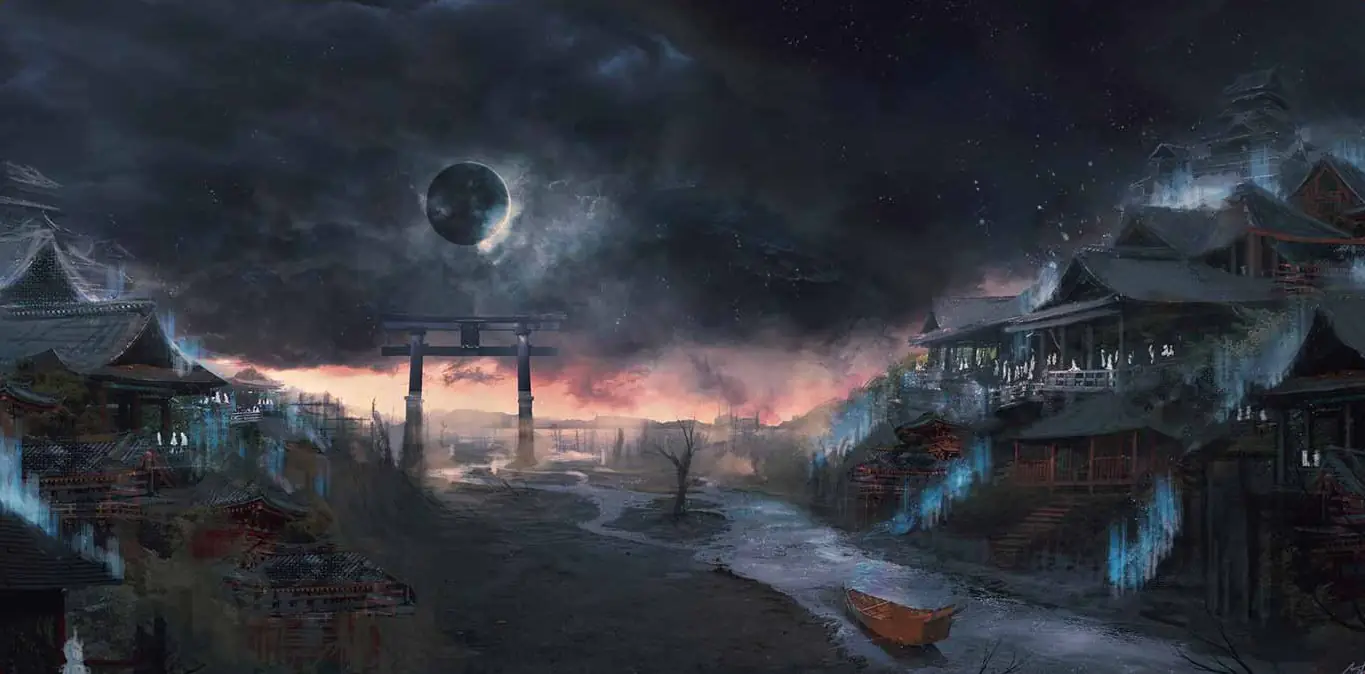
In a deep state of disgust, the widower wanted to abandon his fallen love. She took this as an unforgivable betrayal. Taken by a mad rage, she refused to let him leave. Without a moment's hesitation, she ordered her henchmen to go after him. In order to get away unharmed, Izanagi ran at full speed. To lose the evil troops, he sealed the entrance to the underworld with a huge rock weighing several tons, leaving the new ruler of the abyss imprisoned forever. From that day she is called Yomotsu Okami (黄泉津大神), the great deity of Yomi.
The place of the goddess in Japanese folklore
The story of this legendary figure is so captivating that it has created a real upheaval in the art world. Thanks to this myth, dozens of representations of the great goddess were invented. We will review the 7 works that have held our attention the most.
A jutsu in "Naruto"
This cult manga shows no disrespect to the powerful deity. Her power is terrifying because it is so colossal. Izanami is able to choose the course of fate. The opponent is trapped in an eternal time loop. To escape this prison, there is no other choice but to accept the truth about oneself, however overwhelming it may be.
Character in the second season of "Noragami"
The role that Izanami occupies in this series is faithful to the original story. She is the goddess of the underworld. Loneliness eventually got the better of her mind. Madness has taken hold of her. If an individual dares to enter her lands, she hastens to hunt him down, by all means.
Shirokawa, in the novel "Megami Tensei"
In this literary work, the character of Shirokawa is the reincarnation of the goddess of death. This coincides with the title of the book, which means "the reincarnation of the goddess". The book claims to embody the worldview of its author, Ludovic Castro, on history, society and identity.
Volume 3 of the trilogy of novels "Lotus War"
A marriage of fantasy and steampunk gives the whole Lotus War universe its soul. It is in the heart of the Shima Islands that the plot unfolds. In the middle of this atmosphere reign flying boats and chainsaw katanas.
End boss of the game "Persona 4"
At the end of the role-playing game developed by Atlus, the player has to face Izanami in person. This enemy gives players a large amount of trouble.
Playable character in the moba "SMITE"
Within the bestiary of this moba, Izanami is an excellent choice. Discreet until you start dealing damage, she retaliates with a portal that assaults opponents' life bars while temporarily sealing their abilities.
Hades, in the game "BlazBlue: Central Fiction"
BlazBlue: Central Fiction is a monument of Japanese fighting games. Here Izanami occupies a spectacular role: the embodiment of death. Her goal is machiavellian. Reducing the entire universe to ashes has become her sole reason for existing.
All these versions share one image: a face that belongs to the other world. That is also what mask carvers explore, and it is where the Japanese mask tradition meets the myth.

The spiritual mother of the 3 noble children
Izanami's influence on Japanese mythology did not end with her fate in Yomi. Her creative power was strong enough to endure despite the curse. Her separation from Izanagi caused him deep grief. That sadness gave rise to a very particular ceremony.
In order to cleanse himself of the corruption of the abyss, he performed a purification ritual called misogi (禊). In the middle of a river, he bathed to cleanse his body and soul. By divine magic, this bath proved fertile. The rite gives rise to several births:
- Amaterasu, the sun goddess: from the father's left eye, a creative tear flows. It turned into a goddess as luminescent as the sun.
- Tsukuyomi, the god of the moon: another tear flows from his right eye. It gives rise to a child from whom a pale light emanates.
- Susanoo, the god of the sea and storms: from a drop flowing from his nose comes an uncontrollable being. He is a gust of wind all by himself.
As Izanagi admired his new family, he felt an intense joy. Although his great love was no longer of the living world, three beautiful offspring had come from their story. He chose to name them the 3 noble children.
This is where Wabi-Sabi, one of the three principles that guide our selection, becomes easy to understand. Beauty in Japanese thought is not separated from loss. Izanami creates, then dies, and her death is what makes the sun, the moon and the storm possible.
FAQ
What is Izanami the goddess of?
She is the goddess of creation and of death. In the first half of the myth she shapes the islands and gives birth to the kami; after she dies in childbirth, she rules Yomi, the land of the dead, under the name Yomotsu Okami.
What is Izanami in Naruto?
In Naruto, Izanami is a dojutsu, an eye technique of the Uchiha clan. It locks the target in a repeating loop until the person accepts their own reality. The name comes from the goddess, but the technique is an invention of the manga.
What is the difference between Izanagi and Izanami?
Izanagi is the male deity, "he who invites"; Izanami is the female deity, "she who invites". They create the islands together, then their paths split when she stays in Yomi and he returns to the world of the living. In Naruto, the two names also label two different techniques: Izanagi rewrites reality, Izanami locks it.
Which mask suits an Izanami-inspired outfit?
A Shinigami or a Noh-style face works better than a colorful Kitsune, because the myth is tied to death rather than to trickery. Keep the palette dark and let the mask be the only strong element of the silhouette.