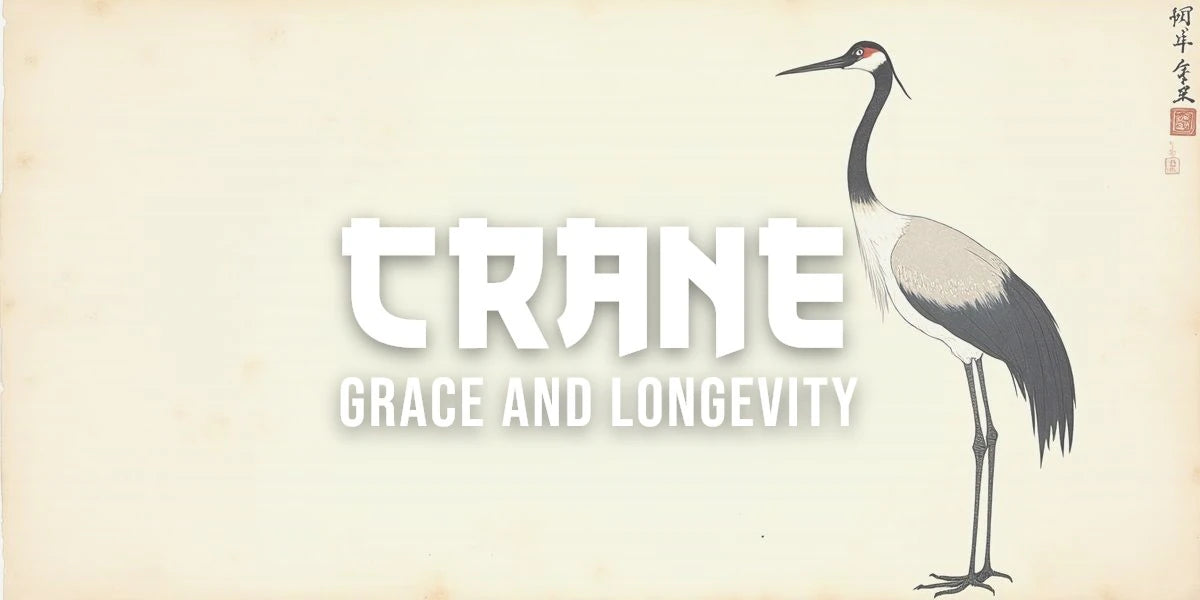
The first time I handled a wedding uchikake with cranes stitched across the back, I counted eleven birds before I noticed the twelfth hidden in the lining. That is how this motif works in Japan: it rewards a second look. In Japan, the crane (tsuru, 鶴) stands for longevity, peace and lifelong loyalty: folklore says it lives a thousand years, and because real cranes pair for life, it also became an emblem of faithful marriage. After 1945 that long-life meaning took on a second layer, when folded paper cranes turned into a wish for peace and recovery. Understanding japanese crane symbolism is also the fastest way to read a garment, because the bird appears on wedding kimonos, New Year decorations and haori linings, usually drawn with a white body, black-tipped wings and a red crown.
Key points
- The crane (tsuru) carries three linked meanings in Japan: long life, peace and lifelong loyalty.
- The thousand-year legend explains both the bird's status and the tradition of folding a thousand paper cranes.
- On fabric, recognise a crane by its red crown, black wing tips and S-curved neck, often set inside a circular tsuru-maru roundel.
- Crane patterns read as celebratory, which is why they belong on wedding, New Year and festival garments rather than everyday workwear.
Japanese crane symbolism: longevity, peace and loyalty
Three meanings sit on top of each other in this one bird. Longevity came first, borrowed from Chinese imagery. Marital loyalty came from watching real cranes behave. Peace is the most recent layer, barely seventy years old. Most articles blend them into one vague idea of good luck, which makes the motif harder to read rather than easier.
Why the Japanese crane is said to live a thousand years
The thousand-year figure is inherited, not observed. In Chinese Daoist painting, cranes carry immortals through the clouds and live on the island of the immortals, Penglai, known in Japan as Hōrai. That imagery arrived in Japan with Chinese art and poetry, and with it came the familiar pairing of the crane and the tortoise as creatures of enormous age. The saying tsuru wa sennen, kame wa mannen puts a thousand years on the crane and ten thousand on the tortoise. It was never a zoological claim. It is a figure of speech for a life so long it passes out of ordinary counting.
The real bird is impressive without the legend. The red-crowned crane (tanchō) stands around one and a half metres tall, the largest bird that breeds in Japan, and lives roughly thirty to forty years in the wild. Captive birds have reached sixty and beyond. Knowing the gap between the legend and the biology does not weaken the motif. It tells you what the pattern is doing: a crane on cloth is a wish addressed to the person wearing it, not a description of the animal. That is why crane patterns turn up on garments for births, weddings and sixtieth-birthday celebrations, the moments when a family wants to say "may this last".
So the longevity reading has two separate sources, and both matter when you buy a piece. The literary source explains the thousand-year shorthand. The conservation story explains why the bird also reads as precious and carefully protected in modern Japan. On a garment, a single large crane usually signals a formal, ceremonial piece. Small repeated cranes scattered over a ground colour read as a general auspicious pattern, closer to what a Western eye would call a print. Neither is more authentic than the other. They simply belong in different settings.
Cranes that pair for life: the crane and marriage
The marriage meaning rests on observable behaviour. Red-crowned cranes form long-term pair bonds and often stay with the same partner for many breeding seasons. They also perform a unison call, standing side by side with heads thrown back, and a courtship dance of leaps and bows that is easiest to see over snow in winter. People watching that in the marshes of Hokkaido did not need a myth to understand that these birds take partnership seriously. The symbolism grew out of the field, not the library.
That is why cranes dominate Japanese wedding textiles. A bride's shiromuku or coloured uchikake will often carry cranes in flight across the back and sleeves, sometimes a facing pair. You also meet the bird at the edges of a wedding: folded paper cranes on gift tables, and cranes shaped from mizuhiki cord on money envelopes. If you are choosing a piece to wear to a wedding, a crane motif is the safest culturally literate choice you can make. If you are choosing one for daily wear, remember that a Japanese guest will read it as a congratulation, which is charming but not neutral.
The tsuru in screens, prints and family crests
Painters treated the crane as a compositional gift. Its white body reads instantly against gold leaf, so cranes march across folding screens (byōbu) in Rinpa-school work, where the bird is often repeated in a rhythmic procession rather than drawn as one portrait. Ukiyo-e artists used it differently, isolating a single crane in bird-and-flower prints where the black wing tips and red crown do all the colour work. Both traditions feed directly into textile design, because the same cartoons and stencils circulated between painters, dyers and crest-makers.
Family crests compressed the bird furthest. A kamon family crest reduces a crane to a flat silhouette inside a circle, legible at the size of a coin on a formal garment. Crane crests are among the most common bird designs, with facing-crane and dancing-crane variants. For readers who want to study the motif without wearing it, I usually suggest starting with a wall piece rather than a garment: I keep one of our Japanese style prints near my worktable precisely because having the bird at eye level trains you to notice the crown and wing tips, and after a week you spot them on fabric without thinking. It is the cheapest way to build the habit of looking.

Tsuru in myth: the crane wife, senbazuru and Sadako
Three stories carry the crane in Japanese culture, and they do different work. One is a folktale about gratitude. One is a practice anyone can perform with paper. One is a twentieth-century history that gave the bird its modern political meaning. Separating them is what prevents the symbol from collapsing into generic good luck.
Tsuru no Ongaeshi: the crane who repays a kindness
In Tsuru no Ongaeshi, the crane's return of a favour, a poor man frees a crane caught in a trap. Soon a woman arrives at his door, asks for shelter, and offers to weave for him. She sets one condition: he must never watch her at the loom. The cloth she produces is extraordinary and sells for a fortune. Curiosity wins, he looks, and he sees a crane plucking her own feathers into the weft. Revealed, she returns to her bird form and flies away.
The tale exists in several versions, including Tsuru Nyōbō, the crane wife, where the pair are married. The structure is a broken-taboo story, common across Japanese folklore, and the moral is not simply "be kind". It is about the cost of the gift and the damage done by looking where you were asked not to look. The detail worth keeping is the loom. Of all the ways a crane could repay a debt, this story chose weaving, which ties the bird to cloth itself. When cranes appear on a kimono, they are landing on material the folktale already made their own.
Senbazuru: why people fold a thousand paper cranes
A senbazuru is one thousand folded paper cranes strung together on threads, traditionally in bundles so the garland hangs as several long strands. The practice links one wish to one thousand acts of patience: the folding is the point, not the finished object. Origami cranes have a long documented history in Japan. A 1797 book, Hiden Senbazuru Orikata, gives instructions for folding connected cranes from single sheets, and is generally treated as the oldest known printed work on recreational paper folding.
Today the garland travels. People fold senbazuru for someone in hospital, for a friend sitting an exam, for a newborn, and for couples marrying. Strands are hung at shrines and temples, and schools often fold them collectively so that a class can produce a thousand birds in an afternoon. The wish attached varies with the occasion, which is why a senbazuru is not only a get-well gift. What stays constant is the arithmetic of effort: a thousand small repetitions standing in for sustained hope.
Sadako Sasaki and the crane as a peace emblem
The peace meaning has a specific origin. Sadako Sasaki was two years old when the atomic bomb fell on Hiroshima on 6 August 1945. She developed leukaemia as a child, was hospitalised in 1955, and folded paper cranes during her illness. She died on 25 October 1955, aged twelve. Accounts differ on whether she completed a thousand cranes, and the Hiroshima museum's position is that she folded more than that figure. The uncertainty is worth stating plainly rather than smoothing over.
Her classmates campaigned for a monument, and the Children's Peace Monument was unveiled in Hiroshima Peace Memorial Park on 5 May 1958, crowned by a girl holding a folded crane above her head. Glass cases beside it hold garlands sent from around the world, and millions of cranes arrive in Hiroshima every year. This is the moment the bird acquired its third meaning. Before 1945 the crane meant long life and faithful partnership. After the monument, the folded crane also meant peace and the refusal of nuclear weapons. Articles about this tend to assert the peace symbolism without dating it, which makes it look ancient. It is not. It is postwar, and it is traceable.
How to recognize a crane motif on a kimono or haori
Here is the practical core. A crane on textile is built from four or five fixed signals, and once you know them you can identify the bird on a garment photo in a few seconds. The signals survive heavy stylisation, which is why they are reliable. What changes between pieces is the posture and the company the bird keeps.
Tsuru-maru: the crane sealed inside a circle
Start with the enclosure. A tsuru-maru roundel is a crane drawn inside a circle, usually with the wings sweeping round to complete the ring and the head turned back along the body. The circle comes from crest design, where a motif had to stay legible when printed small and repeated. On clothing you meet it in two forms: as five small crests on a formal black garment, placed at the back, chest and sleeves, or as a decorative roundel used as a repeating pattern across the cloth. The circular version is the most abstract crane you will encounter, so look for the shape of the enclosure first and the bird second.
Distinguishing a stylised crane from a purely geometric pattern takes one test. Trace the outline and ask where the head is. A crane roundel always keeps a visible head and beak breaking the curve, plus a dark marking where the wing tips cross. A geometric motif such as a shippō interlocking circle or a kikkō hexagon has no head and no asymmetry. If the design is perfectly symmetrical in every direction, it is not a bird. Cranes are never quite symmetrical, because the neck has to go somewhere.
Flying cranes vs standing cranes on a haori
Posture changes the message, and it also changes the silhouette you are hunting for. A flying crane stretches its neck straight forward and trails both legs behind in a long line, wings spread wide, which gives designers a diagonal that suits a sleeve or a back panel. A standing or dancing crane folds the neck into an S curve, shows the long dark legs, and sits upright, which suits a vertical hem placement. Read flying cranes as momentum, ascent and good news arriving. Read standing or dancing cranes as stability, rootedness and celebration in place.
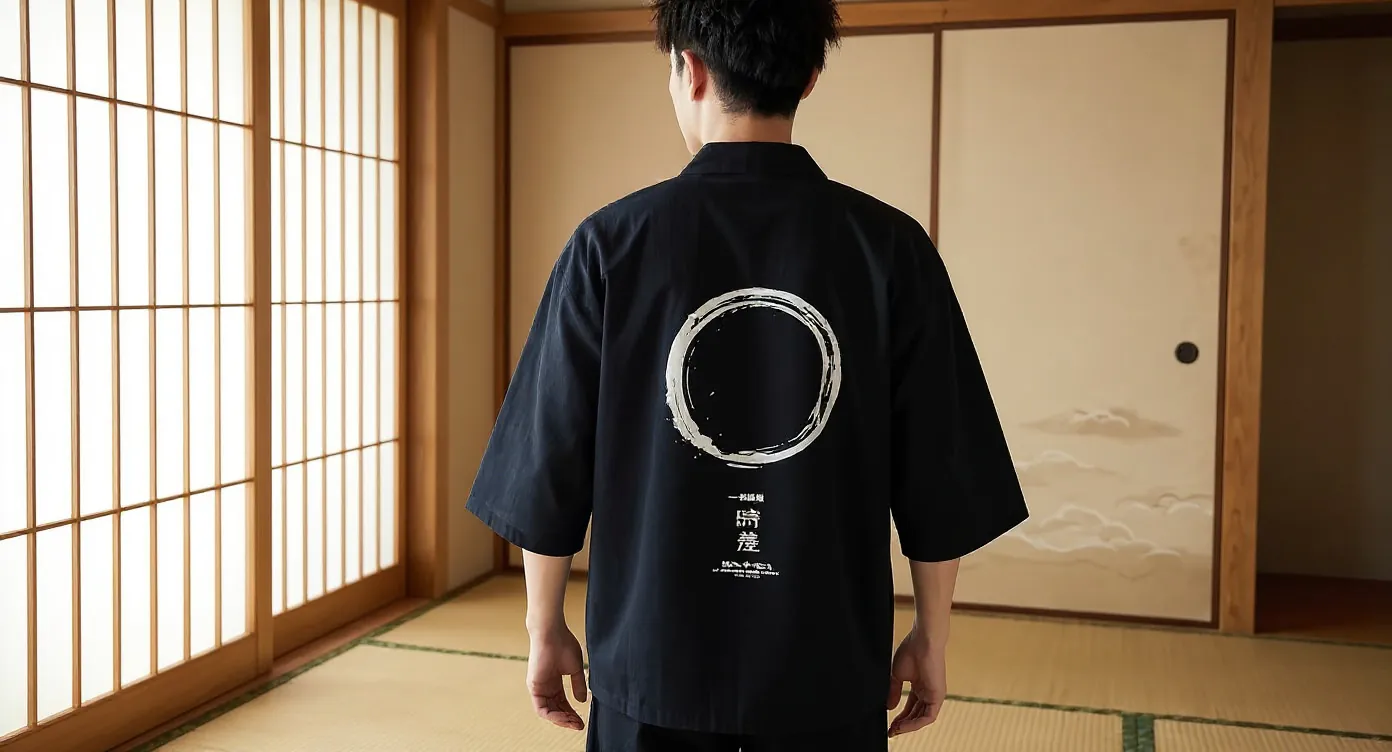
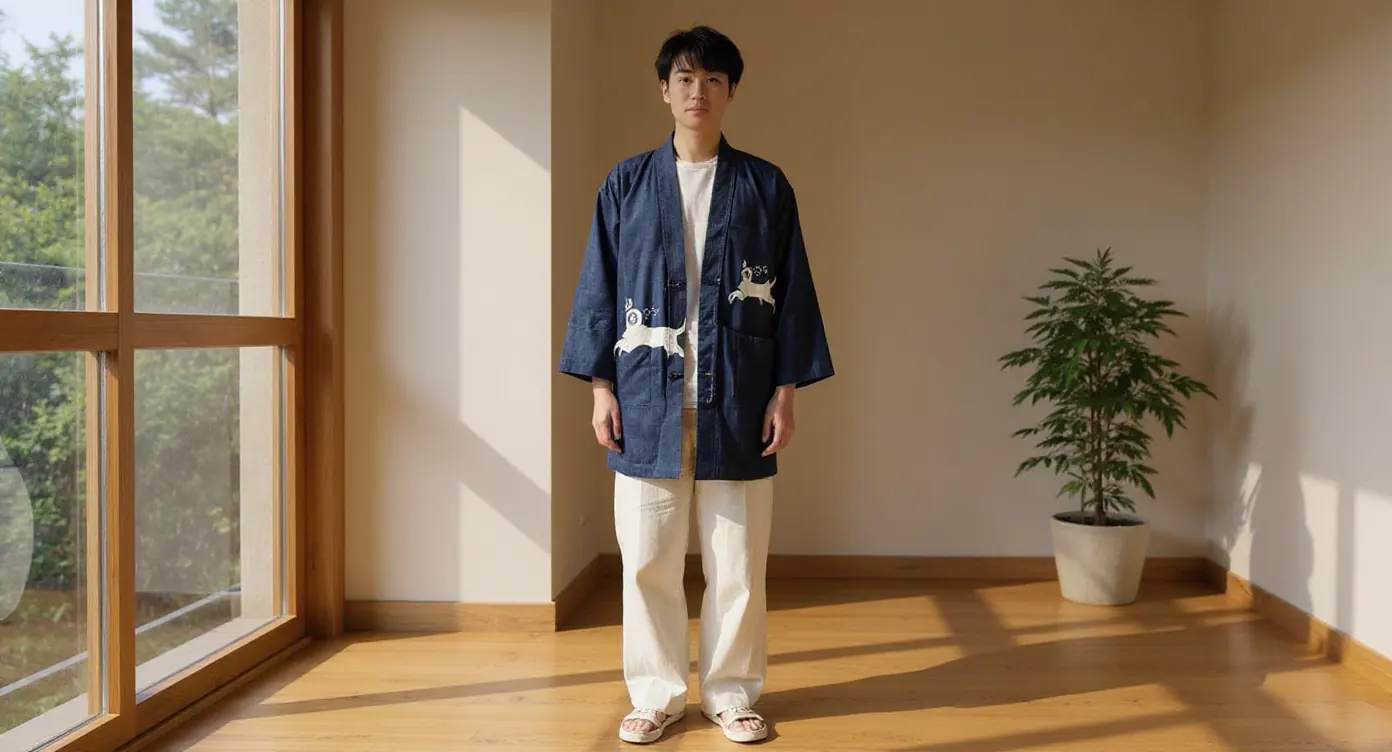
The Japanese haori is the piece I hand to anyone learning this, because the haori (羽織, a hip-length or thigh-length jacket worn open over other clothes) puts the motif exactly where you can study it: across the shoulders and down the back, or hidden in the lining. On a kimono the pattern is partly covered by the obi and the crossed front, so you see fragments. On a haori worn open, the back panel is a flat canvas. Note the dyeing method too. Yuzen dyeing, a hand-painted resist technique developed in Kyoto in the late seventeenth century, allows soft gradations in a crane's wing that a stencil print cannot reproduce, so painterly shading usually signals a more labour-intensive piece.

Crane with pine, bamboo or waves: reading the pairing
A crane rarely flies alone. Japanese pattern design works by combination, and the companion motif narrows the meaning considerably. Pine, bamboo and plum together form shōchikubai, the three friends of winter, a standard congratulatory grouping. Waves add a different note, since water patterns carry endurance and continuity. Clouds and rising sun discs push the piece towards New Year. Learning four pairings is enough to read most garments you will meet.
Use the table as a reading key rather than a rulebook, because dyers mix freely and a single piece may carry three companions at once. The practical consequence is simple: a crane with pine is a congratulation and belongs at a celebration, while a crane over waves is quieter and carries more easily into ordinary wear. This is also where the brand's attachment to Wabi-Sabi shows up in a buying decision. A slightly irregular hand-dyed wing, or a lining that has faded unevenly, tells you the piece was made and used by people. I would take that over a flawless machine repeat.
Crane, heron or phoenix: telling Japanese bird motifs apart
Most mislabelled cranes I see are herons or phoenixes. Online listings use the word crane loosely, and once a photo is cropped the three birds look similar at a glance. The distinctions are easy once you know which three features to check: the tail, the crown and the neck in flight. Spend a minute on the table below and you will not confuse them again.
Japanese crane vs heron (sagi): the quickest visual check
The fastest check uses the neck in flight, and it is genuine ornithology rather than design convention. Cranes fly with the neck fully extended forward, making a long straight line from beak to trailing feet. Herons and egrets fly with the neck folded back into a tight kink against the shoulders, so the bird looks hunched and compact in the air. On the ground the bill settles it: a heron carries a long straight dagger used for spearing fish, while a crane's bill is shorter in proportion and it has a patch of bare red skin on the crown that no heron has.
The crane and the ho-o phoenix are not the same bird
The hō-ō phoenix motif comes from the Chinese fenghuang and is a composite creature, not a species. Designers give it a pheasant-like body, a crest, and a tail of several long trailing plumes that curl like flames, often rendered in gold on brocade. It carries associations with virtuous rule and with the empress, and it is the bird perched on the roof of the Phoenix Hall at Byōdō-in in Uji. Nothing about it is meant to resemble an animal you could watch in a marsh.
Mixing the two changes the register of a garment. A crane is auspicious and personal, a wish for the wearer's long life and faithful partnership. A phoenix is grand and ceremonial, closer to dynastic imagery, and it tends to appear on the most formal brocades. If a listing shows a bird with a flowing multi-plume tail and calls it a crane, the description is wrong, and the piece will read differently at an event than you expect. Check the tail first, every time. Cranes have a short tail, and what looks like a black tail on a standing crane is actually the drooping wing feathers folded over it.
Crane motifs vs sakura and wave patterns on a kimono
Birds and plants also differ in how they handle the calendar. Japanese dress has a strong seasonal grammar: cherry blossom belongs to spring, maple leaves to autumn, and wearing them out of season is noticeable. Cranes escape that system because they are auspicious rather than seasonal, which means a crane motif is wearable all year. That makes it more useful than sakura for anyone building a small wardrobe of Japanese pieces from outside Japan.
Wave patterns sit somewhere between the two. Seigaiha, the repeating fan-shaped wave, is a geometric ground pattern used as a background rather than a statement, so it combines with almost anything. The practical hierarchy is worth remembering when you are putting an outfit together. Cranes are a lead motif and should be the loudest thing you wear. Waves and other geometric grounds are supporting patterns. Seasonal flowers are lead motifs with a date attached. One lead motif per outfit is the rule that keeps a traditional piece looking considered rather than costumed.
Styling a crane haori or kimono with everyday clothes
A symbol you never wear stays an abstraction. Crane pieces work in modern wardrobes, but they need discipline, because the motif is both large and culturally legible. The approach I recommend is to treat the crane as the single ornament of the outfit and strip everything else back to plain colour and clean lines.
A crane haori over jeans and a white tee
The combination I come back to is a black crane haori over a white t-shirt and black jeans, with plain leather or canvas shoes. Neutral layers underneath turn the back panel into the focal point, and the open front of a haori frames the torso in two vertical lines that lengthen the silhouette. Keep the sleeves of your t-shirt short or close-fitting so they do not fight the wide haori sleeve. Avoid logos, stripes and graphics underneath, since the crane is already carrying a complex drawing. If your haori has a patterned lining, roll the front panel back slightly at the top so a strip of it shows.
Colour matters more than people expect. A white-bodied crane needs a dark or mid-tone ground to read from a distance, so indigo, charcoal and black grounds are the most wearable. Cream and pale grounds make the bird subtle and lean formal, which suits an occasion better than a street outfit. If you own one strong piece, make it a dark-ground haori. It will carry over jeans in the afternoon and over tailored trousers in the evening, which is the Kaizen logic of improving a wardrobe one considered piece at a time rather than buying in bulk.
Crane motifs for weddings, New Year and festivals
Crane patterns are congratulatory, so events are where they belong without any hesitation. At a wedding, a crane piece reads as a compliment to the couple, and the pairing meaning makes it specifically appropriate rather than merely decorative. At New Year, the bird joins pine and sun motifs as a standard opening-of-the-year image. At a summer festival or a convention, a crane haori over simple clothes gives you a coherent look without the commitment of full formal dress. Those three settings cover nearly every reason someone orders one.
For a full kimono rather than a haori, the belt does the structural work, and it also decides how much of the motif you see. A wide obi closes the garment, holds the front panels flat, and cuts the body at the waist so the pattern above and below reads as two clean fields. The one I reach for most is a plain black obi belt, because a solid dark band stops competing with the cranes and sharpens them instead, which is exactly what a patterned garment needs. Plan the obi position before you dress: raising or lowering it by a few centimetres can hide or reveal a bird placed near the waist.

Do crane patterns differ for men and women?
Yes, mostly in scale and placement rather than in the motif itself. Women's formal garments, especially the long-sleeved furisode, carry large flowing compositions where cranes sweep across the hem, sleeves and back as one continuous picture. Men's traditional dress is far more restrained, so the crane usually appears as a small crest, as a woven texture in a dark ground, or hidden in the lining of a haori where only the wearer knows it is there. Modern pieces blur this, and I see plenty of women choosing the quiet lining-only version and plenty of men wearing a large back panel. Treat the historical pattern as context, not permission.
Sizing deserves a warning before you order. Japanese sizes run about one size smaller than US and EU equivalents, and traditional cuts are straight rather than shaped, so the fit depends mainly on shoulder width and sleeve length. Measure your shoulders and the distance from your nape to where you want the hem to fall, then check those numbers against the product page rather than trusting the letter size. A haori that is slightly generous still hangs correctly. One that is tight across the back will pull the motif out of shape, which defeats the purpose.
Use the table as a starting point and confirm with the measurements listed on the piece you want. Fabric also changes the calculation. Cotton and polyester haori keep their shape and suit a looser fit, while silk drapes closer to the body and shows the line of the shoulder more honestly. If you are between sizes and plan to layer over a sweater, take the larger one.
Japanese crane and tsuru: frequently asked questions
These are the questions readers send me most often about the bird and its motif. Short answers below, with the nuance kept where it changes the meaning.
What does tsuru mean in Japanese?
Tsuru (鶴) simply means crane, the bird. It also appears inside compound words and names, such as senbazuru for a thousand cranes and tsuru-maru for a crane in a circle. The species most often pictured is the red-crowned crane, called tanchō in Japanese, a name that refers to its red crown.
What is the Japanese myth about the crane?
The best-known tale is Tsuru no Ongaeshi, in which a man frees a trapped crane and a woman later appears and weaves exquisite cloth for him, on condition that he never watch her work. He looks, discovers she is the crane weaving with her own feathers, and she flies away. A related version, Tsuru Nyōbō, makes her his wife. Both are folktales about gratitude and a broken promise, not religious scripture.
Are cranes considered good luck in Japan?
Yes, the crane is one of the standard auspicious motifs, grouped with the tortoise, pine and bamboo. It is associated with long life, lasting partnership and, since the postwar period, peace. That is why crane patterns appear on wedding garments, New Year decorations and gifts for someone recovering from illness.
What does it mean if a crane visits you?
There is no single traditional omen attached to a crane visit, though the bird's auspicious reputation means a sighting is generally taken as a welcome sign. In practical terms, cranes are migratory, and in Japan they are concentrated in known wintering grounds such as eastern Hokkaido and Izumi in Kagoshima. Seeing one is a seasonal event rather than a message.
Which Japanese deity is associated with cranes?
No single deity owns the crane. Among the Seven Lucky Gods, the longevity figures Jurōjin and Fukurokuju are frequently depicted with a crane beside them, alongside tortoises and deer. In older Chinese-influenced imagery, cranes also serve as the mounts of immortals, which is where much of the bird's sacred association comes from.
If you want to see how cranes sit on a full garment rather than a jacket, our Japanese kimono dress collection is a good place to study placement, ground colour and companion motifs side by side.
Explore the Japanese Kimono Dress collection
Browse the kimono collection to see where crane, pine and wave motifs actually sit on a garment, with Japan–US–EU size charts.
Browse the collection →