The first sound in a kendo dojo is rarely the shinai. It is the floor: a flat, dry slap of bare feet landing in unison. That sound is the reason kendo footwork decides everything. Your strike is only as fast, as accurate and as valid as the body that carries it, and in kendo (剣道), the shinai (竹刀, bamboo sword) arrives with the left foot, not with the arms. Beginners spend their first months on ashi-sabaki (foot movement) precisely because distance, timing and balance all live in the feet. Learn to slide, to push off the left leg and to land a clean fumikomi, and the cuts stop looking like arm-waving.
In short:
- Kendo footwork is sliding footwork: heels barely off the floor, weight forward, left heel loaded like a spring.
- Okuri-ashi is the workhorse. The rear foot never crosses the front foot: forward starts with the right, backward with the left.
- Fumikomi is a flat stamp driven by the left leg, synchronised with the cut and the kiai, not a stomp for noise.
- A well-fitted hakama and clean tabi let you feel the floor and let the judge see your feet. Kit is part of the training.
Why kendo footwork decides the whole strike
Kendo is a modern budō descended from kenjutsu, the sword techniques of the samurai. It was codified into a practice with armour (bōgu) and shinai so that full-speed strikes stay safe. Its rules reward the whole body moving as one unit. That is why a beginner with strong arms and lazy feet scores nothing.
Kendo as a way of the sword, not just a sport
The kanji say it plainly: 剣 (ken, sword) and 道 (dō, way). Kendo kept the etiquette, the postures and the distance logic of the old sword schools, then added competition rules in the twentieth century under the All Japan Kendo Federation. A shinai is treated as a blade. You cannot slap with a blade. You have to carry it into the target with your hips and legs, which is what the footwork trains.
Ki-ken-tai-ichi: how the feet validate a point
A valid point in kendo is called yūkō-datotsu. It requires ki-ken-tai-ichi: spirit, sword and body arriving together. In practice, your kiai, your shinai and your right foot must land in the same instant. If the foot arrives a fraction late, the judges see a broken strike and the flags stay down. The feet are what the referees read.
What beginners get wrong in their first kendo footwork months
Three habits appear again and again. Beginners lift their knees and walk instead of sliding. They push with the front leg instead of driving from the back leg. They finish the cut with the left foot trailing behind, body stretched, unable to follow up. None of these are strength problems. They are pattern problems, and patterns respond to slow, boring repetition.
Chudan stance: the foot position all movement starts from
Every step you will learn begins and ends in chudan-no-kamae, the middle guard with the shinai tip pointing at the opponent's throat. If the stance is wrong, the footwork inherits the fault. Fixing your feet in kamae is the highest-value ten minutes you can spend alone at home.
Right foot forward, left heel lifted: the reference posture
Stand naturally. Put the right foot forward so the toes of the left foot sit roughly level with the heel of the right. Keep about one fist of lateral width between the feet so you are not on a tightrope. Both feet point forward. The left heel lifts off the floor by the thickness of a sheet of paper, no more. A high left heel looks dynamic and is actually slow.
Weight distribution and the loaded left leg
Roughly sixty percent of your weight sits on the front foot, forty on the back, with the left leg straight but not locked. That back leg is your engine: a compressed spring waiting for release, not a kickstand. Knees stay soft, hips face the front, shoulders drop.
Checking your kendo stance against a wall or floor line
Use a floorboard seam, a tile joint or a strip of masking tape as a reference line. Place both feet along it and check three things: toes forward, one fist of width, left heel barely raised. Then slide forward and back along the line. If your head bobs up and down, your knees are lifting. Filming from floor level for thirty seconds tells you more than an hour of guessing.
Suri-ashi, okuri-ashi, tsugi-ashi: the five types of ashi-sabaki
Kendo uses a small, closed vocabulary of steps. Learn the five and you have covered almost everything you will do in jigeiko (free practice) and shiai (competition). The common thread is suri-ashi, the sliding quality where the soles brush the floor rather than lift from it.

| Name | Movement | Typical use | Common beginner mistake |
|---|---|---|---|
| Suri-ashi | Sliding the soles along the floor, no lift | The base quality of every other step | Lifting the knees and walking |
| Okuri-ashi | Lead foot moves first, rear foot follows, never crossing | Short advances and retreats, most of jigeiko | Letting the left foot land beside or past the right |
| Tsugi-ashi | Left foot creeps up close to the right, then a long step forward | Closing an unusually long distance before attacking | Telegraphing the attack by creeping too visibly |
| Ayumi-ashi | Ordinary alternating walking, kept low and sliding | Long travel, kata, some long-distance attacks | Using it in close combat, where it exposes the body |
| Hiraki-ashi | Diagonal or lateral opening step with a body turn | Evasion, counters such as debana or kaeshi techniques | Turning the shoulders without moving the feet |
Suri-ashi, the sliding base of every kendo step
Suri-ashi (摺り足) means sliding foot. The sole never fully leaves the floor, which keeps your centre of gravity flat and your shinai tip stable. A stable tip means the opponent cannot read your intention. Practise slowly first, then add speed without adding height.
Okuri-ashi for advancing and retreating in a straight line
Okuri-ashi is the step you will use most. Forward: the right foot slides first, the left snaps up behind it. Backward: the left foot goes first, the right follows. The rear foot never crosses the front foot, so your kamae stays intact at every instant. Small steps, high frequency, no bouncing.
Tsugi-ashi, ayumi-ashi and hiraki-ashi: when each one is used
Tsugi-ashi is a preparation step: you gather the left foot forward, then launch. It buys reach when your opponent stays outside maai, the combative distance, and outside issoku-ittō-no-maai in particular, the distance from which one step produces one strike. Ayumi-ashi is legitimate for covering long ground and appears in the kata. Hiraki-ashi is your escape hatch, moving diagonally off the line while your body turns to face the target again.
Fumikomi-ashi: how to stamp without wrecking your knees
Fumikomi-ashi is the stamping step that accompanies a committed cut. Done well, it is quiet in the joints and loud on the floor. Done badly, it is loud in the knees and flat on the scoreboard. The difference is where the power comes from.
Driving the fumikomi from the left leg, not the right
The left leg extends and pushes the whole body forward. The right foot does not reach or kick out on its own: it is carried, then set down. If you feel your right thigh working hardest, you are pulling yourself along instead of being launched. A useful image is a swimmer pushing off the pool wall.
Landing flat and pulling the left foot up immediately
The right foot lands flat, sole and heel together, knee soft. Never land heel first with a locked leg: that sends the shock straight through the knee and hip. The stamp is a byproduct of a strong forward drive, not a goal. Chasing the sound is the fastest route to a sore heel.
Hikitsuke and recovery after the strike
Hikitsuke, the immediate recall of the left foot, is the invisible half of the movement. As soon as the right foot lands, the left snaps back under your hips so you can continue forward into zanshin, the alert follow-through. Without it, you finish stretched out and defenceless. Wide, fluid trousers help here, which is why I keep a pair of Hakama Pants for demonstration work: the volume and weight of the pleats follow the explosive step instead of catching on the knee.

Kendo footwork drills you can practise at home without a dojo
Footwork needs no partner, no bōgu and barely any space. Three sessions of fifteen minutes a week will change your kamae in a month. Work on a smooth floor if you can, in socks or bare feet, never in shoes.
Ten minutes of suri-ashi on a smooth floor
Set a timer. Two minutes of slow forward and backward sliding, focusing on a level head. Three sets of twenty okuri-ashi steps forward and twenty back, each set faster than the last. Finish with one minute of continuous small steps at maximum frequency. Keep the shinai tip, or a broom handle, steady in front of you as your feedback tool.
Okuri-ashi ladder and line drills for distance control
Mark two lines on the floor with tape, roughly two metres apart. Slide from one to the other and count your steps. The aim is consistency: the same number of steps every crossing, then the same crossing in one step fewer. That is distance control in its rawest form, and it transfers directly to reading maai against an opponent.
Stairs, hops and leg work for fumikomi explosiveness
Twice a week, add ten single-leg hops on the left leg, three sets, landing softly. Then twenty stair ascents pushing off the left foot only. Then thirty seconds of lateral hops for hiraki-ashi agility. Build up over weeks, not days. If your ankles or knees ache the next morning, cut the volume in half.
Hakama and tabi: what to wear for clean footwork
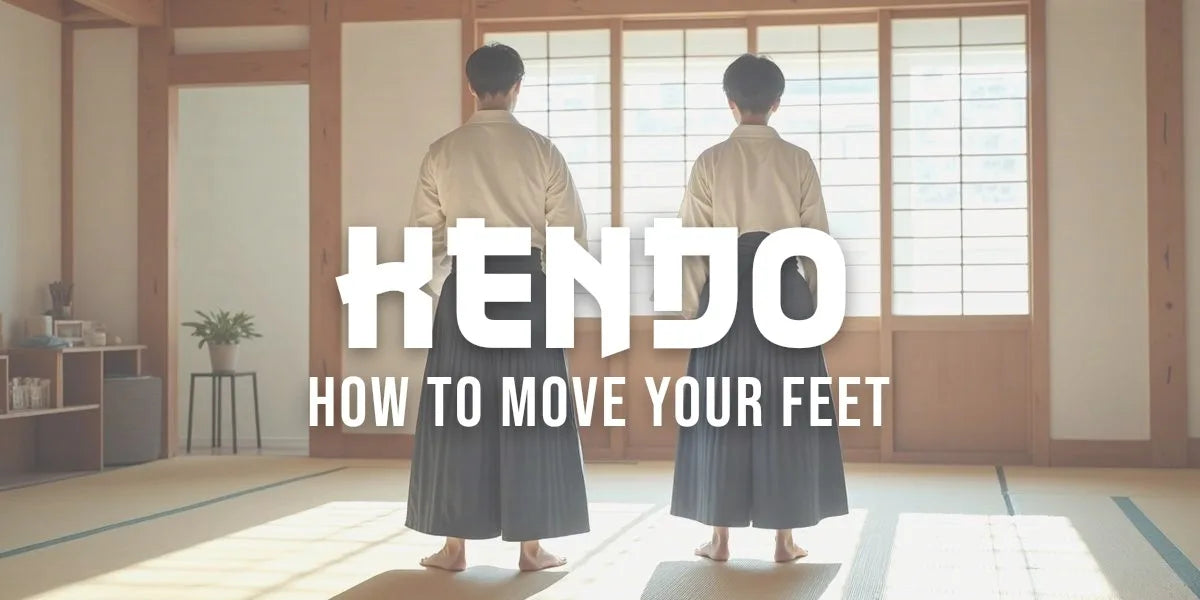
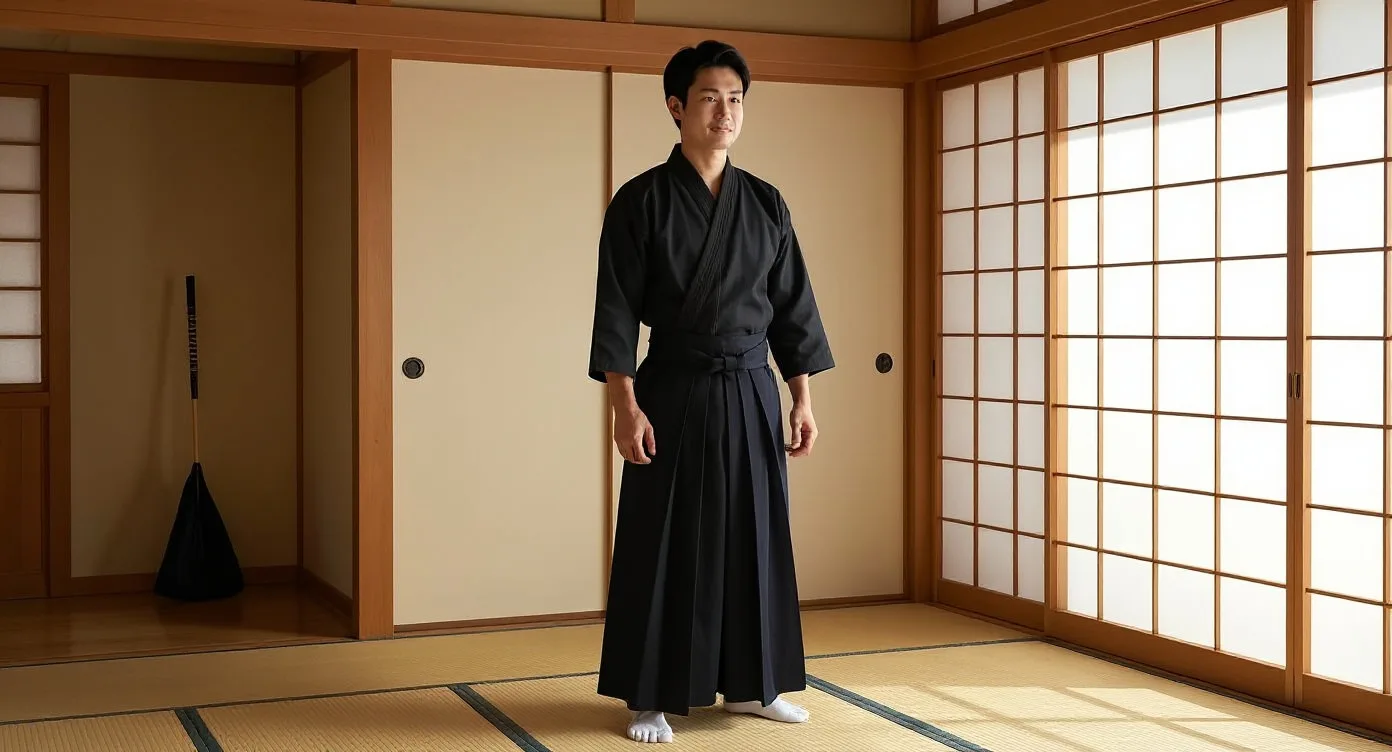
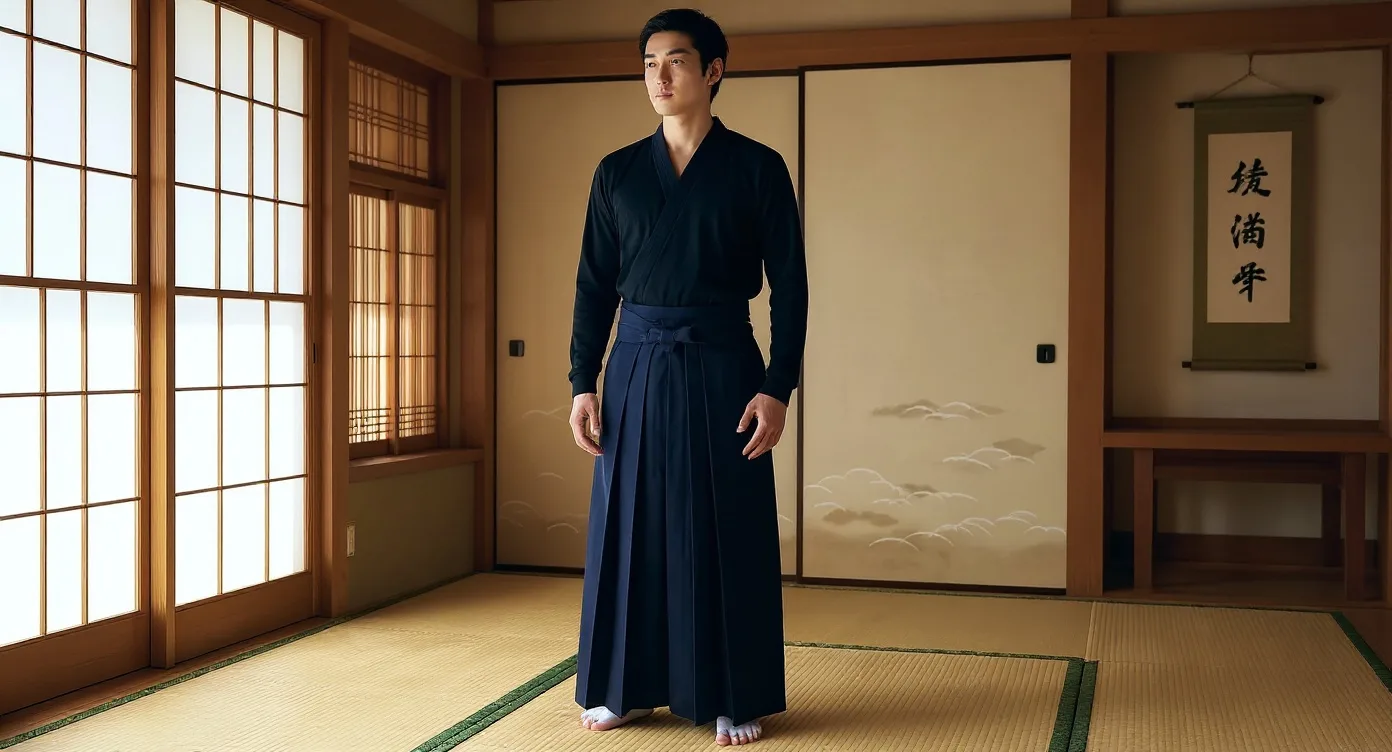
Kendo is practised in a kendogi (剣道着, the padded cotton jacket) and a hakama (袴, pleated wide trousers inherited from samurai dress). The hakama hides the small preparatory movements of your legs, which is exactly why your feet must be trained rather than improvised. Getting the length right is a technical decision, not a style one.
Choosing hakama length so it clears the floor
The front hem should sit at the top of the foot, just covering the ankle bone, with the back hem slightly higher. Too long and you will step on it mid-fumikomi. Too short and your ankles are exposed, which looks unfinished in a grading. Traditional lengths are measured in sun (寸), an old unit worth about 3.03 cm, taken from the waistband to the hem.
| Your height | Approx. hakama length | In sun |
|---|---|---|
| 160 to 168 cm (5'3" to 5'6") | 73 to 79 cm | 24 to 26 sun |
| 168 to 176 cm (5'6" to 5'9") | 79 to 85 cm | 26 to 28 sun |
| 176 to 184 cm (5'9" to 6'0") | 85 to 91 cm | 28 to 30 sun |
Tabi and socks: grip, glide and blister control
Kendo is traditionally practised barefoot, and bare feet remain the standard in competition. Tabi (足袋, split-toe socks) are usually worn in cold dojo, for training in other arts, or with the teacher's permission to protect an injured foot. Cotton tabi with a firm sole give a slight glide that suits suri-ashi, while thick modern socks tend to slip. For blisters under the ball of the foot, the fix is usually technique rather than padding: you are dragging instead of sliding.
Japan / US / EU size equivalences
Japanese sizing runs about one size smaller than US and EU sizing, so a Japanese L usually corresponds to a US or EU M. Hakama are sized on waist and hip measurement plus length, not on trouser size. Tabi are sized on foot length in centimetres.
| Foot length | US (men) | EU |
|---|---|---|
| 24 cm | 6 | 38 to 39 |
| 25 cm | 7 | 40 |
| 26 cm | 8 | 41 |
| 27 cm | 9 | 42 to 43 |
Kendo footwork questions beginners ask most
These are the questions that come up in almost every message I receive about kendo and hakama. Short answers, no theory.
What are the five stances in kendo?
The five kamae are chūdan (middle), jōdan (high), gedan (low), hassō (sword vertical beside the shoulder) and waki (sword hidden behind the body). Chūdan is the reference guard and the one almost all beginners use exclusively. The others appear later, mostly in kata and in specialised competitive styles.
What are the different types of kendo footwork?
The core set is okuri-ashi, tsugi-ashi, ayumi-ashi and hiraki-ashi, all performed with the sliding quality of suri-ashi, plus fumikomi-ashi for the stamping attack. Okuri-ashi covers the vast majority of practice. The rest are situational tools for distance, travel and evasion.
How long does it take to learn fumikomi?
Most beginners produce a recognisable fumikomi within two or three months of regular practice, and a genuinely synchronised one after a year or more. The delay is not physical strength: it is the coordination of foot, shinai and kiai. Slow repetition without armour builds it faster than hard hitting.
Is kendo useful in a real fight?
Kendo is a martial way built around a sword, with rules, armour and defined targets, so it is not self-defence training. What it does build is distance awareness, timing, posture and composure under pressure. Those transfer, the specific techniques do not.
Can I practise kendo footwork on carpet?
You can practise the pattern of okuri-ashi on carpet, but not the glide, because the friction forces you to lift your feet. Use it for posture, step order and rhythm, then confirm the sliding quality on a smooth floor. Avoid fumikomi on carpet over concrete, and skip it entirely if you live upstairs.
If you want a hakama that behaves properly under a fumikomi, look for length first and fabric weight second. Both details are covered in our samurai clothing collection, alongside the pieces I recommend most often to practitioners.
Explore the Samurai Clothing collection
Browse our hakama, tabi and training pieces with Japan/US/EU size charts for each cut.
Browse the collection →