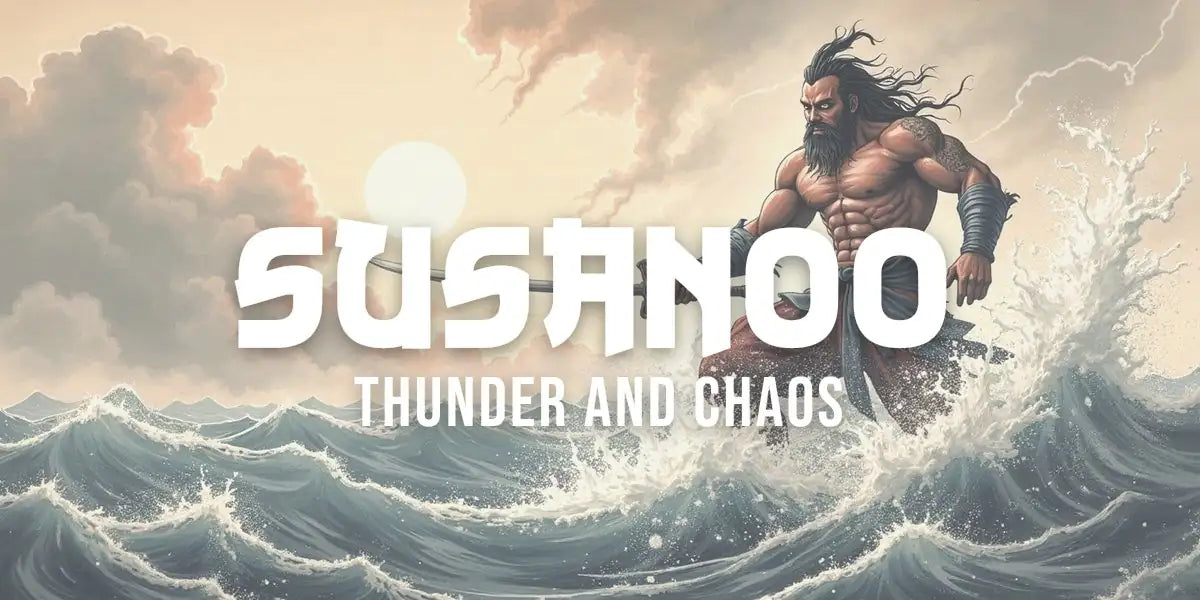
Susanoo is a kami god of Japanese mythology. He is a Shinto deity known for his warlike temperament but also for his heroic acts. He defeated the serpent demon Yamata No Orochi.
The sea off Izumo looks gentle in the morning. Flat water, grey light, fishing boats barely moving. Then the wind turns and the same water tears the coast apart. That double nature is Susanoo (須佐之男), the Shinto god of storm and ocean, and it explains why he remains one of the most quoted kami in Japanese mythology and manga.
Key points
- Susanoo is the Shinto god of storms and the sea, born from Izanagi along with Amaterasu and Tsukuyomi.
- He was banished from heaven for his violence, then became a hero by slaying the eight-headed dragon Yamata no Orochi.
- From the dragon's body he drew the Kusanagi sword, now one of the three sacred treasures of Japan.
- He tested Okuninushi with four trials before blessing his marriage to his daughter Suseribime.
- In Naruto, Susanoo is a sharingan technique with three forms, which is how most readers outside Japan meet the name.
Susanoo is a god who is still worshipped today and especially in Japanese pop culture such as manga.
Susanoo, sometimes written "Susano'o", "Susano-o" or "Susan'o" is, in Japanese Shintoism, the god of storm and ocean. He is also nicknamed "The Impetuous". Because under a false appearance of tranquility or innocence hides in reality a rebellious and turbulent spirit. The ocean, his domain, reflects well this tumultuous character.
Under its calm and peaceful appearance, the sea causes, when it breaks loose, the greatest devastation. Japan knows this well. The archipelago sits on four tectonic plates and has been struck by tsunami again and again across its recorded history. A god of the sea, in that context, is not a decorative figure. He is the name given to a force people have to live with.
Susanoo myth
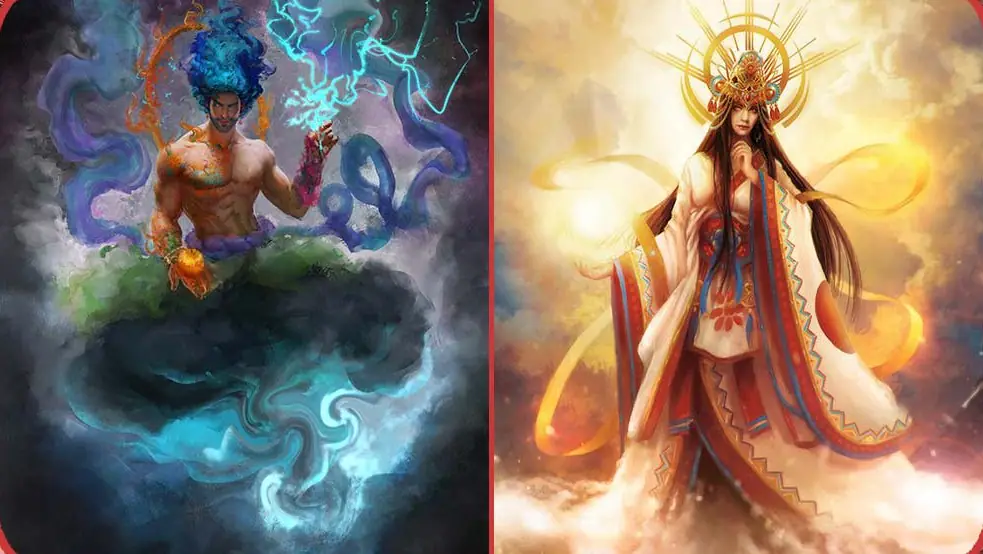
Susanoo is one of the three noble divine children of the Mihashira-no-Uzunomiko myth. Back from Yomi (Japanese hell in Shinto mythology), Izanagi gave birth to Amaterasu by rinsing her right eye. Then to Tsukiyomi by rinsing her left eye and to Susanoo by wiping her nose. The Japanese myth tells us that Izanagi gave parts of her domain to her children. Amaterasu inherited the day sky, Tsukiyomi the night sky and Susanoo received the ocean.
The division matters. Each child receives a realm that matches a temperament. The sun gets order and visibility. The moon gets the quiet half of the cycle. The sea gets the one who cannot settle.
While his siblings went to their respective domains, Susanoo lamented the absence of his mother, Izanami. He provoked the fury of his father who banished him from the domain he had entrusted to him and condemned him to join his mother in the underground world, the Yomi.
Susanoo, upset, took his anger out on the earth, destroying hills and mountains. Before going to his new domain, he pretended to visit his sister Amaterasu. This one, knowing the character of her brother and the resentment which animated him, sensed that it would not be a courtesy visit.
She equipped herself with all her fighting gear, a big bow and arrows, and waited for him at the entrance to her kingdom. When she met him, Susanoo told her that his intentions were peaceful and he proposed a challenge to his sister to prove it. Amaterasu accepted.
The winner of the challenge would be the one who could create the most kami (lower Japanese spirits or deities). Amaterasu asked for her brother's sword, she broke it into pieces, chewed it up and spit it out as a mist. From this mist were born 3 female kami.
Susanoo, in his turn, used the jewels that his sister wore around her neck, crushed them in his mouth and by the smoke that he spat out he gave birth to 5 male kami. Amaterasu considered herself victorious since her necklace had produced the most kami. But her brother said that the three delicate female kami born from the pieces of her sword were a sign of the purity of her heart.
Amaterasu was convinced of Susanoo's honesty and agreed to let him stay in her kingdom. But he continually tormented his sister with his mischievous nature, ransacking and vandalizing everything, even the heavenly palace of the Japanese sun goddess.
Amaterasu withdrew to a cave, depriving the divine and mortal worlds of her precious light. The gods of heaven decided to punish her brother and shaved off his beard and tore off his nails before banishing him from heaven.
That detail is harsher than it sounds. Cutting the beard and the nails strips a kami of what marks him as divine. He leaves heaven looking like a man, which is exactly the state in which the second half of his story begins. The storm god becomes a wanderer on foot, and the costume of that wanderer, rough and dark, is the look most cosplayers reach for when they build a Susanoo outfit. A short embroidered jacket does the same job today, with dragons and waves stitched across the back.

Susanoo, the Princess and the Japanese Dragon
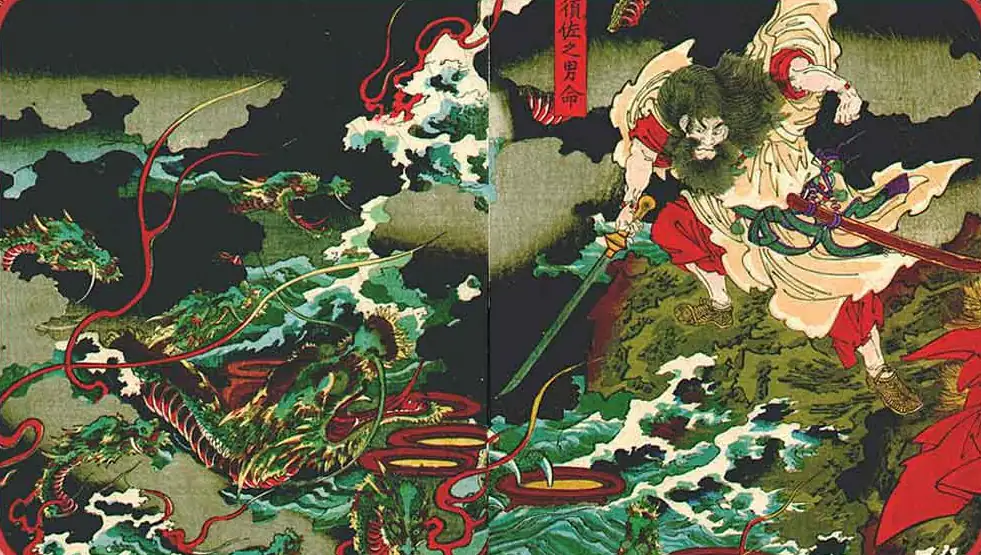
In Japanese mythology Susanoo is not always a vandal god who messes with his sister. He also stands out for his heroic acts.
He comes down to the earth after his banishment and starts to walk it. He arrives in the small village of Izumo where he finds some grieving peasants. When he questions them, the locals explain the torment caused by an eight-headed dragon called Yamata no Orochi.
Every year, they are forced to sacrifice a young girl to the monster. And this time they offer him Kushinada-hime, the king's daughter. Susanoo meets the king and his beautiful daughter. He decides to fight the demonic dragon.
He builds a fence with eight holes around the village. In front of each hole, a barrel of sake is placed. When Yamata-no-Orochi came to collect his sacrifice, each of his heads spitting flames was attracted by the smell of the beverage. The 8-headed monster drank the contents of the eight barrels and became too intoxicated with alcohol to fight Susanoo, who decapitated his eight heads with Totsuka, his greatsword.
Note the method. He does not win by strength. He wins by knowing what the monster wants. That trick, trapping a demon with its own appetite, runs through Japanese folklore and shows up again in the way Oni are handled in festival tales.
He got the hand of the king's daughter whom he had saved. He also got the Kusanagi sword, "The grass-cutting sword", which he drew from the monster's corpse. According to some texts, he offered it to his sister Amaterasu to be forgiven for his bad acts. She later gave it to Ninigi, the first ancestor of the Japanese imperial family. The weapon drawn from the dragon Susanoo defeated became a symbol of imperial power, and one of the three sacred relics of Japanese treasures.
The other two are the mirror Yata no Kagami and the jewel Yasakani no Magatama. Together they are the Imperial Regalia. No photograph of the three has ever been published, and even enthronement ceremonies present them wrapped. The sword kept at Atsuta Shrine in Nagoya is said to be Kusanagi, but nobody outside a very small circle has seen it.
After defeating the dragon, Susanoo settled in Shuga with his wife, and built a palace there. His wife's father became the guardian of his new home and renamed it "Suga No Tatsumimi No Kami" which can be translated as "The eight-eared deity of Suga". Susanoo lived there for some time before finally joining the Yomi.
The myth of Okuninushi
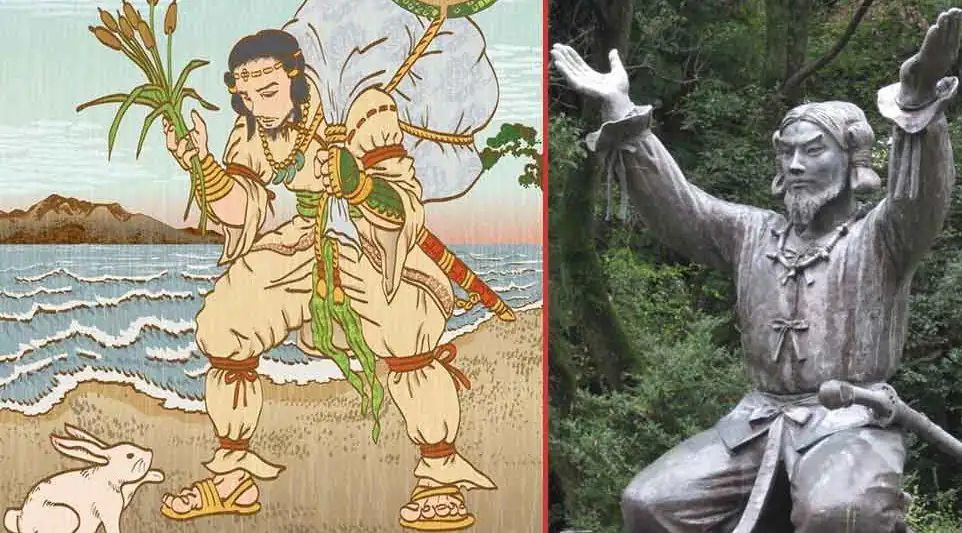
Susanoo's daughter was called Suseribime. A young man came to take refuge in the underworld of Susanoo's domain. He wanted to escape from his brothers who wanted to kill him.
Suseribime and Omamuji (also called Okuninushi) fell in love with each other. But Susanoo did not approve of their union. So he made his daughter's suitor pass four tests:
- First, Susanoo summoned Onamuji to his house and put him in a room full of snakes. But, thanks to the help of Suseribime who gave him a special scarf, the young man had nothing to fear from the reptiles.
- Susanoo then put his guest in another room, this time inhabited by a thousand legs and bees. But Onamuji once again escaped unscathed with the help of another scarf that his sweetheart made for him.
- Suspecting that his daughter is helping Onamuji, Susanoo takes him out of the palace for the third test. The kami shoots an arrow in a huge plain and asks Onamuji to bring it back to him. Suseribime's father burns the plain. Thanks to a field mouse, Onamuji found the arrow and managed to escape the flames by hiding in a hole.
- For the last test, the thunder Japanese god orders him to get rid of the lice in his hair but Onamuji finds none. Suseribime once again came to her lover's aid. With the mixture of nuts and red clay that she provided, Onamuji pretended to crush the lice that he was removing from Susanoo's hair.
Read the four trials together and a pattern appears. Onamuji never passes alone. A scarf, another scarf, a mouse, a handful of clay. The hero survives because other beings help him, which is the opposite of how Susanoo himself operated in heaven.
The two lovers saw that the kami was fiercely opposed to their union and decided to flee. They waited for Susanoo to fall asleep. Onamuji tied Susanoo to his palace by the locks of his hair, stole Susanoo's koto, sword, bow and arrows and fled with Suseribime after placing a big rock in front of the palace exit.
But in their flight, the sword rubs against a tree, alerting the owner of the place who wakes up with a start. He went after Onamuji and his daughter. But seeing that he could not hold them back, Susanoo gave them his blessing. Onamuji was then called Okuninushi no kami (Master of the great territory). And with Susanoo's weapons, he managed to defeat his brothers.
Okuninushi goes on to become the builder of the land and the main deity of Izumo Taisha, one of the oldest shrines in Japan. The ill-tempered father-in-law turns out to be the one who armed the next generation.
Susanoo in the manga
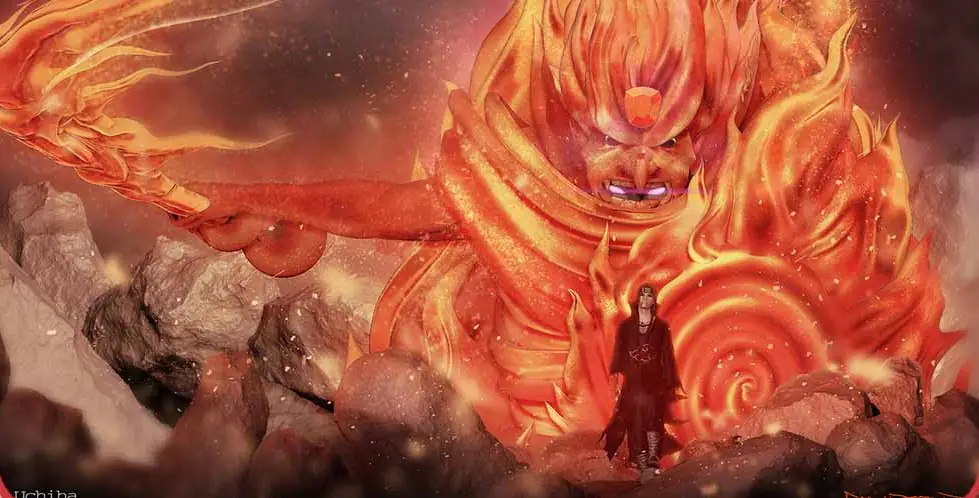
In Naruto manga, Susanoo is a ninja technique linked to the power of sharingan of Uchiha clan. It is one of the favorite techniques of otaku.
This ninjutsu allows to create an entity which protects the shinobi against devastating attacks, and which has a devastating power. The ninja can materialize some weapons: bows, katana and more.
Susanoo has a different appearance depending on the character who uses it. Itachi Uchiha's Susanoo is orange, Shisui's Susanoo is green and Sasuke's Susanoo is a lighter purple than Madara's Susanoo. Another characteristic of Madara's is that he has the Susanoo with the perfect shape. Four arms where all the others have only two. The features as well as the warrior clothes of Susanoo change according to the characters of the anime.
The technique appears in three forms:
- Susanoo Chest cage: the basic form, large enough to contain the user, has a mainly defensive effectiveness. It can be equipped with skeletal arms with which it is possible to seize objects or opponents.
- Susanoo partial form: an intermediate form, less macabre. The trunk and the arms are more complete and a head and a face appear. The whole thing is covered by an armor. Susanoo's partial form is stronger and more powerful than the basic form. The body that shelters the user has fewer flaws. He also seems to be able to materialize and manipulate powerful weapons, as is the case with the sword of Totsuka and the mirror of Yata of Itachi's Susanoo.
- Susanoo perfect form: The final form of the Susanoo in which it has a complete body, upper and lower part. The humanoid entity, like a titan, stands over a hundred meters high. It can even fly thanks to its wings. This ultimate form gives its user a power of massive destruction. In the fight against the most powerful ninjas of the shinobi alliance, Madara Uchiha ravages the country.
The borrowing is not random. Itachi's Susanoo carries the sword of Totsuka and the mirror of Yata, and both names come straight from the myth above. Totsuka is the blade that cut the dragon's heads. Yata no Kagami is one of the three imperial treasures. Readers who know the Kojiki see the reference immediately.
Susanoo in Akame Ga Kill is a weapon of human appearance, a Tengu. This makes him a formidable warrior, with a great resistance and a regeneration capacity. Member of the Night Raid, he died at the hands of Esdeath who destroyed his core.
In the manga Kamigami No Asobi, Susanoo is one of the gods sent to a school in order to understand the humans. We find the same character: irascible and cantankerous but with a noble background.
Across all three, the writers keep the same core. Short temper, real courage, a talent for making enemies and then saving everyone anyway. If you build a cosplay around that character, favour dark layers with one strong accent. A black Japanese hoodie under an embroidered jacket reads as Susanoo without a single prop.
Japanese cult dedicated to the Japanese god Susanoo
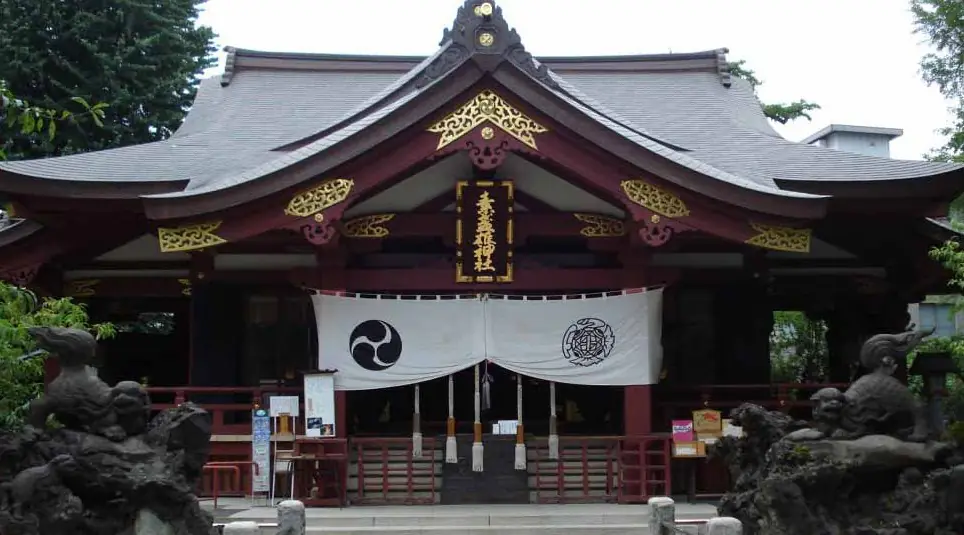
Susanoo is worshipped in several temples in the Japanese archipelago and in particular in the region of Izumo, today Shimane prefecture. The three sites below sit within a short drive of each other and are usually visited as one circuit.
- Susa temple is built on the old square of the city of Susa. This place is known by the Japanese as the place where Susanoo decided to sacralize his spirit. This divine place was once called Jūsansho Daimyōjin. The line of priests who served there were considered descendants of this Nipponese deity.
- Suga Temple located in the Unnan area is built on the site where Susanoo erected a palace for himself and his wife after defeating the dragon.
- Located in Matsue area, Yaegaki Temple is dedicated to Susanoo, Kushinada-hime and Onamuji. The temple takes its name from the palisade that Susanoo built to trap the dragon demon. It is said that the forest near the temple was home to Kushinada-hime while Susanoo was fighting the dragon.
Beyond Izumo, Susanoo is also enshrined at Yasaka Shrine in Kyoto, the shrine behind the Gion Matsuri. The festival began as a plea to stop an epidemic, which fits a god who commands the forces people cannot control.
Visiting a shrine has a simple etiquette worth knowing. Bow once at the gate. Rinse your left hand, then your right, then your mouth at the water basin. At the hall, two bows, two claps, a moment of silence, one bow. Nobody will scold you for a mistake, but following the sequence is a courtesy.
To learn more about other Japanese deities, we suggest you start by discovering the Japanese sun goddess. Her legend is closely linked to that of the Japanese god of storms.
FAQ
Is Susanoo a good god or an evil one?
Neither, and that is the point. Shinto kami are forces rather than moral characters, so Susanoo ruins his sister's palace in one episode and saves a village in the next. He is closer to weather than to a villain.
Is the Susanoo in Naruto the same as the Shinto god?
The technique borrows the name and the props, not the story. Itachi's Susanoo carries the Totsuka sword and the Yata mirror, both lifted from the myth, but the Uchiha version is an invention of the manga.
What should I wear for a Susanoo cosplay?
Dark layers with one embroidered accent work best. A sukajan (スカジャン), the souvenir jacket with satin stitching, gives you the dragon or wave motif without a full costume, and it photographs well under convention lighting.
Do Japanese sizes fit the same as US or EU sizes?
No. Japanese sizes run roughly one size smaller, so a Japanese L is close to a US or EU M. When you are between two sizes on a jacket or a kimono, take the larger one and check the shoulder measurement first.