
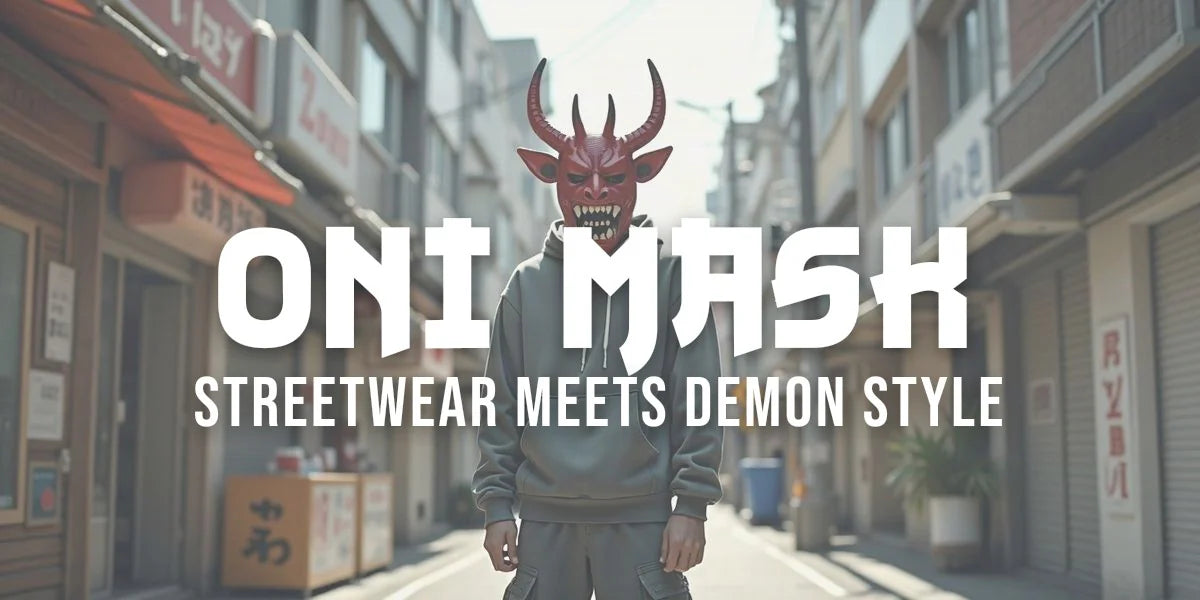
The first time I tied on a full-face oni mask for a convention, I lasted about twenty minutes before pushing it up onto my forehead, and that accidental position turned out to be the one people photographed all day. To wear an oni mask with everyday streetwear, treat it as an accessory you can move: pick a half mask or a side-worn full mask so it can sit on your face, push up to your forehead or hang off the shoulder, and secure it with an adjustable elastic or ribbon tie rather than the stock string. Keep the rest of the outfit quiet, with dark denim, a plain tee and a bomber or haori, so the painted demon face stays the single focal point. For conventions, Halloween or a photo shoot you can go full-face; for a normal day out, half masks and forehead placement read as style rather than costume.
Key points
- A half oni mask or a forehead-worn full mask is the easiest version for daily streetwear.
- Swap the stock string for wide elastic or a ribbon tie, and add foam pads at the cheekbones for comfort.
- Build the outfit around one loud piece: plain tee, dark denim or cargos, one Japanese layer, and let the mask speak.
- Oni are guardian figures as much as demons, so wearing one is about protection and presence, not evil symbolism.
Full, half or forehead: which oni mask fits daily wear?
The oni (鬼) is a horned figure from Japanese folklore, usually translated as demon or ogre. Its face appears on temple roof tiles, in Setsubun processions and in festival dances, and the carved version has been a craft object for centuries. The format you choose decides whether the mask reads as costume or as accessory.
| Format | Face coverage | Breathability | Boldness | Best occasion |
|---|---|---|---|---|
| Half mask | Nose to chin, or upper face only | High, you can talk and drink | Moderate | Daily streetwear, night out, photos |
| Full face | Complete, eyes through slits | Low after 30 minutes | Maximum | Conventions, Halloween, stage |
| Forehead or side placement | None, face visible | Total | Subtle | Any casual day, travel, festivals |
The oni half mask for everyday streetwear
A half mask stops at the cheekbones or the bridge of the nose, so your eyes stay readable and your voice carries normally. The oni half mask I reach for most often is the piece I recommend to anyone starting out, because you can wear it into a bar, push it down around your neck and keep talking without taking anything off.

Full oni masks for conventions and photo shoots
A full-face mask gives the silhouette that cosplay photographers want. Plan for heat. After half an hour most people want air, so I carry mine in a tote and put it on for the shot or the parade, not for the whole afternoon.
Wearing the demon mask pushed up on the forehead
Forehead placement is the trick that makes a full mask wearable on a Tuesday. Tilt it back so the horns rise above your hairline and the chin of the mask sits at your own hairline. It frames the face, keeps your vision clear and lets you drop the mask into position in one second when a camera appears.
How to secure an oni mask so it stays put all day
Most masks ship with a thin cord that cuts into the ears and slips whenever you turn your head. Replacing it takes ten minutes and changes everything about how long you can wear the piece.
Replacing the stock string with elastic or ribbon
Use flat braided elastic between 1 and 2 cm wide. Narrow cord concentrates pressure in one line; wide elastic spreads it. Thread it through the existing side holes, then set the length so the knot sits just below the occiput, the bony bump at the back of your skull. Higher than that and the mask creeps upward all evening.
- Elastic strap: 1 to 2 cm wide, knotted below the occiput, with 2 cm of slack for hair.
- Ribbon tie: 2.5 cm satin or cotton, better for long hair and for photos where the bow shows.
- Four-point setup: two side holes plus a top cord over the crown stops any sliding for full-face masks.
- Test: shake your head twice. If the mask shifts more than a finger's width, shorten by 1 cm.
Padding a resin oni mask at the cheeks and nose
A resin mask is rigid, so it rests on three or four contact points and leaves red marks there. Stick 3 to 5 mm self-adhesive foam pads inside, at the cheekbones and on either side of the nose bridge, never across the nostrils. They also improve airflow and slow down fogging.
Hair, glasses and beard: adjusting the fit
Glasses and full masks rarely cooperate. Put the glasses on first, then seat the mask over the temples, or choose a half mask that stops below the eyes. Long hair goes into a low bun or braid under the strap, not over it, or the mask will slide as the hair moves. A beard adds volume at the chin, so a mask that ends at the nose will always be more comfortable.
Three streetwear outfits built around an oni mask
One rule carries all three looks: a single loud piece per outfit. The mask is a sculpture on your face, so everything else stays plain in cut and colour.
Oni mask with white tee, dark denim and sneakers
Plain white heavyweight tee, raw or washed black denim with a straight leg, white leather low-tops. Add a black leather belt and nothing else. The contrast of a red painted face against white cotton is the clearest version of harajuku streetwear logic: neutral base, one graphic shock.
Layering a Japanese demon mask over a haori
The haori (羽織) is a hip-length open jacket, historically worn over the kimono, and it works over a tee like any other light jacket. The black haori I wear over jeans is my most-used bridge between wardrobe and collection. Wear it open, mask on the forehead, black tapered trousers and black boots. Haori layering works best when the jacket is the only patterned item.
All-black fit: black and gold oni mask as the accent
Black cargos, black tee, black bomber, black chunky sneakers. A black and gold mask hung at the shoulder or held in hand catches light at the horns and teeth.
Red, black or blue oni mask: choosing your color story
Colour in oni imagery carries meaning, and it also decides which half of your wardrobe the mask will work with.

| Colour | Traditional association | Wardrobe palette |
|---|---|---|
| Red (aka-oni) | Raw force, passion, the figure driven out at Setsubun | White, grey, indigo denim, natural cotton |
| Blue (ao-oni) | Anger held in, the counterpart of the red oni in folk tales | Navy, khaki, washed denim, olive |
| Black and gold | Guardian presence, ceremonial finish | Full black, charcoal, deep burgundy |
The red oni mask and its traditional force
Red is not only aggression. In festival practice the red oni is the loud, visible figure that people confront and send away. Worn on a white tee, red reads as energy rather than menace.
Black and gold oni masks for muted fits
If your wardrobe is dark, a black mask with gold or silver detailing disappears into the outfit until the light hits it. Pushed onto the forehead, it pairs well with a hachimaki (鉢巻), the Japanese headband tied around the head as a sign of effort and focus. The bandana headband I tie under a raised mask keeps sweat off the resin and fills the gap between the horns and the eyebrows.

Hannya versus oni: a different face, a different story
A hannya mask comes from Noh theatre and shows a woman transformed by jealousy and grief, with horns, metallic eyes and a mouth caught between rage and sorrow. An oni is a folklore creature; a hannya is a character in a play. A kitsune mask, the white fox face from Inari shrines, sits in a third register entirely: playful, not fearsome.
Where you can actually wear an oni mask in public
Context decides more than style does. A painted face on a train platform in Tokyo during a festival is normal; the same mask in a bank lobby anywhere is a problem.
Conventions, Halloween and Japanese festivals
Anime conventions are the easiest ground, though many have a masks policy at security. Matsuri, Halloween events and club nights with a theme are equally open. A hachimaki, geta sandals or a jinbei (甚平), the light two-piece cotton summer set, complete a festival look without pushing it into full costume.
Photo shoots and street portraits with a demon mask
Shoot in soft light, late afternoon or overcast, because direct sun flattens the carved relief. A three-quarter angle shows the horn line and the profile of the nose. Stand two to three metres from the lens so the mask does not distort, and shoot a few frames with it raised to the forehead; those are usually the keepers.
Laws, venues and common sense about face coverings
Rules on concealing the face in public differ from one country to another, and some European states restrict it outright outside of authorised events. Banks, airports, courthouses and many transport networks will ask you to uncover. Carry the mask in a bag, put it on where it belongs, and take it off when staff ask.
Caring for and storing a resin oni mask between wears
Resin is durable but the painted surface is not indestructible. Most damage comes from solvents and loose transport. Treat the mask like a lacquered object, which is closer to what it is.
Cleaning paint and varnish without dulling the finish
Wipe the outside with a dry microfibre cloth after each wear. For the inside, where sweat and makeup collect, use a cloth barely dampened with water, then let it air dry face down on a towel, away from radiators and direct sun. Avoid alcohol, acetone and household sprays; they lift varnish. In a bag, wrap the mask in a soft cloth and keep the horns clear of hard objects.
Displaying the oni mask on a wall when you're not wearing it
Hang it by the existing strap holes on two small nails or adhesive wall hooks, never by drilling the resin. Keep it out of direct sunlight, which fades red pigment first. A mask at eye level keeps the piece in the rotation instead of forgotten in a box.
Oni mask FAQ: meaning, fit and everyday questions
These are the questions I answer most often by email, usually the week before a convention.
What does it mean to wear an oni mask?
In folk practice, the oni face is both the thing driven away and the thing that guards a threshold. Wearing one today generally signals presence and protection rather than allegiance to anything.
Are oni masks satanic?
No. Oni belong to Japanese folklore and Buddhist iconography, not to Christian demonology. The mask carries no religious commitment for the person wearing it.
Are oni good or evil?
Both, depending on the story. Some tales cast oni as mountain brigands and bringers of disease; others show them as protectors. Japanese folklore is comfortable with figures that are dangerous and useful at once.
What is the correct way to wear an oni mask?
Seat it so the eye openings align with your own eyes, then tighten the strap until it holds through a quick head shake, no further. The knot belongs below the back of the skull. Push it up to the forehead whenever you need to eat, drink or talk at length.
Can you wear an oni mask outside of Halloween?
Yes, and a half mask or forehead placement is how it stops reading as costume. Conventions, festivals, photo shoots, club nights and ordinary days out all work if the rest of the outfit stays plain. Keep local rules on face coverings in mind and remove it indoors when asked.
If you want to see the shapes and colours side by side before choosing, take your time with the oni mask collection and start with the format that matches the way you actually dress.
Explore the Oni Mask collection
Browse the full oni mask collection: half masks, full faces, hannya and samurai menpo, with the strap details listed for each one.
Browse the collection →